If you’ve spent any time on LinkedIn or in a Shopify Slack community over the past year, you’ve probably noticed the terms “chatbot” and “AI agent” being used almost interchangeably. Honestly, that’s where a lot of confusion starts. A vendor pitches you an “AI agent” that turns out to be a slightly smarter version of the old rule-based chatbot you already have. Another company calls their scripted FAQ widget “agentic AI” because it sounds better in a sales deck.
After a decade of building ecommerce systems and advising business owners on where to put their tech budget, I can tell you this distinction isn’t just semantics. It changes what the tool can actually do for your business, what it costs, and how much value you get back from it. This article breaks the difference down in plain language, backs it up with current industry data, and gives you a practical way to decide which one fits where your business is today.
The Short Answer
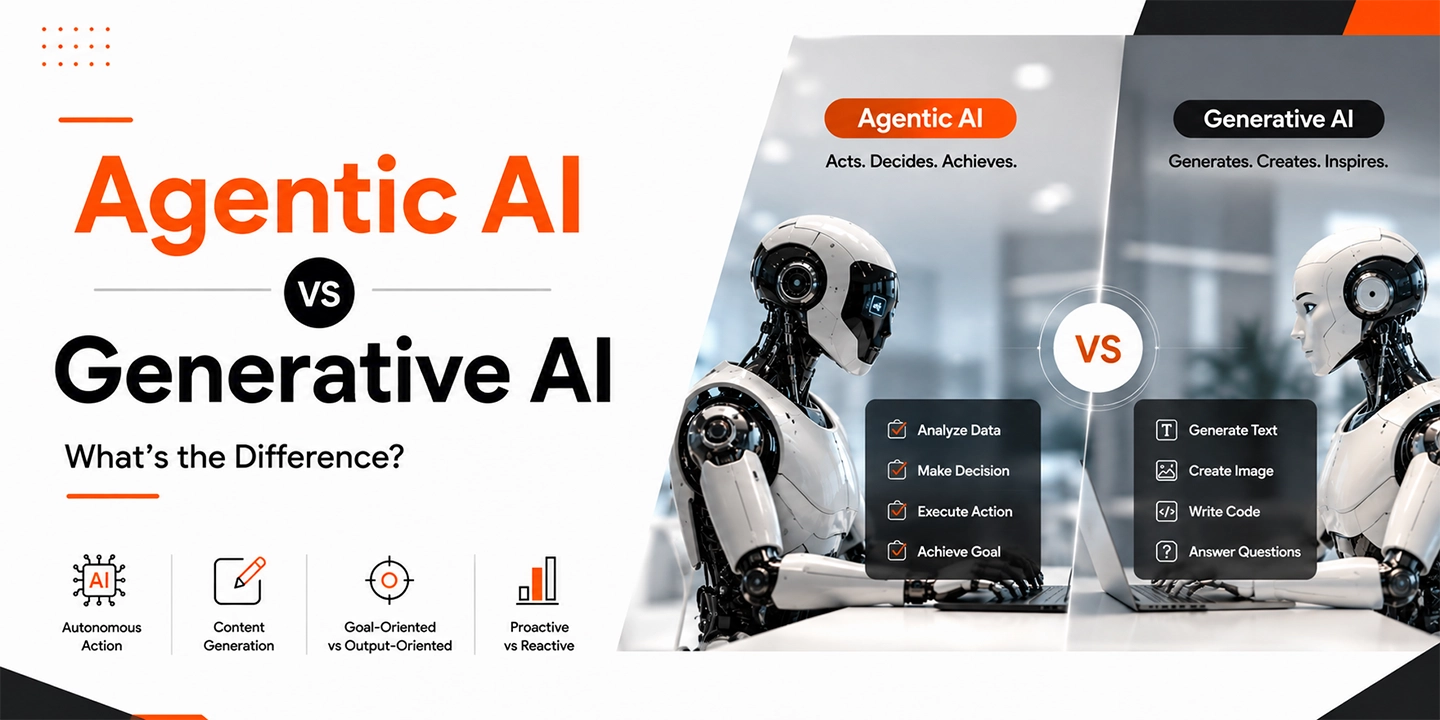
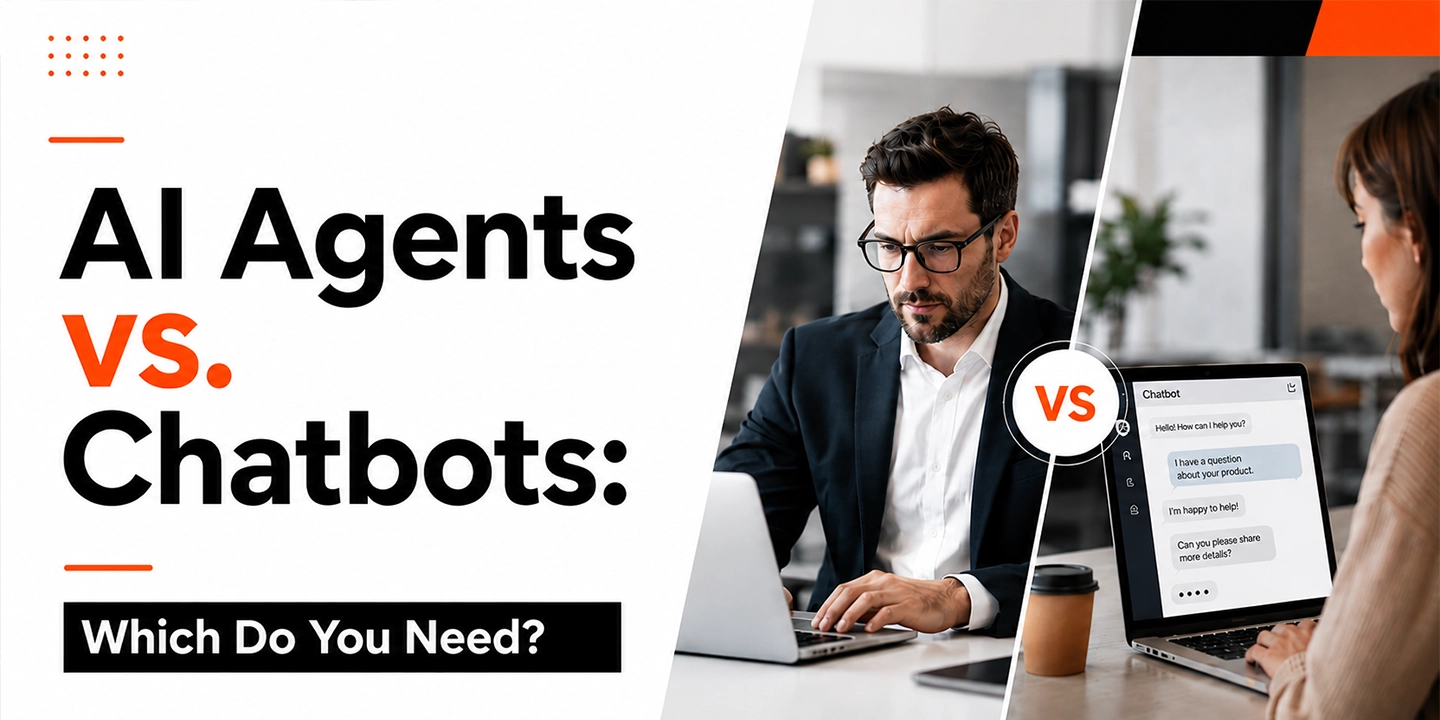
A chatbot follows scripted rules or answers questions using a language model, but it stays inside a conversation. It cannot take action on its own. An AI agent can plan a multi-step task, use tools and APIs, make decisions, and complete a job end to end, like processing a return, updating inventory, or booking a service call, without a human clicking through each step. Chatbots answer. Agents act.
That one sentence is the entire article in miniature. Everything below explains why it matters and how to apply it to your own business.
What Exactly Is a Chatbot?
A chatbot is a conversational tool designed to respond to user input inside a chat window. There are two broad types still in use today:
- Rule-based chatbots follow decision trees. If a customer types “refund,” the bot follows a pre-built script. These are cheap, predictable, and limited. They break the moment a question falls outside the script.
- AI-powered chatbots use natural language processing or a large language model to understand intent and generate a more natural response. They’re better conversationalists, but they still operate within a single request-response loop. You ask, it answers. It doesn’t independently decide to check your order status in Shopify, issue a refund in Stripe, and send a confirmation email, all in one uninterrupted sequence.
In most cases, a chatbot lives on your website or in a messaging app, handles FAQs, and hands off anything complicated to a human. That’s the job it was built for, and for a lot of small businesses, that’s genuinely enough.
What Is an AI Agent, Really?
An AI agent is software built to pursue a goal, not just answer a question. It can break a task into steps, decide which tool or system to use at each step, execute actions across multiple platforms, and adjust its plan based on what it finds along the way.
Here’s a simple way to picture it. Say a customer emails asking to exchange a jacket for a different size. A chatbot might tell them the return policy and give them a link. An AI agent can look up the order in your store, check current inventory for the requested size, initiate the exchange, generate a return label, update the customer record, and send a personalized confirmation, then flag the interaction for a human only if something looks unusual.
That’s the practical difference between a tool that talks and a tool that works.
Chatbot vs AI Agent: Quick Comparison
| Factor | Chatbot | AI Agent |
| Core function | Answers questions in conversation | Completes multi-step tasks and workflows |
| Decision-making | Follows scripts or generates replies | Plans, reasons, and adapts based on context |
| Tool and system access | Usually none or very limited | Connects to CRMs, inventory, payment systems, APIs |
| Autonomy | Needs a human for anything outside its script | Can act independently within defined guardrails |
| Best use case | FAQs, basic support, lead capture | Order management, personalized recommendations, back-office automation |
| Setup complexity | Lower, faster to launch | Higher, needs custom AI agent development and integration work |
| Typical cost | Lower upfront cost | Higher upfront investment, stronger long-term ROI for complex workflows |
That table alone answers the question for a lot of businesses. If your need fits the left column, you don’t need to spend agent-level money. If it fits the right column, a chatbot will frustrate your customers and your team.
Why This Decision Actually Matters Right Now
The thing is, this isn’t a theoretical debate anymore. Money and market activity are moving fast in this direction, and it’s worth understanding the scale of that shift before you decide where your business sits.
According to Gartner’s 2026 enterprise technology forecasts, roughly 40 percent of enterprise applications are expected to include task-specific AI agents by the end of 2026, up from under 5 percent the year before. That’s one of the fastest technology adoption curves Gartner has tracked in recent memory.
The financial numbers back this up. Estimates on the standalone agentic AI market vary depending on how each research firm defines the category, but most land in the $7 billion to $11 billion range for 2026, with compound annual growth rates consistently above 40 percent through the early 2030s. Fortune Business Insights projects the market could exceed $139 billion by 2034. Gartner’s broader estimate, which counts agentic capabilities built into existing enterprise software, is considerably larger.
You’ll notice a pattern across nearly every analyst report published this year: adoption intent is way ahead of actual production use. McKinsey’s research found that while a large majority of organizations have experimented with agentic AI in some form, only about 23 percent have actually scaled a system into production. That gap matters for you as a buyer, because it means the difference between a real agent development partner and a vendor repackaging a chatbot is bigger than ever, and harder to spot from a sales page.
On the customer service side specifically, Zendesk’s research shows customer expectations are climbing just as fast as the technology. A large share of consumers now say they expect a chatbot to match the expertise of a well-trained human agent, and nearly half say it’s getting harder to tell whether they’re talking to a person or a bot at all. That’s a high bar, and it’s exactly the bar that basic scripted chatbots were never built to clear.
When a Chatbot Is Genuinely the Right Call
I want to be honest here, because a lot of agencies will tell you to buy the more expensive thing regardless of what you actually need. That’s not good advice, and it’s not how I’d want to be sold to either.
A chatbot is the right fit when:
- Your questions are repetitive and predictable. Store hours, shipping timelines, return policy, sizing charts. This is the exact use case chatbots were built for, and they still do it well.
- You’re a small team without complex back-office systems to integrate. If you’re running a single Shopify store with a handful of SKUs and no separate CRM, ERP, or fulfillment software, an agent has fewer systems to actually connect to and act on.
- Budget is the deciding factor. Chatbots are cheaper to build and deploy, and you can get one live in days rather than weeks.
- You mainly need lead capture or basic qualification. Collecting an email, asking a few qualifying questions, and routing a lead to a sales rep doesn’t require autonomous decision-making.
One thing many businesses overlook: a well-built AI chatbot, especially one running on a modern language model rather than a rigid script, can already save 20 to 35 percent on support costs in the first year, based on realistic estimates from recent customer service research rather than the more optimistic vendor claims of 60 to 80 percent. That’s a solid return without touching agent-level complexity.
When You Actually Need an AI Agent
From my experience advising ecommerce and service businesses, the need for a real AI agent usually shows up in one of these situations.
Your operations span multiple systems. If a single customer interaction touches your storefront, your inventory platform, your shipping provider, and your CRM, a chatbot simply cannot connect those dots. An agent can be built to check stock in real time, place a reorder, update a customer’s loyalty tier, and log the interaction, all inside one conversation.
You need personalization at scale. Static chatbot scripts can’t account for a customer’s purchase history, browsing behavior, and current cart contents at the same time. An AI agent can pull that context and make a genuinely relevant recommendation instead of a generic one.
You’re losing revenue to slow or clunky processes. Research from AI-in-ecommerce studies this year found that shoppers assisted by AI agents complete purchases noticeably faster than those left to navigate a site alone, in some cases by close to 47 percent, because the agent surfaces the right product or answer immediately instead of making the customer dig for it.
You want to reduce operational headcount pressure without cutting service quality. This is where a lot of businesses get nervous, and rightly so. Klarna’s well-known experiment in 2024, where the company said its chatbot was doing the work of 700 support agents, later became a cautionary tale. By 2025, Klarna’s own leadership admitted the approach had prioritized cost-cutting over quality and began rehiring human agents. That’s where things change with a properly scoped AI agent versus a chatbot pushed past its limits: an agent is designed to escalate to a human when a case gets complex, not to replace human judgment entirely. Gartner’s own research backs this caution, projecting that more than 40 percent of agentic AI projects launched without clear governance could be cancelled by 2027 due to unclear value or weak oversight.
That last point is important enough to repeat: the technology isn’t the risk. Poor scoping, weak governance, and unrealistic expectations are the risk. That’s exactly the gap a genuine AI agent development company is supposed to close for you.
A Real-World Example
A mid-sized home goods brand I worked with a while back had a support inbox drowning in order-status and exchange requests. They’d already tried a basic chatbot, and it technically worked, in that it could answer “where is my order” using tracking data pulled from Shopify. But the moment a customer wanted to change a size or swap a color, the bot dead-ended into “please contact our support team,” which just moved the bottleneck instead of removing it.
We rebuilt that workflow as an agent-driven process. The system could look up the order, check live inventory across warehouses, process the exchange, generate a new shipping label, and send a personalized update, with a human only looped in for high-value orders or anything flagged as unusual. Support ticket volume for exchanges dropped by more than half within two months, and customer satisfaction scores on that specific flow went up, not down, because customers got resolution in minutes instead of a day-long email thread.
That’s the practical difference between a chatbot and an agent in action. It’s not about sounding smarter in conversation. It’s about actually finishing the job.
Cost, ROI, and the Honest Trade-Offs
Let’s talk money, because that’s usually the real question underneath “which one do I need.”
A basic AI chatbot build, using an existing platform with light customization, typically runs from a few thousand dollars to the low five figures, with ongoing monthly costs for the platform and usage. It’s fast to launch and low risk.
Custom AI agent development is a bigger investment. You’re paying for discovery and workflow mapping, integration with your existing tech stack, testing against real edge cases, and ongoing monitoring once it’s live. Depending on the scope, this can range from the mid five figures to well into six figures for enterprise-grade, multi-system deployments. That’s not a small decision, and it shouldn’t be treated like one.
Where the math tends to work out in the agent’s favor is scale and complexity. If you’re handling thousands of support tickets a month, managing inventory across multiple channels, or losing sales to a slow, generic shopping experience, the labor and lost-revenue costs you’re already absorbing often outweigh the agent’s build cost within the first year. If your volume is small and your workflows are simple, that same investment won’t pay back nearly as fast, and a chatbot remains the more sensible starting point.
This is exactly the kind of assessment a competent AI automation agency should walk you through before recommending anything, not after signing a contract.
How to Choose the Right AI Agent Development Company in the USA
If you’ve concluded that your business genuinely needs agentic AI development services rather than a basic chatbot, here’s what I’d actually look for in a partner.
- Ask what happens when the agent doesn’t know the answer. A serious agentic AI development company will have a clear escalation path built in from day one. If they can’t answer this clearly, that’s a warning sign.
- Ask for a workflow map before any code gets written. Custom AI agent development should start with mapping your actual business processes, not a generic template pushed into your business.
- Check their integration experience with your specific stack. Shopify, NetSuite, HubSpot, custom ERPs, whatever you’re running. An agency that’s only ever connected to one or two platforms will struggle with anything outside that comfort zone.
- Ask how they measure success after launch. Ticket deflection rate, average handling time, conversion lift, and error rate are all reasonable metrics. If the pitch is vague on measurement, the delivery usually is too.
- Confirm they build in guardrails, not just capability. Given how many agentic projects are being scrapped due to weak governance, according to Gartner’s own 2026 research, this is not optional. Ask specifically how the agent is tested against edge cases before it goes live with real customers.
Common Mistakes Businesses Make With This Decision
I see the same handful of mistakes over and over, so it’s worth naming them directly.
- Buying agent-level complexity for chatbot-level problems. If your support inbox mostly has repeat FAQs, you don’t need a six-figure agentic build to solve it.
- Buying a chatbot and expecting agent-level results. This is the more common mistake, honestly. Businesses expect a basic bot to handle returns, upsells, and personalized recommendations, and then get frustrated when it can’t.
- Skipping the discovery phase. Jumping straight to build without mapping the actual workflow is how projects end up in that 40 percent cancellation statistic Gartner keeps flagging.
- Assuming “AI” means “no humans needed.” Klarna’s experience is the clearest public example of why that assumption backfires. The best systems combine AI speed with human judgment where it counts.
- Not planning for maintenance. Both chatbots and agents need ongoing tuning as your product catalog, policies, and customer behavior change. Budget for it upfront.
The Bottom Line
Chatbots and AI agents solve different problems, and the businesses that get the most value are the ones that match the tool to the actual need instead of chasing whichever term sounds more impressive. If your support volume is manageable and your questions are predictable, a well-built chatbot will serve you fine, and there’s no reason to overspend. If your business runs across multiple systems, needs personalization at scale, or is losing revenue to slow processes, custom AI agent development is where the real return sits, provided it’s built by a team that understands both the technology and your actual workflow.
That last part is the one businesses underestimate most. The gap between AI agents that deliver real ROI and AI agents that get quietly shelved within a year almost never comes down to the underlying model. It comes down to scoping, integration quality, and governance, which is exactly the work a genuinely capable AI automation agency should be doing with you from the first conversation, not after the contract is signed.