
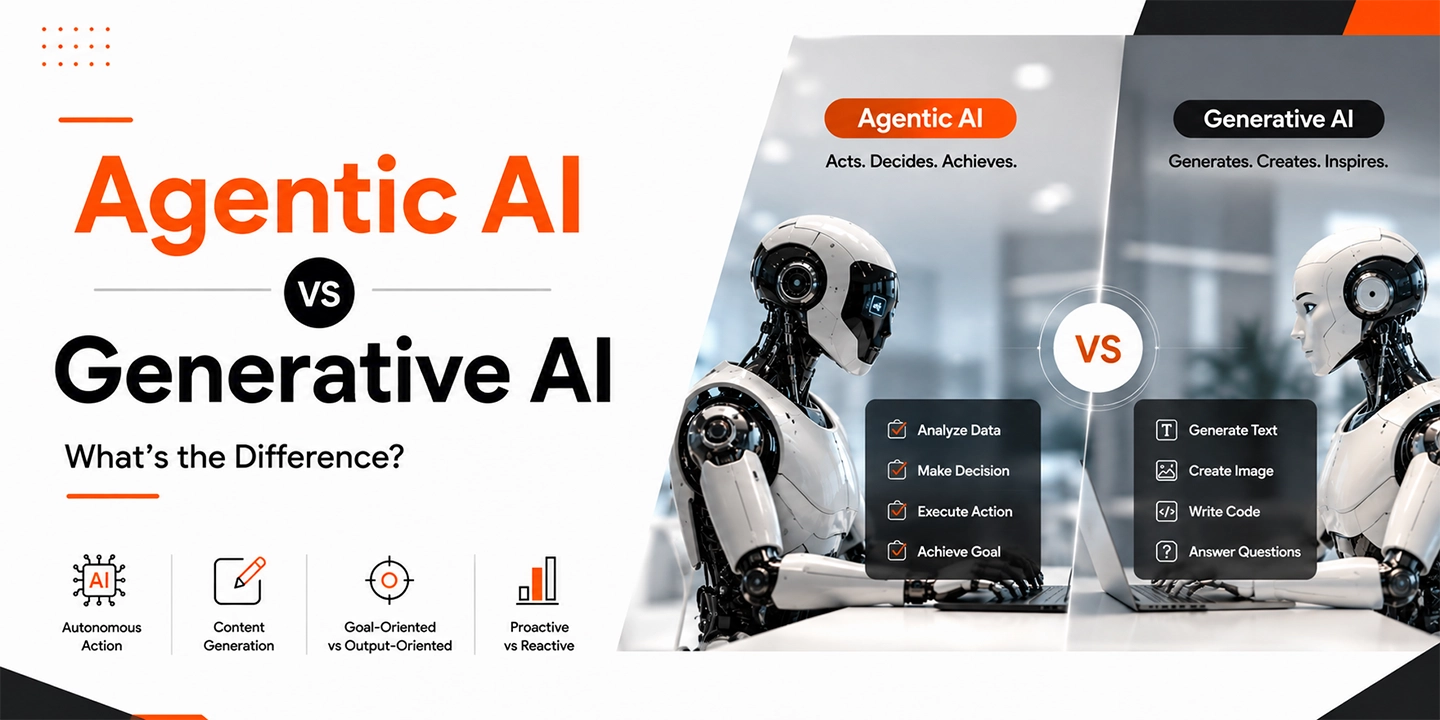
A client called me last month and asked a question I get almost every week now: “We already use ChatGPT for our marketing copy. Isn’t that the same thing as agentic AI?” Honestly, this mix-up is everywhere right now, and it’s costing businesses real money because they’re either overpaying for tools they don’t need or underestimating what agentic systems can actually do for their operations.
The thing is, generative AI and agentic AI are not competing technologies. They’re built on similar foundations, but they solve completely different problems. One writes, drafts, and creates. The other plans, decides, and acts. If you’re evaluating custom AI agent development for your business, understanding this distinction isn’t optional. It’s the difference between investing in a tool that produces content and investing in a system that actually runs parts of your business for you.
I’ve spent the last several years working alongside ecommerce teams and operations leaders who are trying to figure out where AI fits into their growth plans. In this article, I’ll walk you through what separates these two categories of AI, where each one actually earns its keep, and how to decide which one (or which combination) makes sense for your business in 2026.
Quick Answer: What’s the Core Difference?
Generative AI creates content, such as text, images, or code, in response to a single prompt, then stops and waits for your next instruction. Agentic AI goes further: it can independently plan a sequence of steps, use external tools and data, make decisions along the way, and complete multi-step tasks with little to no ongoing human direction. Put simply, generative AI responds. Agentic AI acts.
What Is Generative AI, Exactly?
Generative AI refers to models trained on massive datasets that learn to produce new content based on patterns in that data. You give it a prompt, and it generates a response, a paragraph, an image, a snippet of code, a product description.
Tools like ChatGPT, Gemini, and Claude in their standard chat form are generative AI at work. You ask a question, the model answers. You ask it to write a blog outline, it writes one. But here’s the catch that a lot of business owners miss: the model has no memory of your business systems, no ability to check your inventory, no way to actually send that email campaign or update your CRM. It’s a brilliant writer sitting in a room with no door to the outside world.
In most cases, generative AI is reactive. It waits for a human to prompt it, produces an output, and the interaction ends there. You’ll notice this in practically every generative AI tool on the market today: the workflow is prompt in, content out, human reviews and takes the next step manually.
Common Generative AI Use Cases
- Drafting marketing copy, product descriptions, and blog content
- Generating images for ads or social media
- Summarizing documents or customer reviews
- Writing and debugging code snippets
- Answering customer questions in a basic chatbot format
None of these are bad use cases. They’re genuinely useful. But they all share one trait: a person still has to connect the dots, execute the follow-up actions, and manage the workflow around the output.
What Is Agentic AI, Exactly?
Agentic AI describes AI systems built to pursue a goal with a level of independence that traditional generative tools simply don’t have. Instead of just answering a prompt, an agentic system can break a broad objective into smaller steps, decide which tools or data sources it needs, take action across connected systems, and adjust its approach based on what it finds along the way, often without a human clicking “go” at every stage.
From my experience building and deploying these systems, the easiest way to explain agentic AI to a non-technical client is this: imagine hiring a new team member and giving them a goal instead of a checklist. A generative AI tool is like handing someone a script to read. An agentic AI system is like handing someone a job description and letting them figure out how to get it done, checking in with you only when something genuinely needs your judgment.
That’s where things change for ecommerce and operations teams specifically. An agentic AI system built for order management doesn’t just draft a response to a shipping delay complaint. It can check the order status in your fulfillment platform, calculate a revised delivery estimate, decide whether a discount or refund is warranted based on your policy rules, issue that action, and then send the customer a personalized update, all without a human touching the ticket.
Common Agentic AI Use Cases
- Autonomous customer support agents that resolve tickets end to end, not just draft replies
- Inventory and supply chain agents that reorder stock based on real-time demand signals
- Sales agents that qualify leads, schedule meetings, and update your CRM automatically
- Multi-step research agents that gather competitor pricing and adjust your listings
- AI shopping and checkout agents that help customers discover and buy products across channels
One thing many businesses overlook here: agentic AI doesn’t replace generative AI. It usually sits on top of it. The large language model still generates the reasoning and the language. Agentic AI adds the planning layer, the tool access, and the decision-making loop around it.
Agentic AI vs Generative AI: Side-by-Side Comparison
| Factor | Generative AI | Agentic AI |
| Core function | Creates content from a prompt | Plans and executes multi-step tasks |
| Human involvement | Required at every step | Required only for oversight or exceptions |
| Memory and context | Limited to a single session in most cases | Persists context across tasks and workflows |
| Tool use | Typically none, unless manually integrated | Uses APIs, databases, and business systems directly |
| Decision-making | Produces suggestions, doesn’t act on them | Makes decisions and takes real actions |
| Output | Text, image, audio, or code | Completed tasks, transactions, and workflow outcomes |
| Best fit | Content creation, drafting, brainstorming | Automation, operations, customer-facing workflows |
Why This Distinction Matters for Your Business Right Now
Here’s something I tell every business owner I consult with: you don’t need agentic AI for everything, and you shouldn’t buy it just because it’s the trending term this year. But if you’re running an ecommerce operation, a service business, or anything with repetitive multi-step workflows, the gap between what generative AI can do and what agentic AI can do is where your competitors are quietly pulling ahead.
According to Gartner’s 2026 CIO and Technology Executive Survey, only 17% of organizations have deployed AI agents to date, yet more than 60% expect to do so within the next two years, making it the most aggressive adoption curve among all emerging technologies the survey tracked. That gap between current deployment and near-term intent tells you something important: the businesses that move now, with a properly scoped agentic AI development services partner, are positioning themselves ahead of a wave that’s about to get very crowded.
Gartner also projects that by the end of 2026, 40% of enterprise applications will include task-specific AI agents, up from less than 5% just a year earlier. That’s not a gradual shift. That’s a near-vertical adoption curve, and it matters because the applications your team already uses, your CRM, your helpdesk, your ecommerce platform, are being rebuilt around this agentic layer whether you actively adopt it or not.
The ecommerce numbers are even more direct. Salesforce’s 2026 Agentic Enterprise Index found that businesses deploying agents on their digital commerce channels saw 4x higher online sales growth compared to those that didn’t. In a separate release tied to their Agentforce Commerce launch, Salesforce reported that retailers running their own shopper agents grew sales 59% faster than retailers sitting on the sidelines, and that AI influenced roughly 20% of global online sales during the 2025 holiday season, worth an estimated $262 billion. That’s not a hypothetical future benefit. That’s money already moving through agentic systems while some businesses are still deciding whether to test a chatbot.
Adobe’s data adds another layer to this. AI-driven traffic to US retail sites jumped 693.4% year over year during the 2025 holiday season, and by March 2026, that AI-referred traffic was converting 42% better than traditional traffic, a full reversal from a year earlier when it converted 38% worse. Shoppers arriving through AI channels also spent 48% longer on-site and generated 37% more revenue per visit. If your product catalog and customer experience aren’t structured to work with AI agents and AI-powered discovery, you’re leaving a fast-growing, high-converting channel almost entirely on the table.
One thing worth being honest about: not every agentic AI initiative succeeds. Gartner predicts that 40% of agentic AI projects will be canceled by the end of 2027, largely because organizations rush into deployment without the right data infrastructure, governance, or a clear use case. This is exactly why working with an experienced AI agent development company matters more than the technology itself. The failure rate isn’t a knock against agentic AI. It’s a reflection of what happens when businesses treat it like a plug-and-play tool instead of a system that needs to be built around their actual workflows.
How Agentic AI and Generative AI Work Together
I want to clear up a misconception here, because it comes up in nearly every discovery call I run. Businesses often think they have to choose one or the other. In practice, the strongest systems combine both.
Picture a customer support workflow for an online retailer. The generative AI layer handles the language: understanding the customer’s message, drafting a natural-sounding response, adjusting tone based on the situation. The agentic layer handles everything around that language: pulling the customer’s order history, checking warehouse inventory, applying your refund policy logic, updating the order status, and closing the loop, all before a human ever sees the ticket unless something falls outside the defined rules.
That’s the real value of a properly built agentic system. It’s not one technology replacing another. It’s generative AI providing the reasoning and communication skills, and agentic AI providing the hands, the memory, and the follow-through.
Signs Your Business Is Ready for Agentic AI
You’ll notice a pattern across the businesses that get the most value from agentic AI. They tend to share a few traits before they even start the build:
- Repetitive multi-step workflows. If your team is manually stitching together data from five different tools to complete one task, that’s a strong signal.
- High volume, low judgment decisions. Order status updates, basic refund approvals, appointment scheduling, these are exactly the kinds of decisions agentic AI handles well.
- Clean-ish data and connected systems. Agentic AI needs access to your actual business data through APIs. If your systems are siloed and undocumented, that’s step one before any agent gets built.
- A defined process to automate. Agentic AI works best when there’s an existing process to encode, not when you’re hoping the AI will invent your operations from scratch.
- Willingness to start small. The businesses that succeed almost always start with one narrow, well-defined workflow, prove the ROI, then expand.
If you’re checking two or three of these boxes, it’s worth a conversation with an agentic AI development company before you scale further with manual processes that are already stretching your team thin.
What to Look for in an AI Automation Agency
I’ve seen businesses get burned by vendors who slap “agentic AI” on what’s really a basic chatbot with a few if-then rules. Here’s what actually separates a credible partner from a marketing pitch:
- They ask about your workflows before they talk about the technology. A good partner wants to understand your actual bottleneck first.
- They can explain tool integration in plain language. If they can’t clearly describe how the agent will connect to your CRM, inventory system, or payment processor, that’s a red flag.
- They build in human oversight, not blind automation. Reliable agentic systems include checkpoints for decisions that carry real risk or cost.
- They talk about data infrastructure, not just AI models. Remember, most agentic AI failures come down to messy data and poor system connections, not the model itself.
- They have real deployment experience, not just prototypes. Ask to see a workflow they’ve built that’s been running in production for at least a few months.
This is the practical difference between choosing any generic AI automation agency and choosing genuine agentic AI development services built by a team that understands both the AI layer and the operational reality of running a business.
Cost and ROI: What Businesses Are Actually Seeing
Businesses considering custom AI agent development often ask how quickly this pays off. According to BCG and Forrester’s 2026 surveys, the median time to value across agent deployments is around 5.1 months, with sales development agents paying back in as little as 3.4 months and finance or operations agents taking closer to 8.9 months. That range gives you a realistic planning window instead of vague promises of instant transformation.
McKinsey and IDC’s broader AI research points to an average return of roughly 3.7 times for every dollar invested in generative and agentic AI initiatives when they’re properly scoped and measured. The word “properly” is doing a lot of work in that sentence. The businesses hitting those returns are the ones that picked a specific, high-friction workflow first instead of trying to automate everything at once.
A Simple Way to Decide Which One You Actually Need
If you’re still not sure which category fits your next project, ask yourself one question: does this task end when the content is produced, or does something still need to happen after that? If a task ends the moment the words are written, the image is generated, or the code is drafted, generative AI is probably enough on its own. If the real value only shows up after several more steps happen, checking a system, making a decision, updating a record, notifying someone, that’s the territory where agentic AI earns its cost.
I usually walk clients through their current workflow on a whiteboard, literally mapping out every handoff between a person and a tool. In most cases, the pattern becomes obvious pretty quickly. Wherever you see three or more manual handoffs between systems for a single task, that’s usually your best candidate for an agentic build. Wherever the workflow starts and ends with one person producing one piece of content, generative AI is doing its job just fine already, and there’s no need to overcomplicate it with a full agentic buildout.
Where This Leaves Your Business
Honestly, the businesses I see making the most progress right now aren’t the ones chasing every new AI headline. They’re the ones taking a clear-eyed look at where a repetitive, multi-step process is quietly draining their team’s time, and asking whether an agentic system could take that off their plate entirely.
Generative AI is a genuinely useful tool for content and communication. Agentic AI is a different kind of investment: it’s closer to building a digital team member than buying software. If you’re weighing custom AI agent development for your business, start with one workflow, work with a partner who understands both the technical build and your actual operations, and let the results from that first project guide how far you take it from there.