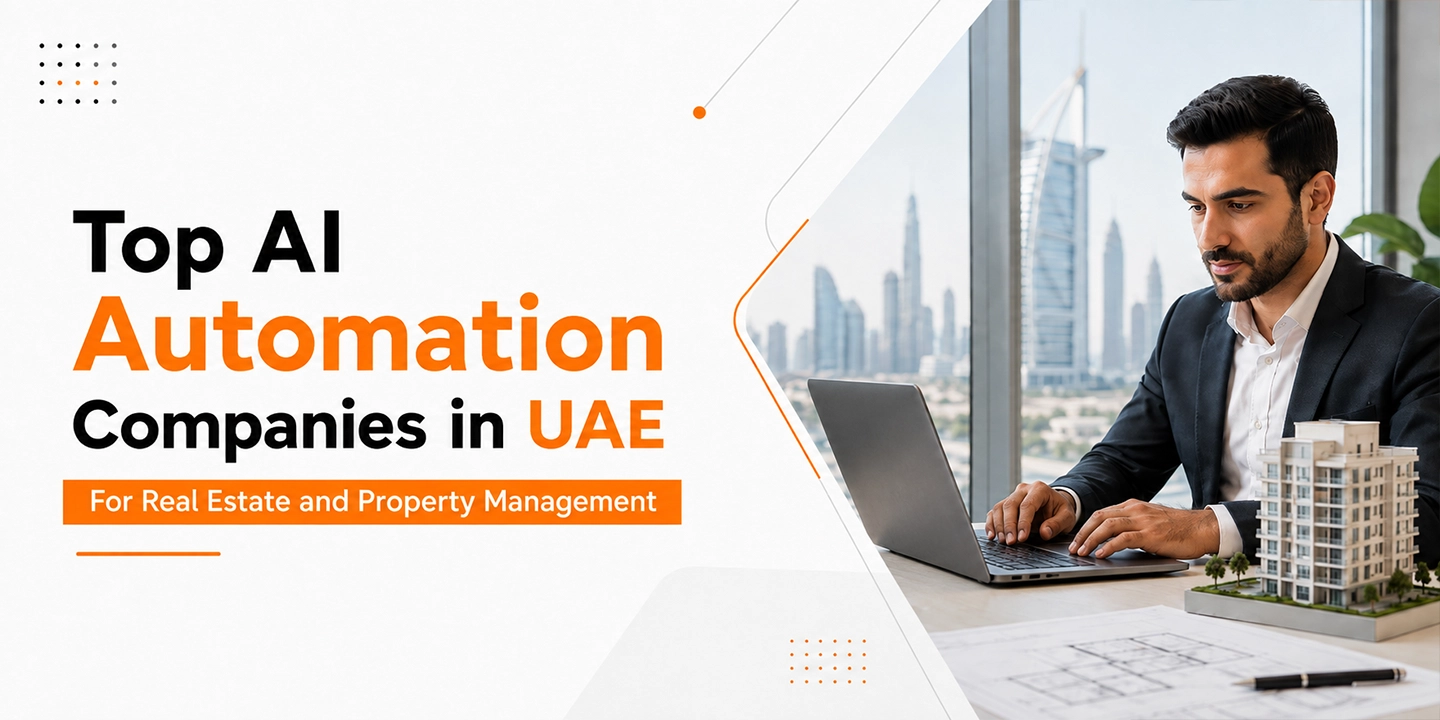
The UAE’s real estate market runs fast. Real estate firms have to handle tons of inquiries, follow-ups, viewings, tenant queries, maintenance tickets, documentation, and CRM updates on a daily basis.
With the help of AI automation, it is possible to automate such tasks that would otherwise burden the sales and operations teams of property firms. An efficient AI automation agency in UAE can integrate AI into CRM, WhatsApp, website, database, emails, calendar, and other internal tools to perform these tasks with reduced manual labor.
Here are the 11 companies for UAE’s real estate and property management firms to consider in 2026.
Top AI Automation Companies in UAE
| Company | Main Focus |
| DIT Interactive | AI agents and workflow automation |
| Arcitech AI | Business process and sales automation |
| DigeeX | AI automation and real estate workflows |
| Groovy Web | AI-powered real estate lead automation |
| Devex Hub | AI integration and workflow automation |
| TradingAI | AI-powered automated trading |
| AI-Tech | AI-powered AV and building technology |
| TechGropse | Custom AI development and automation |
| AIA Group | Building and property automation |
| Bird | AI agents, sales and customer automation |
| Codiant | AI development and PropTech solutions |
1. DIT Interactive
DIT Interactive offers AI workflow automation and agentic AI for enterprises looking to automate tedious operations.
The company offers AI solutions such as customized AI agents, workflow automation, system integration, conversational system, and business process automation. DIT has the ability to integrate with platforms such as CRM software, Google Sheets, email, WhatsApp, and other enterprise applications, making it relevant for businesses that already have a number of technologies in place.
In the case of a UAE real estate firm, possible work flow might include the capturing of a property inquiry, identification of the customer budget and preferences, updating of the CRM system, lead assignment to a sales agent, and subsequent communication.
Similar flows may be used by property management firms for tenant inquiries, maintenance scheduling, reporting, and internal communications.
It is recommended to consider DIT Interactive in cases when customized AI automation is required rather than just one off-the-shelf chatbot.

2. Arcitech AI
AI Automation services are available from Arcitech AI, operating out of Dubai and offering automation services for business process, sales, marketing, and conversational automation.
UAE Services provided by Arcitech AI include Business Process Automation, Marketing and Sales Automation, Conversational AI, and Enterprise AI Systems. They characterize their methodology as the integration of AI within everyday processes instead of considering it just an application alone.
This would fit quite well in the case of real estate.
In a scenario where an agency receives lead data via Meta Ads, real estate portal, and the agency’s website, it could use this process for organizing inquiries, finding high-intent buyers, creating CRM entries and assigning prospective customers to the appropriate sales person.
The same infrastructure could be used for automating reporting or administrative processes as well.
This could be applicable for larger companies in UAE exploring AI automation in multiple processes.
3. DigeeX
DigeeX is an AI automation company owned by DigeeSell and based in Dubai.
While some companies only mention real estate as one of the industries that may be using their product, DigeeX has an automation solution specifically designed for real estate companies. The services provided by them include AI chatbots, marketing automation, business process automation, and real estate workflows.
Thus, it is especially useful for real estate businesses that get many inquiries.
An example of an automation might involve starting communication with a client and collecting all the required information such as location, budget, kind of property, and time frame after which the information is passed on to the sales representative.
Frankly speaking, this first contact phase is extremely important in real estate business because leads often transfer to other brokers if there is no reply for hours.
Thus, DigeeX is one of the most real estate-focused companies from the list.
4. Groovy Web
Groovy Web has gone one step further by developing its own AI automation product for responding to UAE real estate leads.
This product specializes in answering leads via WhatsApp, qualifying buyers by budget, location, and motivation in both Arabic and English, and arranging visits to the real estate.
It is an extremely realistic use case.
Think of a buyer who approaches an agency late at night regarding a two-bedroom apartment in Dubai Marina. Without having to wait until the next day, an AI-based system would be able to ask questions that will gather all requirements and qualify the lead before the agent gets involved.
It doesn’t mean that the AI-based system should substitute the broker; negotiations require human interaction.
The helpful aspect of it is to ensure that the sales team begins the conversation with more qualified leads.
5. Devex Hub
The Devex Hub offers AI integration and workflow automation services on platforms like Zapier, Make, Airtable, Relevance AI, and other automation tools.
It is especially important for this article that Devex Hub has a service specifically for real estate agencies in Dubai, which specializes in AI-based lead management and communication.
This automation service might come in handy for firms that already have multiple separate systems working.
A lead could start on the portal, then go to a CRM, get an email sent out, need a WhatsApp outreach and eventually end up as a calendar entry.
Without automation, people would manually copy the data from one system to another.
ai workflow automation agency in uae would help eliminate the need to do that.
Devex Hub stands out because it is good for organizations that like using existing workflow platforms and AI together rather than creating everything from scratch.
6. TradingAI
TradingAI is unique compared to most of the other businesses featured in this article and should be considered as such.
The company provides an AI-based automated trading platform specializing in the trading of financial assets like Forex, gold, silver, and commodities. Its solution involves automated trading with configurable parameters and linked trading accounts.
Thus, TradingAI shouldn’t be mistaken for an AI business process automation company that can assist in property management.
Its role in the article is rather connected with AI investment technology than automation of tenant management, CRM processes, or sales procedures in real estate.
An enterprise from the property industry, searching for a solution in lead qualification or maintenance automation, is more likely to find suitable options among other featured businesses.
Nevertheless, TradingAI provides an example of how the UAE automation market expands into AI-assisted financial decision-making and trading systems.
7. AI-Tech
AI-Tech (Artificial Intelligence Technologies LLC) differs from a normal software automation business as well.
This Dubai-based company works mainly in audiovisual technologies powered by AI, AV consulting, AV equipment, and communication systems for organizations in the UAE and the entire Middle East region.
In terms of relevance to real estate, the company is more relevant to smart buildings, meeting rooms, property environment, and technology infrastructure than any CRM sales automation.
For instance, commercial property managers, hotels, developers, or high-end residential properties might be looking for intelligent AV and communication systems within buildings.
As you can see, this is a completely different form of “AI automation,” compared to an AI chatbot or n8n workflow.
When considering this company, one should look at it as a provider of AV systems in the physical property sector, rather than viewing it as an alternative to a software automation firm.
8. TechGropse
TechGropse has a UAE-based artificial intelligence development department offering services like custom AI development, workflow automation, machine learning, generative AI, NLP, document processing, and third-party integrations.
TechGropse also has specific real estate application development expertise.
The firm’s property technology services include AI-based property searches, recommendations, real-time notifications, location-based search, in-app messaging, and other features available in property technology apps.
This is relevant in cases where the requirement is bigger than workflow automation.
For instance, the developer can seek for a complete property technology platform that will incorporate an AI assistant, recommendation engine, customer portal, CRM integration, and automated communications.
In such cases, TechGropse’s wider application development expertise makes sense.
When looking for a custom ai automation company in uae, businesses should first determine their needs to help differentiate among the proposals.
9. AIA Group
While Advanced Integration Automation (AIA Group) specializes in physical building automation and not generative AI workflow automation.
The services offered by AIA in Dubai include Integrated Building Management Systems, energy management, critical asset monitoring, lighting control, security, and home and office automation.
This is where the relevance of AIA to the property management section of this article becomes quite evident.
As more commercial buildings and residential buildings continue to incorporate heating and cooling systems, lighting systems, security systems, access control systems, energy management systems, and various other integrated technologies.
These services offered by AIA are applicable to both commercial and residential properties.
For property managers, the benefits of automation can help in managing their buildings and equipment/energy usage.
However, this automation does not replace the need for an AI lead generation agency but is important for automation needs in property management.
10. Bird
The company Bird offers AI agency services in UAE with a special emphasis on AI agents and business automation. Their portfolio includes AI sales and lead-qualification agents, customer support agents, automated follow-up, analysis and automation pipeline that integrates into business systems. This is very suitable for the task of property sales.
A property real estate brokerage firm could utilize an AI sales agent to answer to leads, gather information about buyer needs, classify leads and keep them engaged until the moment when it becomes appropriate to contact the broker.
Real estate firms could also employ customer support automation for standard queries by tenants and homeowners.
Since Bird has a special marketing and customer communication orientation, firms mostly interested in lead generation and customer management should consider this option.
11. Codiant
Codiant integrates AI development with wider software and real estate technology expertise.
The UAE AI development services of Codiant explicitly mention applications of AI in real estate, including intelligent property listings, virtual experiences, and predictive analytics. The firm has developed real estate platforms with the help of AI chatbots, recommendations, and digital property management tools.
It has also documented work on property management with a focus on centralizing workflows, maintenance operations, payments, and operation dashboards.
That is why Codiant can be considered a suitable firm for hiring when a real estate business requires something more than mere automation.
For instance, the property manager can have a requirement to integrate a tenant application, maintenance operations, AI assistant, payments, notifications, and management dashboards.
How AI Automation Helps UAE Real Estate Businesses
The power of AI automation shines in real estate where many procedures can be described as being repetitive and yet contain information which requires interpretation.
A perfect example is lead management. Instead of each query getting directly to the broker, the AI system can extract information like budget, location, type of property, number of bedrooms, and time frame for purchasing before passing the lead on.
With CRM automation, contacts can be made, deal phases recorded, agents assigned, reminders scheduled and records updated without employees having to enter data repeatedly.
WhatsApp automation can come in handy in dealing with queries and reminders where the business uses authorized messaging integrations and customer consent.
Another area where AI can be used by the property manager is classification of maintenance queries. Where the tenant complains about a leaking pipe, the issue is directed in a different manner than where there is a request for access cards.
Lastly, AI can assist in document processing by extracting information from forms, invoices, tenancy agreements and other internal documents.
The size of the market is such that operational efficiency is becoming more and more critical. The real estate market in Dubai saw over 270,000 transactions worth AED 917 billion in 2025, as reported by the Dubai Government Media Office, with an increase of 20% year-over-year.
With such numbers being processed for transactions and inquiries, time savings on repeat tasks become relevant.
How to Choose an AI Automation Company in UAE
There is not one ai automation agency in uae that suits every real estate business perfectly.
A real estate brokerage interested in qualifying 5,000 leads per month will have different needs compared to a property management company planning to use ai for maintenance automation in several dozen buildings.
Start by specifying your workflow.
And then determine how well the firm knows:
Integrations with CRM and APIs
- AI agents
- Workflow automation
- Customer communication via WhatsApp
- Privacy of customer data
- Error handling
- Human confirmation
- Reporting and monitoring
- Post-deployment support
If you are looking for a custom ai automation agency in uae, ask about the situation where the ai makes a mistake or one of the integrated systems fails.
This is a crucial question.
It is simple to give a great demo of a chatbot.
But production automation has to handle missing data, API errors, duplicate leads, incorrect customer data, etc.
Companies with their own technical team may opt to hire ai automation developers in uae.
Final Thoughts
In UAE, a good AI automation company must fix real business challenges and not just implement AI for the sake of implementing AI.
For real estate and property management firms, there are many clear areas where automation can really help: lead response, CRM cleanup, automated follow-up, tenant support, maintenance routing, document management, and improved reporting.
These companies do not all specialize in the same form of automation. Some may be better at AI workflows and bots while others excel at property automation software, communications, building controls, or specific types of automation.
Focus first on the task that costs your team the most time. Then find the automation company that has the capability to handle it.