
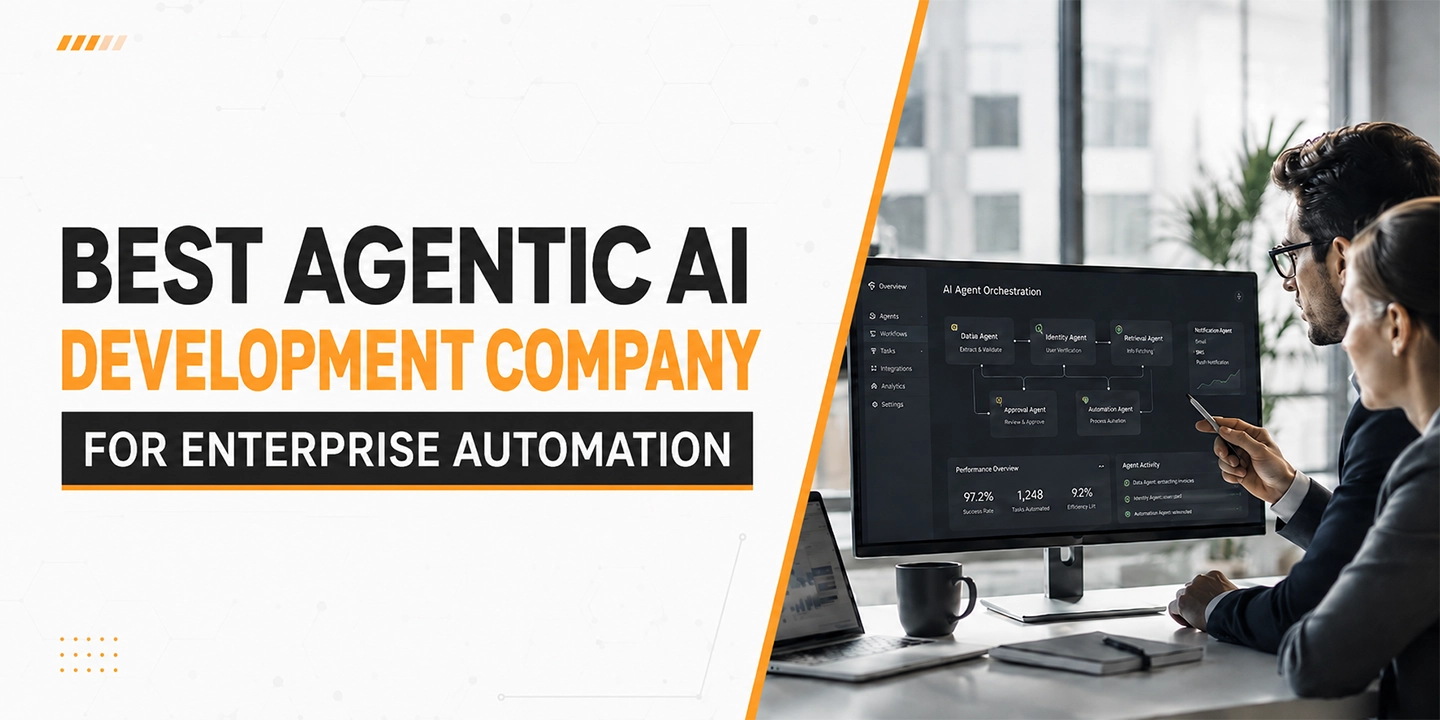
Best Agentic AI Development Company for Enterprise Automation

Artificial intelligence has moved far beyond chatbots and basic automation. Businesses today want systems that can think through tasks, make decisions based on data, coordinate with multiple tools, and complete workflows with minimal human intervention.

That’s exactly why Agentic AI has become one of the biggest technology trends in 2026.

If you’ve been following developments in enterprise automation, you’ve probably noticed that companies are no longer asking whether they should adopt AI. The conversation has shifted. Businesses are now asking how quickly they can deploy intelligent AI agents that deliver measurable results.

From customer support and sales operations to finance, logistics, and internal workflow management, organizations are actively searching for an experienced AI automation agency that can build practical solutions instead of experimental projects.

The thing is, enterprise automation isn’t just about reducing manual work anymore. It’s about creating systems that can plan, act, learn, and continuously improve business processes.

In this guide, we’ll explore what Agentic AI is, how it works, why enterprises are investing heavily in it, and what to look for when selecting an organization that provides agentic AI development services.

What Is Agentic AI?

Quick Answer

Agentic AI refers to artificial intelligence systems designed to operate as autonomous agents. These agents can understand goals, make decisions, execute tasks, interact with software systems, and adapt based on outcomes.

Unlike traditional automation tools that follow predefined rules, Agentic AI can reason through complex workflows and determine the best actions to achieve a specific objective.

Think about a traditional automation workflow.

A task starts.
A trigger occurs.
A predefined action follows.

That’s useful, but it’s limited.

Now imagine an AI agent that receives a goal like:

“Process all incoming customer inquiries, prioritize urgent requests, draft responses, update CRM records, and escalate only the issues requiring human review.”

That’s where things change.

Instead of simply following instructions, the AI agent actively manages the workflow.

Why Enterprise Automation Is Changing

For years, businesses relied on automation platforms that required detailed workflow mapping.

Every action needed rules.

Every exception needed handling.

Every change required updates.

As organizations grew, these systems became increasingly difficult to maintain.

You’ll notice that many enterprise teams spend significant time managing automation instead of benefiting from it.

Agentic AI introduces a different approach.

The system understands objectives and determines how to achieve them using available tools and data.

This flexibility makes automation more practical for dynamic business environments.

How Agentic AI Works

At a high level, Agentic AI combines several technologies:

Large Language Models

These models help agents understand requests, process information, and communicate naturally.

Decision-Making Frameworks

Agents evaluate options before selecting actions.

Memory Systems

Agents retain context and use historical information when making decisions.

Tool Integrations

Agents connect with CRMs, ERP platforms, databases, communication tools, and business applications.

Workflow Execution Engines

These systems enable agents to perform actions across multiple platforms.

Together, these components create AI systems capable of handling sophisticated business processes.

Why Businesses Are Investing in Agentic AI Development Services

Short Answer

Organizations invest in agentic AI development services because they help reduce manual work, improve operational efficiency, accelerate decision-making, and support business growth without proportionally increasing staffing requirements.

The reality is simple.

Most enterprises operate with hundreds of repetitive workflows.

Employees spend hours every week:

  • Updating records
  • Responding to inquiries
  • Managing approvals
  • Processing documents
  • Collecting information
  • Coordinating across departments

Many of these activities can be delegated to intelligent AI agents.

That creates more time for employees to focus on higher-value work.

Key Benefits of Agentic AI for Enterprise Automation

Increased Productivity

AI agents work continuously without requiring breaks or shift schedules.

They can manage multiple tasks simultaneously and process information significantly faster than manual workflows.

Faster Decision Making

Many business decisions depend on gathering information from different systems.

AI agents can analyze data, generate insights, and recommend actions within seconds.

Lower Operational Costs

Reducing repetitive manual work helps organizations control operating expenses.

In most cases, businesses see cost reductions in areas involving administrative processes and routine support activities.

Better Customer Experiences

Customers expect quick responses and accurate information.

AI agents can provide support around the clock while maintaining consistent service quality.

Improved Scalability

As businesses grow, workloads increase.

AI agents can absorb much of that growth without requiring proportional increases in staffing.

Industries Benefiting from Agentic AI

Healthcare

Healthcare organizations use AI agents for:

  • Appointment scheduling
  • Patient communication
  • Documentation support
  • Administrative workflow management

Financial Services

Banks and financial institutions deploy agents for:

  • Compliance monitoring
  • Customer service
  • Fraud detection
  • Risk assessment support

Ecommerce

Online retailers use AI agents to:

  • Manage inventory
  • Process customer inquiries
  • Handle order tracking
  • Generate product recommendations

Manufacturing

Manufacturers automate:

  • Supply chain monitoring
  • Procurement workflows
  • Maintenance scheduling
  • Production reporting

Professional Services

Consulting firms and agencies use AI agents to assist with:

  • Research
  • Documentation
  • Project coordination
  • Knowledge management

What Makes a Great Agentic AI Development Company?

Choosing the right technology partner can significantly impact project success.

Not all providers have the same level of expertise.

A strong agentic AI development company should demonstrate experience in several key areas.

AI Strategy and Consulting

Before building anything, the company should understand business objectives.

Technology should support outcomes, not the other way around.

Custom Development Capabilities

Every enterprise has unique workflows.

That’s why custom AI agent development is often necessary.

A one-size-fits-all solution rarely works for complex organizations.

Integration Experience

Enterprise environments contain numerous systems.

The development team should understand how to connect AI agents with:

  • CRM platforms
  • ERP systems
  • Internal databases
  • Communication tools
  • Cloud infrastructure

Security Knowledge

Enterprise automation often involves sensitive data.

Security and compliance should be built into the development process from the beginning.

Scalability Planning

Successful AI projects grow over time.

The underlying architecture should support expansion without requiring major redesigns.

Why Custom AI Agents Deliver Better Results

Many businesses initially explore generic AI tools.

While these tools can be useful, they often struggle with enterprise-specific requirements.

Custom AI agent development allows organizations to build solutions tailored to their workflows, policies, and operational goals.

Honestly, this is where many companies see the greatest value.

Instead of forcing processes to fit software limitations, businesses can create agents that work the way their teams already operate.

The result is often higher adoption and stronger outcomes.

Common Enterprise Use Cases for Agentic AI

Customer Support Automation

AI agents can:

  • Answer common questions
  • Access customer records
  • Create support tickets
  • Escalate complex issues

Sales Assistance

Sales teams use agents for:

  • Lead qualification
  • CRM updates
  • Follow-up reminders
  • Proposal generation

Human Resources

HR departments automate:

  • Candidate screening
  • Employee onboarding
  • Policy inquiries
  • Internal support requests

Finance Operations

Finance teams benefit from:

  • Invoice processing
  • Expense verification
  • Reporting automation
  • Data reconciliation

IT Service Management

IT departments deploy agents to:

  • Resolve common issues
  • Manage tickets
  • Monitor systems
  • Coordinate support workflows

How an AI Automation Agency Approaches Enterprise Projects

Successful projects typically follow a structured process.

Discovery

The team identifies automation opportunities and business objectives.

Workflow Analysis

Existing processes are reviewed to understand challenges and bottlenecks.

Solution Design

AI agent architecture and integration requirements are defined.

Development

Agents are built and connected with required systems.

Testing

Performance, security, and accuracy are validated.

Deployment

The solution moves into production.

Continuous Improvement

Agents are monitored and refined based on real-world usage.

This ongoing optimization often delivers the greatest long-term value.

The Future of Agentic AI in Enterprise Automation

We’re still in the early stages of Agentic AI adoption.

Over the next few years, businesses will likely move beyond isolated AI projects and toward enterprise-wide intelligent automation strategies.

You’ll notice several emerging trends:

  • Multi-agent collaboration
  • Autonomous workflow orchestration
  • Real-time decision intelligence
  • AI-powered operations management
  • Self-improving business processes

The organizations that start building AI capabilities today will likely gain significant advantages as these technologies mature.

How to Choose the Right AI Agent Development Company

When evaluating an AI agent development company in USA, consider the following questions:

  • Do they understand enterprise workflows?
  • Can they build custom solutions?
  • Do they have integration experience?
  • How do they approach security?
  • What industries have they worked with?
  • Can they support future scalability?
  • Do they provide post-launch support?

The answers to these questions often reveal whether a provider can deliver long-term success.

Conclusion

Enterprise automation is evolving rapidly, and Agentic AI is becoming one of the most important technologies driving that transformation.

Organizations are moving beyond basic automation and adopting intelligent systems capable of planning, reasoning, and executing complex workflows. As a result, demand for experienced providers offering agentic AI development services continues to grow.

Whether you’re exploring customer support automation, workflow orchestration, process optimization, or intelligent decision-making systems, partnering with the right AI automation agency in USA can significantly influence outcomes.

The best results often come from organizations that combine technical expertise, business understanding, and strong custom AI agent development capabilities. As enterprises continue embracing intelligent automation, selecting the right agentic AI development company will become an increasingly important strategic decision.
Agentic AI Development Services: Everything Businesses Need to Know

Artificial intelligence has moved far beyond simple chatbots and automation scripts. Businesses today are looking for systems that can actually make decisions, complete tasks, analyze situations, and improve workflows without constant human input. That’s exactly why agentic AI is getting so much attention right now.

If you’ve been hearing terms like AI agents, autonomous workflows, or multi-agent systems lately, you’re not alone. The thing is, companies are no longer interested in basic AI tools that only answer prompts. They want intelligent systems that can actively work for the business.

That’s where agentic AI development services come into the picture.

From customer support automation to operations management, sales workflows, data analysis, and internal productivity, agentic AI is starting to reshape how companies operate. And honestly, many businesses are still trying to figure out what it actually means and whether it’s worth investing in.

In this guide, we’ll break everything down in simple terms. You’ll learn what agentic AI is, how it works, why businesses are investing in it, and how working with an AI automation agency in the USA can help companies build practical AI solutions instead of experimental tools that never get used.

What Is Agentic AI?

Agentic AI refers to AI systems that can independently perform tasks, make decisions, adapt to changing situations, and work toward goals with minimal human involvement.

Unlike traditional AI models that mainly respond to prompts, agentic AI systems can:

  • Plan actions
  • Execute multi-step tasks
  • Analyze outcomes
  • Make decisions
  • Interact with tools and software
  • Learn from workflows
  • Coordinate with other AI agents

Think of it this way.

A normal AI chatbot answers questions.

An AI agent can receive a business objective like:

“Handle incoming support tickets, prioritize urgent cases, generate responses, update CRM records, and escalate unresolved issues.”

And then actually complete those tasks on its own.

That’s where things change.

Businesses are now shifting from “AI that talks” to “AI that works.”

Why Businesses Are Investing in Agentic AI Development Services

Companies are under pressure to do more with fewer resources. Teams are overloaded with repetitive work, operations are becoming more complex, and customer expectations keep increasing.

In most cases, businesses initially adopt simple automation tools. But eventually, they realize those systems are too rigid.

Traditional automation usually follows fixed rules.

Agentic AI can adapt.

That difference matters a lot.

Here are some of the biggest reasons companies are investing in agentic AI services right now.

Better Operational Efficiency

AI agents can handle repetitive workflows across departments without requiring employees to manually manage every step.

This includes:

  • Ticket handling
  • Appointment scheduling
  • Inventory monitoring
  • Workflow approvals
  • Internal reporting
  • Lead qualification
  • Data processing

You’ll notice that businesses using AI agents often reduce operational delays significantly because tasks move automatically between systems.

Faster Decision-Making

Agentic AI systems can process large amounts of information in real time and suggest or execute actions immediately.

For example:

  • Fraud detection systems
  • Supply chain management
  • Dynamic pricing adjustments
  • Sales prioritization
  • Financial analysis

Instead of waiting for teams to manually review data, AI agents can react instantly.

Lower Manual Workload

Employees spend huge amounts of time switching between tools, copying data, replying to repetitive emails, or updating systems.

AI agents can handle much of that background work automatically.

Honestly, this is one of the biggest practical benefits businesses notice first.

Improved Customer Experience

Customers expect fast responses and personalized interactions.

Agentic AI systems can:

  • Manage customer inquiries
  • Recommend solutions
  • Escalate complex cases
  • Track customer history
  • Follow up automatically

And they can do it 24/7.

How Agentic AI Actually Works

A lot of businesses assume agentic AI is just a more advanced chatbot. It’s much broader than that.

An agentic AI system usually combines multiple technologies together.

Core Components of Agentic AI Systems

Large Language Models (LLMs)

These models handle communication, reasoning, and language understanding.

Examples include systems similar to OpenAI GPT models or other enterprise-grade LLMs.

Memory Systems

AI agents often need memory to retain context across workflows.

For example:

  • Previous customer interactions
  • Ongoing tasks
  • Workflow history
  • Preferences
  • Business rules

Without memory, AI agents lose continuity.

Tool Integration

This is critical.

AI agents become useful when they connect with business tools like:

  • CRM platforms
  • ERP systems
  • Slack
  • Email platforms
  • Databases
  • Ecommerce systems
  • Project management tools

That’s why businesses often hire an AI agent development company instead of trying to build these integrations internally.

Decision Engines

Agentic AI systems use logic and reasoning layers to decide:

  • What action to take
  • Which tool to use
  • When to escalate
  • How to prioritize tasks

Multi-Agent Coordination

Some advanced systems use multiple AI agents working together.

For example:

  • One agent handles research
  • Another processes customer data
  • Another manages reporting
  • Another executes tasks

Together, they complete larger workflows.

Difference Between Traditional Automation and Agentic AI

This is where many businesses get confused.

Traditional automation and agentic AI are not the same thing.

Traditional Automation Agentic AI
Rule-based workflows Adaptive decision-making
Fixed conditions Dynamic reasoning
Limited flexibility Learns from context
Requires manual setup Can self-manage tasks
Simple triggers Goal-oriented behavior

Traditional automation works well for predictable workflows.

But businesses today deal with changing conditions constantly.

That’s why agentic AI development company solutions are becoming more valuable.

Common Use Cases for Agentic AI Development Services

Agentic AI is already being used across industries. Some companies just don’t realize they’re interacting with AI agents yet.

Here are some of the most common applications.

Customer Support Automation

AI agents can:

  • Answer customer questions
  • Pull account information
  • Create tickets
  • Process refunds
  • Escalate urgent requests
  • Follow up automatically

The difference is that agentic systems can manage full conversations and workflows, not just provide scripted answers.

Sales and Lead Qualification

Sales teams waste time filtering unqualified leads.

AI agents can:

  • Analyze inquiries
  • Score leads
  • Schedule meetings
  • Send follow-ups
  • Update CRM records
  • Recommend next actions

Many businesses working with an AI automation agency in the USA start with sales automation because ROI becomes visible quickly.

Ecommerce Operations

Online stores use AI agents for:

  • Inventory tracking
  • Personalized recommendations
  • Order management
  • Return handling
  • Customer engagement
  • Marketplace monitoring

Especially for high-volume ecommerce businesses, agentic AI can reduce operational chaos.

Healthcare Administration

Healthcare providers use AI agents for:

  • Appointment scheduling
  • Insurance verification
  • Patient communication
  • Record processing
  • Workflow management

Human oversight is still necessary, of course. But AI significantly reduces administrative workload.

Financial Services

Banks and finance companies are adopting AI agents for:

  • Risk assessment
  • Fraud detection
  • Transaction analysis
  • Customer onboarding
  • Compliance workflows

The thing is, finance teams deal with massive data volumes daily. AI agents can process information far faster than manual teams.

HR and Recruitment

AI agents can help HR teams by:

  • Screening resumes
  • Scheduling interviews
  • Answering employee questions
  • Managing onboarding
  • Tracking hiring pipelines

That saves recruiters a surprising amount of time.

Why Businesses Prefer Custom AI Agent Development

Prebuilt AI tools can help with basic automation. But many businesses eventually outgrow them.

Every company has different workflows, systems, and operational requirements.

That’s why custom AI agent development in the USA is growing rapidly.

Custom development allows businesses to create AI systems tailored specifically to:

  • Their processes
  • Their customer journey
  • Their internal tools
  • Their compliance requirements
  • Their business goals

Honestly, custom AI solutions usually perform better because they’re designed around actual operational needs instead of generic use cases.

What an AI Automation Agency in the USA Actually Does

A lot of companies understand they need AI automation but aren’t sure how implementation works.

An experienced AI automation agency in the USA typically helps businesses with:

AI Strategy Planning

Before building anything, agencies analyze:

  • Current workflows
  • Operational bottlenecks
  • Automation opportunities
  • Integration requirements
  • ROI potential

This step matters more than people think.

Poor AI planning usually leads to expensive systems nobody fully uses.

AI Agent Development

The agency builds intelligent agents customized for business operations.

This may include:

  • Conversational AI agents
  • Workflow automation agents
  • Multi-agent systems
  • Internal productivity assistants
  • Data analysis agents

Tool Integration

Agencies connect AI systems with existing software platforms.

That includes:

  • Shopify
  • Salesforce
  • HubSpot
  • Slack
  • SAP
  • QuickBooks
  • Microsoft tools
  • Ecommerce platforms

Without proper integration, AI agents become isolated tools instead of operational assets.

Testing and Optimization

AI systems require continuous testing.

Agencies monitor:

  • Accuracy
  • Response quality
  • Workflow performance
  • Failure handling
  • User interactions

You’ll notice that successful AI deployments usually improve gradually over time rather than working perfectly on day one.

Industries Benefiting Most from Agentic AI Services

Almost every industry can use AI agents in some form, but some sectors are seeing faster adoption.

Ecommerce

Online retailers use AI for:

  • Product recommendations
  • Automated customer support
  • Inventory forecasting
  • Marketing workflows
  • Order management

Healthcare

Hospitals and clinics use AI agents to reduce administrative burden.

Logistics

Shipping and logistics companies use AI agents for:

  • Route optimization
  • Shipment tracking
  • Delivery coordination
  • Warehouse management

SaaS Companies

Software companies often use AI agents internally for:

  • Support automation
  • User onboarding
  • Analytics reporting
  • Customer success workflows

Manufacturing

Manufacturers use agentic AI for:

  • Predictive maintenance
  • Supply chain management
  • Quality monitoring
  • Production planning

Challenges Businesses Should Know Before Adopting Agentic AI

Agentic AI has huge potential, but businesses should understand the challenges too.

Data Quality Issues

AI systems rely heavily on accurate data.

If company data is inconsistent or messy, AI performance drops quickly.

Integration Complexity

Many businesses use outdated systems that don’t integrate easily with AI platforms.

This is honestly one of the biggest technical hurdles.

Security and Compliance

AI agents often access sensitive business data.

Companies must ensure:

  • Data privacy
  • Secure access controls
  • Compliance standards
  • Audit tracking

Over-Automation Risks

Not every workflow should be fully automated.

Some businesses try automating too aggressively and create frustrating customer experiences.

Human oversight still matters.

How to Choose the Right AI Agent Development Company

Choosing the wrong partner can waste a lot of time and budget.

Here’s what businesses should evaluate before hiring an AI agent development company.

Technical Expertise

Look for experience with:

  • AI models
  • Workflow automation
  • API integrations
  • Cloud infrastructure
  • Multi-agent systems
  • Enterprise software

Industry Experience

An agency familiar with your industry will usually understand operational challenges faster.

Integration Capabilities

This is extremely important.

AI systems must connect properly with existing tools and workflows

Scalability

Businesses often start with small AI projects but expand later..

The AI architecture should support future scaling.

Ongoing Support

AI systems require maintenance and improvement.

You’ll want a partner that provides long-term support instead of disappearing after launch.

Future Trends in Agentic AI Development

Agentic AI is evolving very quickly.

Honestly, we’re still in the early stages.

Here are some trends businesses should watch closely.

Multi-Agent Collaboration

Future systems will involve multiple AI agents working together autonomously.

Different agents may specialize in:

  • Research
  • Communication
  • Analytics
  • Decision-making
  • Workflow execution

AI Employees for Internal Operations

Many businesses are starting to experiment with AI agents functioning like virtual employees.

Not replacing teams entirely, but handling repetitive operational tasks independently.

More Personalized Customer Experiences

AI agents will become much better at understanding customer behavior and preferences.

That means more accurate recommendations, support, and engagement.

Autonomous Business Workflows

Over time, businesses may automate complete operational chains instead of isolated tasks.

For example:

  • Customer inquiry
  • Lead qualification
  • Proposal generation
  • Scheduling
  • Payment processing
  • Reporting

All managed through connected AI agents.

Is Agentic AI Worth It for Small Businesses?

A lot of small business owners assume AI agents are only for enterprises.

That’s not really true anymore.

Cloud-based AI infrastructure has made development more accessible.

Small businesses can use agentic AI for:

  • Customer support
  • Appointment booking
  • Email automation
  • Sales workflows
  • Internal task management
  • Ecommerce operations

The key is starting with a focused use case instead of trying to automate everything at once.

In most cases, businesses see better results when they solve one operational problem first and expand gradually.

How Much Do Agentic AI Development Services Cost?

Pricing varies widely depending on complexity.

Simple AI automation projects may cost a few thousand dollars.

Advanced enterprise systems involving:

  • Multiple integrations
  • Custom workflows
  • Autonomous decision-making
  • Multi-agent architectures

can become much more expensive.

Factors affecting cost include:

  • Number of integrations
  • Workflow complexity
  • AI model requirements
  • Security requirements
  • Scalability needs
  • Custom development scope

That’s why many companies first consult with an AI automation agency in the USA to identify high-impact automation opportunities before committing to larger investments.

Final Thoughts on Agentic AI Development Services

Agentic AI is changing how businesses approach automation.

We’re moving beyond simple bots and scripted workflows into systems that can actually reason, adapt, and execute tasks independently.

That shift is significant.

Companies that successfully implement agentic AI development services are already improving efficiency, reducing manual work, and creating faster operational workflows.

At the same time, successful adoption requires proper planning, clean integrations, realistic expectations, and ongoing optimization.

Businesses looking into custom AI agent development in the USA should focus less on hype and more on solving practical operational problems. That’s usually where the biggest value appears.

And honestly, the companies experimenting with AI agents today are probably building an operational advantage that becomes much harder for competitors to catch up with later.

Agentic AI Development Services: Everything Businesses Need to Know

Artificial intelligence is no longer just about chatbots answering customer questions or tools generating content. Businesses are now moving toward systems that can actually think through tasks, make decisions, complete actions, and improve workflows with very little human input.

That shift is exactly why agentic ai development services are getting so much attention right now.

If you’ve been hearing terms like AI agents, autonomous workflows, or intelligent automation and wondering what they actually mean for businesses, you’re not alone. Honestly, many companies are still trying to figure out where AI agents fit into their operations and whether the investment makes sense.

The short answer? In most cases, it does.

From customer support automation to sales operations and internal task management, AI agents are starting to handle work that previously needed full teams. And businesses that adopt this early are already seeing faster execution, lower operational costs, and better productivity.

Let’s break it down properly.

What Are Agentic AI Development Services?

Agentic AI refers to AI systems that can independently perform tasks, make decisions, and interact with tools or software to achieve a goal.

Traditional AI usually responds to prompts. Agentic AI goes a step further. It can:

  • Analyze situations
  • Plan actions
  • Execute tasks
  • Learn from outcomes
  • Adapt over time

That’s where agentic AI development services come in. These services help businesses build AI agents designed around their workflows, operations, and goals.

For example, an AI agent can:

  • Handle customer support tickets
  • Qualify leads automatically
  • Manage appointment scheduling
  • Monitor inventory levels
  • Generate reports
  • Send follow-ups
  • Coordinate between multiple software tools

And the thing is, these systems don’t just follow static rules. They’re built to reason through tasks dynamically.

That’s where things change compared to older automation systems.

How Agentic AI Differs From Traditional Automation

A lot of businesses already use automation tools. Zapier workflows, email triggers, CRM automations, and chatbot flows are pretty common now.

But those systems only work when conditions are predefined.

Agentic AI works differently.

Traditional Automation Agentic AI
Rule-based Goal-oriented
Requires fixed workflows Adapts dynamically
Limited decision-making Autonomous reasoning
Needs manual updates Learns from interactions
Simple task execution Multi-step problem solving

For example:

A traditional automation may send an email after form submission.

An AI agent can:

  • Analyze the lead quality
  • Search CRM history
  • Draft a personalized reply
  • Schedule a meeting
  • Notify the sales team
  • Update the pipeline automatically

Without constant human involvement.

You’ll notice businesses are now prioritizing AI systems that actually reduce operational dependency instead of just speeding up small tasks.

Why Businesses Are Investing in Agentic AI

The demand for agentic ai services in usa has grown rapidly because companies are under pressure to do more with fewer resources.

Hiring costs are rising. Teams are overloaded. Customers expect faster responses.

AI agents help close that gap.

1. Faster Operations

AI agents can perform repetitive operational tasks 24/7 without delays.

This includes:

  • Data entry
  • Customer communication
  • Ticket routing
  • Lead qualification
  • Reporting
  • Scheduling

Teams spend less time on admin work and more time on actual decision-making.

2. Lower Operational Costs

Businesses don’t necessarily replace employees with AI. Most companies use AI agents to reduce manual workload.

That means:

  • Smaller support overhead
  • Reduced repetitive staffing
  • Fewer workflow bottlenecks
  • Faster task completion

Over time, the cost savings become significant.

3. Better Customer Experience

Customers hate waiting.

AI agents can provide:

  • Instant responses
  • Personalized recommendations
  • Faster issue resolution
  • Consistent communication

And unlike old-school bots, modern AI agents can actually understand context much better.

4. Scalability Without Massive Hiring

Growing companies often struggle to scale operations.

Agentic AI helps businesses expand workflows without constantly increasing headcount.

That’s one major reason why many companies are now partnering with an ai AI automation agency in usa to build custom solutions.

What Does a Custom AI Agent Actually Do?

This depends entirely on the business model.

That’s why custom ai agent development is becoming more valuable than generic AI tools.

Generic software works for basic use cases. Custom AI agents are built around specific workflows.

Here are some real-world examples.

Customer Support AI Agents

These agents can:

  • Answer customer queries
  • Escalate urgent issues
  • Access order details
  • Process refunds
  • Update tickets
  • Learn from past conversations

And they can operate across websites, WhatsApp, email, Slack, and CRM systems.

Sales AI Agents

Sales teams are using AI agents to:

  • Qualify inbound leads
  • Send follow-ups
  • Research prospects
  • Schedule meetings
  • Update CRM pipelines
  • Generate sales summaries

Honestly, this alone saves hours every week.

Ecommerce AI Agents

For ecommerce businesses, AI agents can:

  • Recommend products
  • Recover abandoned carts
  • Track inventory
  • Manage customer inquiries
  • Analyze buying patterns

You’ll notice this becomes especially useful during high-volume sales periods.

Internal Workflow AI Agents

Businesses also use AI internally for:

  • HR onboarding
  • Employee support
  • Meeting summaries
  • Knowledge management
  • Document analysis
  • Workflow approvals

These use cases are growing very fast right now.

Key Features Businesses Should Look For

Not every AI solution is worth investing in.

If you’re considering an agentic ai development company, there are a few things you should pay attention to.

Workflow Integration

The AI system should connect with:

  • CRM platforms
  • ERP software
  • Email tools
  • Slack
  • APIs
  • Databases

Without integration, AI becomes isolated and less useful.

Context Awareness

Modern AI agents should remember conversations, user actions, and workflow history.

Otherwise, the experience feels robotic very quickly.

Multi-Step Reasoning

Good AI agents don’t just answer questions.

They should:

  • Analyze goals
  • Break tasks into steps
  • Execute actions logically

This is one of the biggest differences between basic AI tools and advanced agentic systems.

Human Escalation

AI should know when to hand tasks to humans.

That balance matters a lot in customer-facing environments.

Security and Compliance

Businesses handling sensitive data need secure AI deployment.

This includes:

  • Access controls
  • Data encryption
  • Audit logs
  • Compliance support

Especially for healthcare, finance, and enterprise operations.

Industries Using Agentic AI Right Now

Almost every industry is exploring AI agents, but some sectors are moving much faster than others.

Healthcare

Healthcare providers are using AI agents for:

  • Appointment coordination
  • Patient communication
  • Medical documentation
  • Insurance verification

Finance

Financial businesses use AI for:

  • Fraud monitoring
  • Customer onboarding
  • Reporting
  • Compliance workflows

Ecommerce

Ecommerce brands rely heavily on AI agents for:

  • Customer support
  • Product recommendations
  • Order tracking
  • Inventory forecasting

SaaS Companies

SaaS businesses use AI agents internally and externally:

  • Technical support
  • Lead qualification
  • Knowledge base assistance
  • Workflow automation

Real Estate

AI agents help manage:

  • Lead follow-ups
  • Property recommendations
  • Scheduling
  • Client communication

And honestly, this is still just the beginning.

How the Development Process Usually Works

Businesses often assume AI development is extremely complicated. In reality, experienced teams simplify the process quite a bit.

A typical custom ai agent development workflow usually looks like this:

Step 1: Workflow Analysis

The development team studies:

  • Business operations
  • Repetitive tasks
  • Existing software
  • Pain points
  • Automation opportunities

This stage is critical because bad AI implementation usually starts with unclear workflows.

Step 2: AI Strategy Planning

The company decides:

  • Which tasks AI should handle
  • Where humans stay involved
  • Which integrations are needed
  • Performance expectations

Step 3: Agent Development

The AI agent is built using:

  • Large language models
  • APIs
  • Automation frameworks
  • Internal databases
  • Workflow logic

Step 4: Testing and Training

Before deployment, AI agents are tested for:

  • Accuracy
  • Context handling
  • Workflow reliability
  • Security

This stage often takes longer than businesses expect.

Step 5: Deployment and Monitoring

After launch, teams continue improving the AI system based on:

  • User interactions
  • Workflow results
  • Error analysis
  • Business feedback

AI systems improve continuously over time.

Challenges Businesses Should Expect

Agentic AI is powerful, but it’s not magic.

There are still real challenges businesses need to understand.

Poor Workflow Planning

If processes are messy before AI, automation usually creates bigger confusion.

AI works best when workflows are already somewhat organized.

Unrealistic Expectations

Some businesses expect AI to replace entire teams instantly.

That rarely happens.

In most cases, AI works best as a productivity multiplier.

Data Quality Problems

AI agents rely heavily on clean, structured information.

Bad data often leads to inaccurate outputs.

Integration Complexity

Older systems sometimes make AI integration difficult.

Especially in enterprise environments with legacy software.

Still, businesses that approach implementation properly usually see strong long-term value.

Choosing the Right AI Development Partner

There are many companies entering the AI market right now. Not all of them actually understand business automation deeply.

When selecting an ai agent development company in USA, look beyond flashy demos.

Pay attention to:

  • Real workflow understanding
  • Integration experience
  • Industry expertise
  • Security knowledge
  • Long-term support
  • Scalability planning

The thing is, building an AI demo is easy.

Building AI systems that work reliably inside real businesses is much harder.

That’s why choosing the right partner matters so much.

The Future of Agentic AI in Business

We’re still early in this shift.

Right now, many businesses use AI agents for support tasks and operational assistance. Over the next few years, AI agents will likely become central to everyday business workflows.

You’ll probably see:

  • AI-managed departments
  • Autonomous business operations
  • Multi-agent collaboration systems
  • AI-driven decision support
  • Real-time workflow orchestration

And honestly, businesses waiting too long may struggle to catch up later.

This feels similar to the early cloud software transition years ago. Companies that adapted early gained a major operational advantage.

Final Thoughts on Agentic AI Development Services

Businesses are moving beyond simple automation now. They want systems that can think, execute, adapt, and improve workflows intelligently.

That’s exactly why demand for agentic ai development services keeps growing across industries.

Whether it’s customer support, ecommerce operations, sales management, or internal workflow automation, AI agents are starting to reshape how companies operate day to day.

And in most cases, businesses don’t need generic AI tools anymore. They need specialized systems built around their actual workflows.

That’s where custom ai agent development becomes valuable.

The companies adopting these systems early are already reducing operational friction, improving productivity, and creating faster customer experiences. Over the next few years, that gap between AI-enabled businesses and traditional operations will probably grow even wider.