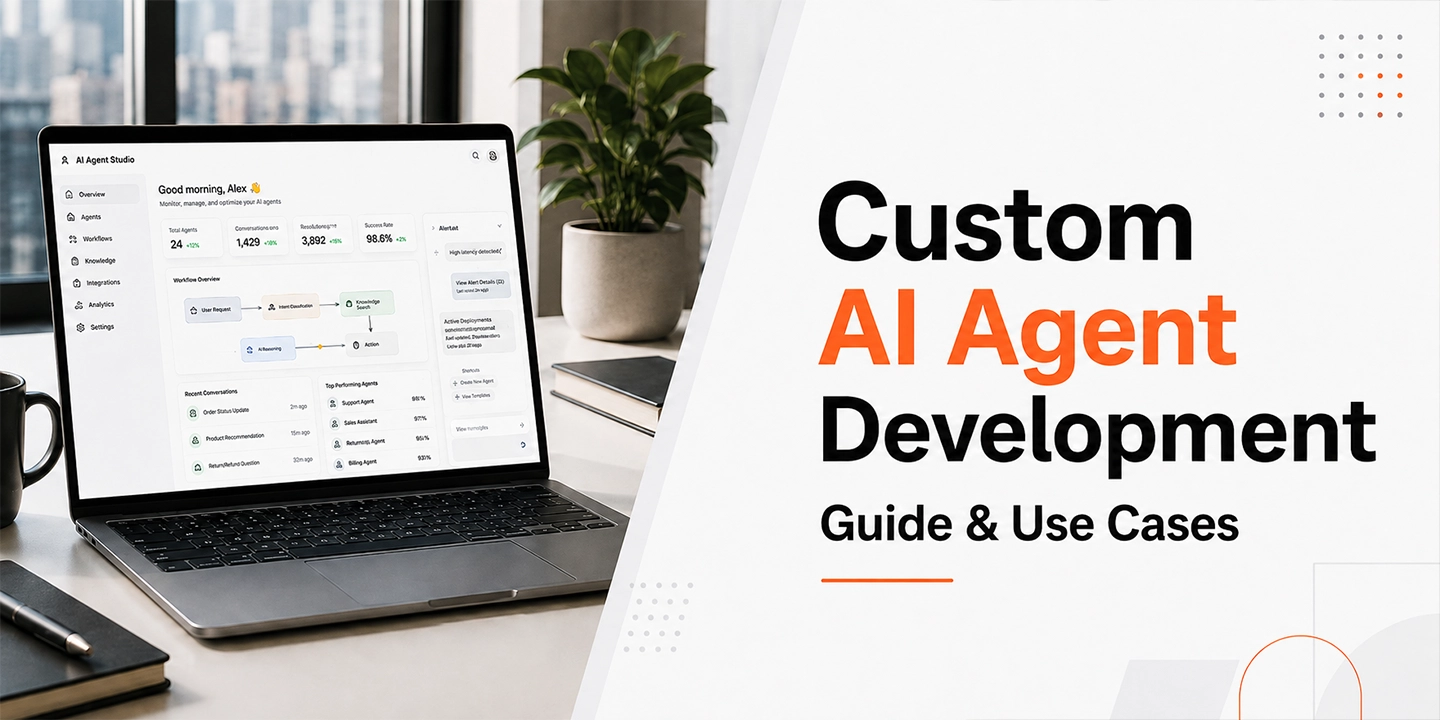
Custom AI Agent Development: Benefits, Process, and Use Cases

Businesses are increasingly moving beyond AI tools that simply answer questions. The next step is software that can understand a goal, gather information, interact with systems, make workflow decisions within defined rules, and complete tasks across multiple applications.

This is where custom AI agents come into the picture.

Unlike a standalone AI chatbot that responds to prompts, an AI agent can interact with business systems, retrieve information, execute actions, and manage multi-step workflows. A customer support agent might check order status, update tickets, and escalate complex issues. A sales agent might research prospects, qualify leads, update a CRM, and schedule meetings.

For organizations exploring AI adoption, understanding custom AI agent development is becoming increasingly important. Whether you’re evaluating an AI automation initiative or considering working with an experienced agentic AI development company, the goal should be the same: solving a real business problem through intelligent workflow automation.

What Is Custom AI Agent Development?

Short answer: Custom AI agent development is the process of designing, building, testing, and deploying AI-powered systems that can perform specific business tasks by combining AI models, business logic, company knowledge, software integrations, and controlled actions.

A custom AI agent is built around a business workflow rather than a generic conversation interface.

These systems can:

  • Understand goals
  • Break tasks into smaller steps
  • Retrieve relevant information
  • Use tools and APIs
  • Interact with software systems
  • Maintain context
  • Make workflow decisions within defined rules
  • Take approved actions
  • Escalate situations to humans when needed

For example, a customer support AI agent may:

  1. Receive a customer request
  2. Access order information
  3. Verify eligibility for a return
  4. Create a support ticket
  5. Send a confirmation email
  6. Escalate unusual cases to a support representative

That workflow goes far beyond generating text. It combines AI reasoning, business rules, integrations, and operational processes.

What Is Agentic AI?

Short answer: Agentic AI refers to AI systems designed to pursue goals through planning, tool usage, information retrieval, workflow execution, and feedback-driven decision-making within defined constraints.

In practical business terms, Agentic AI combines several components:

  • AI models
  • Planning mechanisms
  • Context and memory
  • Tool access
  • APIs
  • Business rules
  • Human oversight
  • Feedback loops

An agentic system does not simply answer a question.

Instead, it may:

  • Understand an objective
  • Determine required steps
  • Access business data
  • Use external tools
  • Evaluate results
  • Decide what to do next

For example, a sales operations agent might receive a request to identify qualified leads in a specific industry. It can gather CRM information, review lead data, apply qualification rules, generate recommendations, and create tasks for sales representatives.

Importantly, agentic systems are not conscious and do not possess human judgment. Their effectiveness depends on workflow design, data quality, permissions, testing, and monitoring.

AI Agent vs Chatbot vs Generative AI

Short answer: Generative AI primarily creates content, chatbots primarily handle conversations, and AI agents can execute multi-step workflows using tools, systems, and business logic.

Capability Generative AI Traditional Chatbot AI Agent
Generates content Yes Limited Yes
Understands context Limited Moderate Stronger
Uses tools Sometimes Limited Yes
Connects to APIs Limited Sometimes Yes
Makes workflow decisions No Limited Yes
Performs multi-step tasks Limited Limited Yes
Takes actions Rarely Sometimes Yes
Works autonomously within rules No Limited Yes
Human escalation Not typical Yes Yes
Best use cases Content generation Customer interactions Workflow execution

These categories often overlap.

A chatbot can use generative AI. An AI agent may include a conversational interface. A generative AI application can become agentic when connected to tools, workflows, and decision-making processes.

The difference is usually the ability to take action and manage tasks rather than simply generate responses.

How Do AI Agents Work?

Short answer: AI agents combine AI models, instructions, tools, business data, and workflow logic to complete tasks through a sequence of planned actions.

Simplified AI Agent Flow

Business Goal → AI Model → Planning → Tool Selection → Action → Result Evaluation → Next Action → Completion

Key components include:

  • Large Language Models (LLMs)
  • System instructions
  • APIs
  • Retrieval systems
  • Databases
  • Memory
  • Business rules
  • Guardrails
  • Monitoring systems
  • Human approvals

For example:

A customer asks about a delayed shipment.

The agent:

  1. Understands the request
  2. Retrieves order data
  3. Checks shipping status
  4. Applies company policies
  5. Generates a response
  6. Creates a support case if necessary
  7. Escalates complex situations

The practical answer is that successful AI agents rely just as much on integrations, workflow design, and controls as they do on the underlying AI model.

Key Components of a Custom AI Agent

AI Model

The AI model interprets instructions, understands context, generates responses, and supports decision-making.

Popular choices include models from OpenAI, Anthropic, Google, Microsoft, and open-source providers.

Agent Instructions

Instructions define:

  • Goals
  • Business rules
  • Allowed actions
  • Escalation requirements
  • Communication style

These instructions act as operating guidelines.

Tools and APIs

Tools allow agents to interact with external systems.

Examples include:

  • CRM platforms
  • ERP systems
  • Ecommerce platforms
  • Helpdesk software
  • Email platforms
  • Databases

Knowledge and Retrieval

Agents often need access to company-specific information.

Retrieval systems can provide:

  • Product documentation
  • Policies
  • Internal procedures
  • Knowledge bases

Memory and Context

Memory helps agents maintain continuity.

This may include:

  • Current conversation context
  • Workflow state
  • Historical interactions
  • Business-specific preferences

Planning and Decision Logic

Planning systems break objectives into manageable tasks.

The agent determines:

  • What information is needed
  • Which tools to use
  • Which actions are appropriate

Guardrails

Guardrails help control behavior.

Examples include:

  • Permission controls
  • Data validation
  • Action approval requirements
  • Compliance checks

Monitoring

Monitoring provides visibility into:

  • Performance
  • Errors
  • Costs
  • User satisfaction
  • Escalation rates

Benefits of Custom AI Agent Development

Short answer: Custom AI agents can help businesses automate repetitive workflows, improve response times, support employees, and connect activities across multiple systems.

Automate Multi-Step Workflows

Many business processes involve multiple systems and decisions.

Examples include:

  • Lead qualification
  • Customer onboarding
  • Ticket management
  • Order processing

Reduce Manual Work

Employees often spend time on repetitive administrative tasks.

AI agents can assist with:

  • Data entry
  • Status updates
  • Information retrieval
  • Report generation

Improve Response Times

Faster access to information often improves customer and employee experiences.

Work Across Business Systems

AI agents can connect:

  • CRM systems
  • ERP platforms
  • Ecommerce tools
  • Databases
  • Support software
  • Communication platforms

Personalize Customer Experiences

Agents can use customer context to provide more relevant interactions.

Support Employees

Internal agents can help staff locate information, complete workflows, and answer operational questions.

Scale Operations

As task volume grows, agents can help manage larger workloads within defined boundaries.

Improve Decision Support

Agents can gather information, analyze data, and present recommendations for human review.

Custom AI Agent Development Process

Short answer: Successful AI agent projects begin with workflow discovery and progress through architecture, integration, testing, deployment, and ongoing monitoring.

Step 1: Identify the Business Problem

Start with the workflow.

Common questions include:

  • What process causes delays?
  • Where do employees spend excessive time?
  • Which workflows involve repetitive decisions?

Step 2: Define Goals and KPIs

Potential metrics include:

  • Time saved
  • Resolution rate
  • Response time
  • Conversion rate
  • Accuracy
  • Task completion rate

Step 3: Map the Workflow

Document:

  • Inputs
  • Decisions
  • Actions
  • Exceptions
  • Human approvals
  • Outputs

Step 4: Select the AI Model and Architecture

Selection depends on:

  • Complexity
  • Cost
  • Latency
  • Context requirements
  • Reliability
  • Multimodal needs

Step 5: Connect Business Data and Tools

Common integrations include:

  • Salesforce
  • HubSpot
  • Microsoft Dynamics
  • SAP
  • Shopify
  • Zendesk
  • Internal databases

Step 6: Build Agent Logic

This includes:

  • Planning systems
  • Retrieval mechanisms
  • Memory
  • Workflow logic
  • Permissions
  • Validation rules

Step 7: Develop the Agent

Development typically includes:

  • Backend services
  • Integrations
  • User interfaces
  • Knowledge systems
  • Monitoring tools

Step 8: Test and Evaluate

Testing should cover:

  • Accuracy
  • Reliability
  • Tool usage
  • Failure handling
  • Edge cases
  • Security risks

Step 9: Human Approval and Escalation

Some workflows should always include human review.

Examples include:

  • Financial approvals
  • Legal decisions
  • Healthcare recommendations
  • Sensitive customer actions

Step 10: Deploy and Monitor

Deployment is not the end.

Ongoing activities include:

  • Performance tracking
  • Cost monitoring
  • User feedback analysis
  • Workflow refinement

Custom AI Agent Development Use Cases

Customer Support Agent

Can assist with:

  • FAQ responses
  • Order tracking
  • Ticket creation
  • Routing requests
  • Escalation workflows

Sales Agent

Can support:

  • Lead qualification
  • Prospect research
  • CRM updates
  • Follow-up sequences
  • Meeting scheduling

Marketing Agent

Useful for:

  • Research
  • Content planning
  • Campaign analysis
  • Performance reporting

Ecommerce Agent

Can assist with:

  • Product discovery
  • Order support
  • Recommendations
  • Inventory workflows

Finance Agent

May support:

  • Invoice processing
  • Data collection
  • Reporting
  • Reconciliation assistance

Human review remains important for financial decisions.

HR Agent

Useful for:

  • Employee onboarding
  • Policy lookup
  • Document support
  • Internal assistance

IT Support Agent

Can help with:

  • Ticket classification
  • Troubleshooting guidance
  • Knowledge retrieval
  • Approved system actions

Operations Agent

Can coordinate:

  • Workflow tracking
  • Data collection
  • Exception handling
  • Task management

Research Agent

Useful for:

  • Document review
  • Information gathering
  • Competitive research
  • Report preparation

[Internal Link: Custom AI Agent Development]

Industry-Specific AI Agent Use Cases in the USA

Industry Business Problem AI Agent Use Case Potential Benefit
Ecommerce High support volume Order support agent Faster customer service
Healthcare Administrative workload Patient information workflows Reduced manual processing
Finance Reporting complexity Data gathering agent Improved operational efficiency
SaaS Lead management Sales qualification agent Better lead prioritization
Retail Inventory visibility Inventory monitoring agent Faster issue detection
Manufacturing Operational coordination Workflow monitoring agent Improved visibility
Logistics Shipment tracking Logistics support agent Faster updates
Real Estate Lead follow-up Property inquiry agent Better responsiveness
Professional Services Research workload Knowledge assistant Faster information access
Education Student support Student information agent Improved support workflows

For regulated industries, privacy, compliance, auditability, and human oversight are particularly important.

Custom AI Agent Development vs Off-the-Shelf AI Tools

Factor Off-the-Shelf AI Custom AI Agent
Customization Limited High
Integrations Basic Extensive
Data Control Limited Greater control
Workflow Complexity Simple Advanced
Initial Cost Lower Higher
Deployment Speed Faster Longer
Scalability Moderate High
Maintenance Vendor-managed Shared responsibility
Security Controls Standard Business-specific
Business Logic Limited Customized

An off-the-shelf solution may be sufficient for generic use cases.

Custom development often becomes attractive when workflows involve multiple systems, business rules, and proprietary processes.

AI Automation Agency vs AI Agent Development Company

An AI automation agency often focuses on workflow automation using existing tools, integrations, and automation platforms.

Typical Automation Focus

  • Process automation
  • Workflow integration
  • Task routing
  • System synchronization

Typical Agent Development Focus

  • Agent architecture
  • Multi-step workflows
  • Tool-using AI agents
  • Decision support systems
  • Agentic workflows

Neither approach is universally better. The right choice depends on business requirements.

Agentic AI Development Services: What Do They Include?

Organizations offering agentic AI development services often provide:

  • AI strategy
  • Use-case discovery
  • Architecture design
  • Custom AI agent development
  • API integration
  • Retrieval systems
  • Workflow automation
  • Multi-agent architectures
  • Testing and evaluation
  • Guardrail implementation
  • Monitoring
  • Ongoing support

The most successful projects usually begin with workflow discovery rather than model selection.

Agentic AI Services for Business Automation

Agentic AI services can support many operational areas.

Examples include:

  • Customer service automation
  • Sales workflow support
  • Marketing operations
  • Ecommerce assistance
  • Research automation
  • Data workflows
  • Internal knowledge management
  • Employee support

The value comes from connecting AI to meaningful business processes rather than deploying AI in isolation.

How Much Does Custom AI Agent Development Cost?

Short answer: Costs vary significantly based on complexity, integrations, security requirements, and operational scope.

Factors affecting cost include:

  • Number of workflows
  • AI model usage
  • API integrations
  • Knowledge systems
  • Security requirements
  • User interfaces
  • Testing requirements
  • Monitoring infrastructure
  • Compliance obligations
Project Type Complexity Main Cost Drivers
Basic single-workflow agent Low One workflow, limited integrations
Integrated business agent Medium CRM, helpdesk, databases
Advanced multi-system agent High Multiple systems, approvals, orchestration
Enterprise agentic platform Very High Governance, security, scalability, compliance

Indicative market pricing can range from a few thousand dollars for simple prototypes to six-figure enterprise implementations. Actual costs vary substantially.

How Long Does AI Agent Development Take?

Timelines depend on workflow complexity and integration requirements.

Typical stages include:

Stage Approximate Duration
Discovery 1-3 weeks
Architecture 1-2 weeks
Prototype 2-4 weeks
Development 4-12+ weeks
Integration 2-8 weeks
Testing 2-6 weeks
Deployment 1-2 weeks
Monitoring and refinement Ongoing

Simple internal agents may launch quickly. Enterprise platforms often require significantly longer timelines.

AI Agent Security and Privacy

Short answer: Security should be considered throughout the entire lifecycle of an AI agent, from architecture and permissions to deployment and monitoring.

Key considerations include:

Data Privacy

Protect customer, employee, and operational data.

Access Control

Agents should only access required systems.

Authentication

Verify identities before allowing actions.

Authorization

Control what actions an agent can perform.

API Security

Secure integrations and credentials.

Prompt Injection Protection

Defend against attempts to manipulate agent behavior.

Data Leakage Prevention

Restrict access to sensitive information.

Tool Permissions

Apply least-privilege access.

An AI agent should have only the permissions required to perform its assigned tasks.

Logging and Monitoring

Maintain audit trails and visibility.

Human Approval

Require review for high-impact actions.

Security frameworks and guidance from organizations such as NIST and OWASP provide useful references when designing enterprise AI systems.

How to Measure AI Agent ROI

AI agent ROI should be measured against the workflow being improved.

Potential KPIs include:

  • Tasks completed
  • Hours saved
  • Cost per task
  • Response times
  • Resolution rates
  • Conversion rates
  • Escalation rates
  • Error rates
  • Customer satisfaction
  • Employee satisfaction
  • Revenue influence

You’ll notice that meaningful measurement requires baseline metrics before deployment.

Common Challenges in Custom AI Agent Development

Common challenges include:

  • Hallucinations
  • Incorrect tool usage
  • Poor data quality
  • Complex integrations
  • Unclear workflows
  • Security concerns
  • Unexpected operating costs
  • Latency
  • Inconsistent outputs
  • Weak evaluation processes
  • Missing escalation paths

Risk reduction strategies include:

  • Better testing
  • Structured workflows
  • Strong guardrails
  • Monitoring
  • Human review
  • Clear permissions

That sounds simple, but ongoing evaluation is often one of the most overlooked parts of AI projects.

How to Choose an Agentic AI Development Company in the USA

Selecting an agentic AI development company should involve more than reviewing AI model expertise.

Evaluation Checklist

  1. AI and LLM experience
  2. Agent architecture expertise
  3. API integration capabilities
  4. Business process understanding
  5. Security practices
  6. Testing methodologies
  7. Data governance approach
  8. Deployment experience
  9. Monitoring and support capabilities
  10. Industry experience
  11. Communication quality
  12. KPI-driven project planning

Questions to Ask

  • How do you evaluate AI agents?
  • How do you handle security reviews?
  • What monitoring tools do you use?
  • How do you measure business outcomes?
  • What escalation controls are available?
  • How do you manage model updates?

When Should Your Business Build a Custom AI Agent?

A custom AI agent may be appropriate when:

  • Workflows are repetitive
  • Multiple systems are involved
  • Decisions follow defined rules
  • Employees spend substantial time on the process
  • Context matters
  • Existing automation tools fall short
  • Custom integrations are required
  • Business outcomes can be measured

When Not to Build One

Consider alternatives when:

  • The workflow is extremely simple
  • Processes change constantly
  • Data quality is poor
  • Human judgment is required at every step
  • Automation costs exceed expected value

The thing is, not every workflow needs an AI agent.

Sometimes a traditional automation platform is the better choice.

Future of Agentic AI for Businesses in the USA

Several trends are emerging:

  • More AI-supported workflows
  • Multi-agent systems
  • Improved tool usage
  • Multimodal capabilities
  • Wider enterprise adoption
  • AI-native business processes
  • Human-AI collaboration models
  • Greater focus on governance

Most organizations are unlikely to replace entire departments with AI agents. More often, they redesign workflows so humans and AI systems work together.

Custom AI Agent Development Checklist

Business

  • Define the workflow
  • Identify the business problem
  • Define KPIs
  • Estimate business value

Technical

  • Choose AI model
  • Define architecture
  • Connect APIs
  • Configure data access
  • Build tools
  • Define agent logic

Security

  • Access control
  • Authentication
  • Authorization
  • Data protection
  • Logging
  • Guardrails
  • Human approval

Testing

  • Accuracy testing
  • Reliability testing
  • Edge-case testing
  • Hallucination testing
  • Tool-use testing
  • Security testing

Deployment

  • Monitoring
  • Cost tracking
  • User feedback
  • Performance measurement
  • Continuous improvement

Final Thoughts

Custom AI agent development is most valuable when AI is connected to a meaningful business workflow.

The right approach is not:

“Let’s build an AI agent.”

The better approach is:

Business problem → Workflow → AI opportunity → Agent architecture → Integration → Testing → Measurable outcome

Organizations that follow this process are more likely to build systems that provide practical business value rather than experimental technology projects.

For companies evaluating advanced automation, working with an experienced agentic AI development company can help navigate architecture decisions, integrations, security requirements, testing strategies, and long-term maintenance.

The goal is not maximum autonomy. The goal is building AI systems that help people work more effectively within well-designed business processes.
Agentic AI vs Generative AI: What’s the Difference (And Why It Matters for Your Business)

A client called me last month and asked a question I get almost every week now: “We already use ChatGPT for our marketing copy. Isn’t that the same thing as agentic AI?” Honestly, this mix-up is everywhere right now, and it’s costing businesses real money because they’re either overpaying for tools they don’t need or underestimating what agentic systems can actually do for their operations.

The thing is, generative AI and agentic AI are not competing technologies. They’re built on similar foundations, but they solve completely different problems. One writes, drafts, and creates. The other plans, decides, and acts. If you’re evaluating custom AI agent development for your business, understanding this distinction isn’t optional. It’s the difference between investing in a tool that produces content and investing in a system that actually runs parts of your business for you.

I’ve spent the last several years working alongside ecommerce teams and operations leaders who are trying to figure out where AI fits into their growth plans. In this article, I’ll walk you through what separates these two categories of AI, where each one actually earns its keep, and how to decide which one (or which combination) makes sense for your business in 2026.

Quick Answer: What’s the Core Difference?

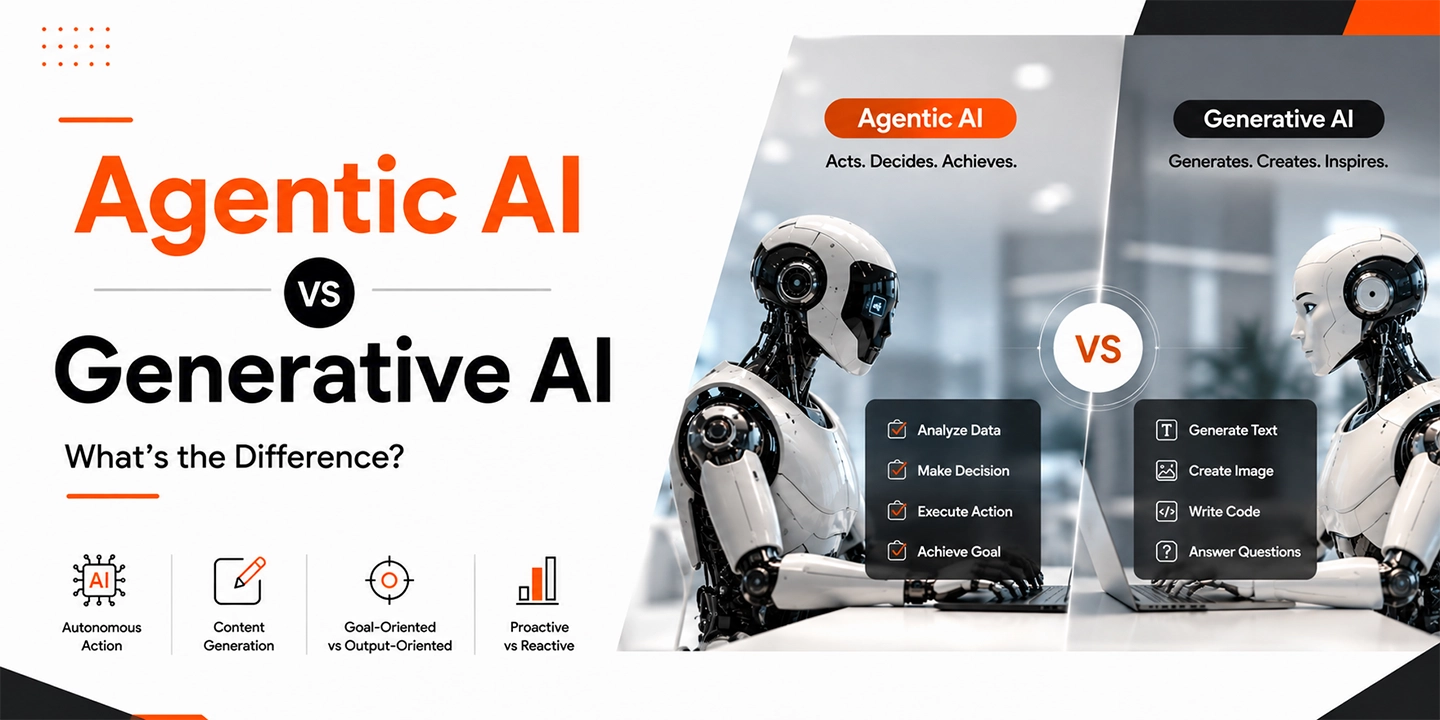
Generative AI creates content, such as text, images, or code, in response to a single prompt, then stops and waits for your next instruction. Agentic AI goes further: it can independently plan a sequence of steps, use external tools and data, make decisions along the way, and complete multi-step tasks with little to no ongoing human direction. Put simply, generative AI responds. Agentic AI acts.

What Is Generative AI, Exactly?

Generative AI refers to models trained on massive datasets that learn to produce new content based on patterns in that data. You give it a prompt, and it generates a response, a paragraph, an image, a snippet of code, a product description.

Tools like ChatGPT, Gemini, and Claude in their standard chat form are generative AI at work. You ask a question, the model answers. You ask it to write a blog outline, it writes one. But here’s the catch that a lot of business owners miss: the model has no memory of your business systems, no ability to check your inventory, no way to actually send that email campaign or update your CRM. It’s a brilliant writer sitting in a room with no door to the outside world.

In most cases, generative AI is reactive. It waits for a human to prompt it, produces an output, and the interaction ends there. You’ll notice this in practically every generative AI tool on the market today: the workflow is prompt in, content out, human reviews and takes the next step manually.

Common Generative AI Use Cases

  • Drafting marketing copy, product descriptions, and blog content
  • Generating images for ads or social media
  • Summarizing documents or customer reviews
  • Writing and debugging code snippets
  • Answering customer questions in a basic chatbot format

None of these are bad use cases. They’re genuinely useful. But they all share one trait: a person still has to connect the dots, execute the follow-up actions, and manage the workflow around the output.

What Is Agentic AI, Exactly?

Agentic AI describes AI systems built to pursue a goal with a level of independence that traditional generative tools simply don’t have. Instead of just answering a prompt, an agentic system can break a broad objective into smaller steps, decide which tools or data sources it needs, take action across connected systems, and adjust its approach based on what it finds along the way, often without a human clicking “go” at every stage.

From my experience building and deploying these systems, the easiest way to explain agentic AI to a non-technical client is this: imagine hiring a new team member and giving them a goal instead of a checklist. A generative AI tool is like handing someone a script to read. An agentic AI system is like handing someone a job description and letting them figure out how to get it done, checking in with you only when something genuinely needs your judgment.

That’s where things change for ecommerce and operations teams specifically. An agentic AI system built for order management doesn’t just draft a response to a shipping delay complaint. It can check the order status in your fulfillment platform, calculate a revised delivery estimate, decide whether a discount or refund is warranted based on your policy rules, issue that action, and then send the customer a personalized update, all without a human touching the ticket.

Common Agentic AI Use Cases

  • Autonomous customer support agents that resolve tickets end to end, not just draft replies
  • Inventory and supply chain agents that reorder stock based on real-time demand signals
  • Sales agents that qualify leads, schedule meetings, and update your CRM automatically
  • Multi-step research agents that gather competitor pricing and adjust your listings
  • AI shopping and checkout agents that help customers discover and buy products across channels

One thing many businesses overlook here: agentic AI doesn’t replace generative AI. It usually sits on top of it. The large language model still generates the reasoning and the language. Agentic AI adds the planning layer, the tool access, and the decision-making loop around it.

Agentic AI vs Generative AI: Side-by-Side Comparison

Factor Generative AI Agentic AI
Core function Creates content from a prompt Plans and executes multi-step tasks
Human involvement Required at every step Required only for oversight or exceptions
Memory and context Limited to a single session in most cases Persists context across tasks and workflows
Tool use Typically none, unless manually integrated Uses APIs, databases, and business systems directly
Decision-making Produces suggestions, doesn’t act on them Makes decisions and takes real actions
Output Text, image, audio, or code Completed tasks, transactions, and workflow outcomes
Best fit Content creation, drafting, brainstorming Automation, operations, customer-facing workflows

Why This Distinction Matters for Your Business Right Now

Here’s something I tell every business owner I consult with: you don’t need agentic AI for everything, and you shouldn’t buy it just because it’s the trending term this year. But if you’re running an ecommerce operation, a service business, or anything with repetitive multi-step workflows, the gap between what generative AI can do and what agentic AI can do is where your competitors are quietly pulling ahead.

According to Gartner’s 2026 CIO and Technology Executive Survey, only 17% of organizations have deployed AI agents to date, yet more than 60% expect to do so within the next two years, making it the most aggressive adoption curve among all emerging technologies the survey tracked. That gap between current deployment and near-term intent tells you something important: the businesses that move now, with a properly scoped agentic AI development services partner, are positioning themselves ahead of a wave that’s about to get very crowded.

Gartner also projects that by the end of 2026, 40% of enterprise applications will include task-specific AI agents, up from less than 5% just a year earlier. That’s not a gradual shift. That’s a near-vertical adoption curve, and it matters because the applications your team already uses, your CRM, your helpdesk, your ecommerce platform, are being rebuilt around this agentic layer whether you actively adopt it or not.

The ecommerce numbers are even more direct. Salesforce’s 2026 Agentic Enterprise Index found that businesses deploying agents on their digital commerce channels saw 4x higher online sales growth compared to those that didn’t. In a separate release tied to their Agentforce Commerce launch, Salesforce reported that retailers running their own shopper agents grew sales 59% faster than retailers sitting on the sidelines, and that AI influenced roughly 20% of global online sales during the 2025 holiday season, worth an estimated $262 billion. That’s not a hypothetical future benefit. That’s money already moving through agentic systems while some businesses are still deciding whether to test a chatbot.

Adobe’s data adds another layer to this. AI-driven traffic to US retail sites jumped 693.4% year over year during the 2025 holiday season, and by March 2026, that AI-referred traffic was converting 42% better than traditional traffic, a full reversal from a year earlier when it converted 38% worse. Shoppers arriving through AI channels also spent 48% longer on-site and generated 37% more revenue per visit. If your product catalog and customer experience aren’t structured to work with AI agents and AI-powered discovery, you’re leaving a fast-growing, high-converting channel almost entirely on the table.

One thing worth being honest about: not every agentic AI initiative succeeds. Gartner predicts that 40% of agentic AI projects will be canceled by the end of 2027, largely because organizations rush into deployment without the right data infrastructure, governance, or a clear use case. This is exactly why working with an experienced AI agent development company matters more than the technology itself. The failure rate isn’t a knock against agentic AI. It’s a reflection of what happens when businesses treat it like a plug-and-play tool instead of a system that needs to be built around their actual workflows.

How Agentic AI and Generative AI Work Together

I want to clear up a misconception here, because it comes up in nearly every discovery call I run. Businesses often think they have to choose one or the other. In practice, the strongest systems combine both.

Picture a customer support workflow for an online retailer. The generative AI layer handles the language: understanding the customer’s message, drafting a natural-sounding response, adjusting tone based on the situation. The agentic layer handles everything around that language: pulling the customer’s order history, checking warehouse inventory, applying your refund policy logic, updating the order status, and closing the loop, all before a human ever sees the ticket unless something falls outside the defined rules.

That’s the real value of a properly built agentic system. It’s not one technology replacing another. It’s generative AI providing the reasoning and communication skills, and agentic AI providing the hands, the memory, and the follow-through.

Signs Your Business Is Ready for Agentic AI

You’ll notice a pattern across the businesses that get the most value from agentic AI. They tend to share a few traits before they even start the build:

  1. Repetitive multi-step workflows. If your team is manually stitching together data from five different tools to complete one task, that’s a strong signal.
  2. High volume, low judgment decisions. Order status updates, basic refund approvals, appointment scheduling, these are exactly the kinds of decisions agentic AI handles well.
  3. Clean-ish data and connected systems. Agentic AI needs access to your actual business data through APIs. If your systems are siloed and undocumented, that’s step one before any agent gets built.
  4. A defined process to automate. Agentic AI works best when there’s an existing process to encode, not when you’re hoping the AI will invent your operations from scratch.
  5. Willingness to start small. The businesses that succeed almost always start with one narrow, well-defined workflow, prove the ROI, then expand.

If you’re checking two or three of these boxes, it’s worth a conversation with an agentic AI development company before you scale further with manual processes that are already stretching your team thin.

What to Look for in an AI Automation Agency

I’ve seen businesses get burned by vendors who slap “agentic AI” on what’s really a basic chatbot with a few if-then rules. Here’s what actually separates a credible partner from a marketing pitch:

  • They ask about your workflows before they talk about the technology. A good partner wants to understand your actual bottleneck first.
  • They can explain tool integration in plain language. If they can’t clearly describe how the agent will connect to your CRM, inventory system, or payment processor, that’s a red flag.
  • They build in human oversight, not blind automation. Reliable agentic systems include checkpoints for decisions that carry real risk or cost.
  • They talk about data infrastructure, not just AI models. Remember, most agentic AI failures come down to messy data and poor system connections, not the model itself.
  • They have real deployment experience, not just prototypes. Ask to see a workflow they’ve built that’s been running in production for at least a few months.

This is the practical difference between choosing any generic AI automation agency and choosing genuine agentic AI development services built by a team that understands both the AI layer and the operational reality of running a business.

Cost and ROI: What Businesses Are Actually Seeing

Businesses considering custom AI agent development often ask how quickly this pays off. According to BCG and Forrester’s 2026 surveys, the median time to value across agent deployments is around 5.1 months, with sales development agents paying back in as little as 3.4 months and finance or operations agents taking closer to 8.9 months. That range gives you a realistic planning window instead of vague promises of instant transformation.

McKinsey and IDC’s broader AI research points to an average return of roughly 3.7 times for every dollar invested in generative and agentic AI initiatives when they’re properly scoped and measured. The word “properly” is doing a lot of work in that sentence. The businesses hitting those returns are the ones that picked a specific, high-friction workflow first instead of trying to automate everything at once.

A Simple Way to Decide Which One You Actually Need

If you’re still not sure which category fits your next project, ask yourself one question: does this task end when the content is produced, or does something still need to happen after that? If a task ends the moment the words are written, the image is generated, or the code is drafted, generative AI is probably enough on its own. If the real value only shows up after several more steps happen, checking a system, making a decision, updating a record, notifying someone, that’s the territory where agentic AI earns its cost.

I usually walk clients through their current workflow on a whiteboard, literally mapping out every handoff between a person and a tool. In most cases, the pattern becomes obvious pretty quickly. Wherever you see three or more manual handoffs between systems for a single task, that’s usually your best candidate for an agentic build. Wherever the workflow starts and ends with one person producing one piece of content, generative AI is doing its job just fine already, and there’s no need to overcomplicate it with a full agentic buildout.

Where This Leaves Your Business

Honestly, the businesses I see making the most progress right now aren’t the ones chasing every new AI headline. They’re the ones taking a clear-eyed look at where a repetitive, multi-step process is quietly draining their team’s time, and asking whether an agentic system could take that off their plate entirely.

Generative AI is a genuinely useful tool for content and communication. Agentic AI is a different kind of investment: it’s closer to building a digital team member than buying software. If you’re weighing custom AI agent development for your business, start with one workflow, work with a partner who understands both the technical build and your actual operations, and let the results from that first project guide how far you take it from there.

What Is Agentic AI? A Complete Guide for Business Leaders

If you’ve spent any time in a leadership meeting this year, you’ve probably heard the term “agentic AI” thrown around at least once. Half the room nods like they get it. The other half quietly Googles it later. Honestly, that’s fair, because the term gets used loosely, and a lot of the marketing around it doesn’t help.

This guide is meant to clear that up. No hype, no buzzword soup. Just a straight explanation of what agentic AI actually is, how it’s different from the chatbots and automation tools you already know, and what it takes to actually build and deploy it in a real business. Whether you’re evaluating an AI automation agency, comparing an AI agent development company, or trying to figure out if agentic AI development services are worth the investment for your business, this article should give you a solid foundation to make that call.

What Is Agentic AI? (Quick Definition)

Agentic AI refers to AI systems that can plan, make decisions, and take multi-step actions toward a goal with little or no human input at each step. Unlike a chatbot that answers one question at a time, an agentic system can break down a task, choose tools, execute actions across systems, check its own results, and adjust its approach until the goal is met.

That’s the short version. Now let’s unpack what that actually means for a business.

Agentic AI vs. Traditional AI vs. Automation: What’s the Real Difference?

Traditional automation (think Zapier workflows or basic RPA bots) follows fixed rules: if X happens, do Y. It’s rigid but predictable. Traditional generative AI, like a standard chatbot, responds to a single prompt and stops. It doesn’t remember what it did five minutes ago unless you build that in separately, and it doesn’t take action in the real world on its own.

Agentic AI sits a level above both. It’s given a goal, not just a prompt, and it figures out the steps needed to get there. It can call APIs, query databases, send emails, update a CRM record, or hand off to another agent, all without someone manually approving every single move.

Here’s a table that breaks it down simply:

Capability Traditional Automation (RPA) Standard AI Chatbot Agentic AI
Follows fixed rules Yes No No
Understands natural language No Yes Yes
Plans multi-step tasks No No Yes
Takes autonomous action Limited No Yes
Learns and adjusts mid-task No No Yes
Works across multiple tools/systems Rarely Rarely Yes

You’ll notice the jump isn’t just “smarter chatbot.” It’s a fundamentally different way of getting work done, closer to hiring a very fast, very literal junior employee than installing a new app.

How Does Agentic AI Actually Work?

Most agentic systems are built around a loop, not a single response. In most cases, the loop looks something like this:

  1. Goal input – A person or system gives the agent an objective, not just a question.
  2. Planning – The agent breaks the goal into smaller steps using a reasoning model.
  3. Tool selection – It decides which tools, APIs, or data sources it needs to complete each step.
  4. Execution – It carries out the action, whether that’s pulling data, writing code, sending a message, or updating a system.
  5. Evaluation – It checks whether the result actually matches the goal.
  6. Iteration – If something’s off, it adjusts and tries again, sometimes asking a human for input if it hits a wall.

That last step is the part people underestimate. The self-checking loop is what separates a real agentic system from a glorified script. From my experience talking with businesses exploring this, the companies that get burned are the ones that skip proper evaluation steps because they want faster deployment. That almost always backfires.

Why Are Business Leaders Paying Attention Now?

The short answer: the technology crossed a usability threshold in the last two years, and the ROI data started backing up the hype, at least in specific use cases.

According to Gartner, 40% of enterprise applications are expected to include task-specific AI agents by the end of 2026, up from less than 5% in 2025. That’s not a small jump. It reflects software vendors racing to bake agent capability directly into the tools businesses already use, from CRMs to ERPs to customer support platforms.

McKinsey’s 2025 State of AI survey found that 88% of organizations now use AI in at least one business function, and 23% are actively scaling agentic AI in at least one part of the business. The gap between those two numbers matters. It tells you most companies are still experimenting, not scaling, which is actually useful context if you’re worried you’re “behind.”

Deloitte’s 2026 State of AI in the Enterprise report, based on a survey of 3,235 leaders across 24 countries, found that 23% of enterprises currently use agentic AI at least moderately, but that figure is expected to jump to 74% within two years. One thing many businesses overlook here: the same report found only 21% of organizations have a mature governance model for these systems. That’s the part nobody puts in the sales deck.

Why does this matter for your business specifically? Because the same reports that show fast growth also show a wide gap between companies that treat agentic AI as a real operational shift versus a bolt-on feature. The winners aren’t the ones who adopted first. They’re the ones who redesigned how a process actually works before automating it.

What Business Problems Does Agentic AI Actually Solve?

This is where things get practical. Agentic AI tends to deliver the clearest value in workflows that are repetitive, rule-based at the core, but require judgment calls along the way. A few real-world categories:

Customer support and service resolution. Agents can handle account questions, order status, returns, and troubleshooting without a human touching every ticket. Gartner has projected agentic AI could autonomously resolve a large share of common customer service issues by 2029, cutting resolution costs meaningfully in the process.

Sales and marketing personalization. Instead of static email sequences, agents can adjust messaging and timing per customer based on behavior, in something closer to a real conversation than a drip campaign.

Back-office operations. Invoice processing, reconciliation, compliance checks, and data entry across disconnected systems are a natural fit, since these tasks are structured but still need exception handling.

Supply chain and inventory decisions. Agents can monitor stock levels, vendor lead times, and demand signals, then place or adjust orders without waiting on a person to notice a problem first.

Internal knowledge and IT support. Employees ask questions in plain language and the agent pulls from internal documentation, resets access, or escalates when it hits something it can’t resolve.

That’s where things change for a lot of leadership teams: once you see agentic AI applied to a specific, narrow, high-friction workflow, it stops feeling abstract and starts feeling like an obvious next step.

Is Agentic AI Actually Reliable Yet?

Short answer: it depends heavily on the use case and how well the system is governed, not on the technology alone. Reliability comes from tight scoping, human review at key checkpoints, and proper testing before full autonomy is granted, not from picking a “better” AI model.

This is the honest part of the conversation nobody selling AI wants to lead with. Gartner has predicted that more than 40% of agentic AI projects will be canceled before the end of 2027, largely due to unclear business value, ballooning costs, or inadequate risk controls, not because the underlying technology fails. Deloitte’s research points to a similar pattern: while adoption is accelerating fast, governance maturity is lagging noticeably behind.

The thing is, this isn’t really an argument against agentic AI. It’s an argument against rushing it. The businesses that succeed generally start with one well-defined process, run it with a human checking outputs, and only expand autonomy once the agent has proven itself over real volume. That’s a very different approach from “let’s automate everything by Q3.”

Agentic AI vs. Generative AI: A Quick Comparison

People mix these up constantly, so here’s a clean answer. Generative AI creates content, text, images, code, in response to a prompt, and then it’s done. Agentic AI uses generative capabilities as one component inside a larger system that plans, acts, checks its work, and pursues a goal across multiple steps, often without a person prompting each stage.

Put another way: generative AI answers a question. Agentic AI completes a task.

Feature Generative AI Agentic AI
Primary function Produces content or responses Completes multi-step tasks
Human involvement One prompt per output Set goal once, agent runs the process
Memory across steps Usually none Maintains context through the task
Tool and system access Limited or none Connects to APIs, databases, apps
Example Drafting a marketing email Researching a lead, drafting the email, sending it, logging the response in the CRM

What Does It Take to Build a Working Agentic AI System?

A lot of businesses assume this means buying a single tool off a shelf. In most cases, it’s closer to building a small, connected system with several parts working together:

A reasoning engine. Usually a large language model that handles planning and decision-making.

Tool and API integrations. Connections to the systems the agent actually needs to touch, your CRM, inventory database, email platform, payment processor, and so on.

Memory and context management. A way for the agent to remember what it already did in a task, and ideally across sessions, so it doesn’t repeat work or lose track of a multi-day process.

Guardrails and permissions. Clear boundaries around what the agent is allowed to do without approval, and what always requires a human to sign off.

Monitoring and evaluation. A way to track what the agent is doing, catch mistakes early, and measure whether it’s actually delivering value, not just activity.

This is exactly why working with a genuine agentic AI development company matters more than picking a trendy tool. Off-the-shelf agent products can handle narrow, well-defined tasks reasonably well. But most real business workflows are messier than the demo video suggests, and that’s usually where custom AI agent development earns its cost. A team that understands your specific systems, data structure, and compliance requirements builds something that survives contact with your actual operations, not just a sandbox environment.

Build In-House, Buy Off-the-Shelf, or Hire an Agency?

There’s no universally right answer here, but there is a reasonably clear way to think about it.

Building in-house makes sense if you already have a mature engineering team, sensitive proprietary workflows, and the patience to invest six months or more before seeing return. Off-the-shelf tools make sense for narrow, common use cases, like basic customer support deflection, where a vendor has already solved the problem for thousands of companies before you.

Working with an AI automation agency or specialized agentic AI services provider tends to make the most sense for businesses that want a system tailored to their actual operations, without carrying the full cost of an internal AI team. In most cases, this is where mid-size and growing businesses land, since they need something more capable than a generic tool but don’t have the internal bandwidth to build and maintain a custom system alone.

One thing worth asking any agency you’re evaluating: how do they handle the gap between pilot and production? Given that McKinsey’s research shows a large share of organizations stuck in experiment mode, this is genuinely the question that separates a good partner from one that will leave you with a nice-looking demo and nothing that survives real usage.

Common Mistakes Businesses Make With Agentic AI

Automating a broken process. If a workflow is messy or poorly defined today, adding an agent on top doesn’t fix that. It just makes the mess move faster.

Skipping governance until something goes wrong. Only about one in five companies currently have a mature governance model for autonomous agents, according to Deloitte’s research. Waiting until after deployment to build oversight is a costly way to learn this lesson.

Trying to automate everything at once. The businesses seeing real returns almost always started with one narrow, well-scoped use case, proved it out, then expanded.

Underestimating integration complexity. Agents are only as good as the systems they connect to. Legacy software, inconsistent data, and siloed departments create friction that no amount of clever prompting solves on its own.

Confusing activity with value. An agent that sends a hundred emails a day isn’t automatically valuable if none of them move the needle. Measuring actual business outcomes, not agent activity, is what separates a real deployment from a science project.

How Much Does Agentic AI Development Cost?

There’s no single number here, and anyone who gives you one without knowing your systems first is guessing. Costs generally scale with three things: how many systems the agent needs to connect to, how much custom logic and guardrail work the use case requires, and how much ongoing monitoring and retraining the workflow needs once it’s live.

A narrow, single-workflow agent connected to one or two existing tools is a meaningfully smaller project than a multi-agent system coordinating across your entire order-to-cash process. This is another reason a proper discovery conversation with an agentic AI development company matters more than a quoted price on a website. The scoping conversation itself usually reveals whether the project is realistic in the timeframe and budget a business has in mind.

Getting Started: A Practical First Step

If you’re a business leader trying to figure out where to begin, don’t start with the technology. Start with the process. Pick one workflow that’s repetitive, costly, and has clear success criteria, something like ticket triage, order reconciliation, or lead qualification. Map out exactly what a good outcome looks like today. Then bring that specific problem to a team that builds custom AI agent development solutions and ask them to show you, concretely, how an agent would handle it end to end, including what happens when it gets something wrong.

That last part matters more than most demos let on. Any vendor can show you the happy path. The ones worth trusting will walk you through the failure path too.

Final Thoughts

Agentic AI isn’t magic, and it isn’t hype either. It’s a genuine shift in how software can handle work, provided it’s scoped carefully and built by people who understand both the technology and your actual operations. The businesses pulling ahead right now aren’t necessarily the ones who moved fastest. They’re the ones who picked the right first problem, built proper oversight in from day one, and treated this as an operational change, not just a tech purchase.

If you’re evaluating agentic AI development services for your business, the best next step isn’t picking a vendor off a search results page. It’s having a real conversation about one specific process you want to fix, and seeing how a team responds when you ask them what happens when the agent gets it wrong.

Best Agentic AI Development Company for Enterprise Automation

Artificial intelligence has moved far beyond chatbots and basic automation. Businesses today want systems that can think through tasks, make decisions based on data, coordinate with multiple tools, and complete workflows with minimal human intervention.

That’s exactly why Agentic AI has become one of the biggest technology trends in 2026.

If you’ve been following developments in enterprise automation, you’ve probably noticed that companies are no longer asking whether they should adopt AI. The conversation has shifted. Businesses are now asking how quickly they can deploy intelligent AI agents that deliver measurable results.

From customer support and sales operations to finance, logistics, and internal workflow management, organizations are actively searching for an experienced AI automation agency that can build practical solutions instead of experimental projects.

The thing is, enterprise automation isn’t just about reducing manual work anymore. It’s about creating systems that can plan, act, learn, and continuously improve business processes.

In this guide, we’ll explore what Agentic AI is, how it works, why enterprises are investing heavily in it, and what to look for when selecting an organization that provides agentic AI development services.

What Is Agentic AI?

Quick Answer

Agentic AI refers to artificial intelligence systems designed to operate as autonomous agents. These agents can understand goals, make decisions, execute tasks, interact with software systems, and adapt based on outcomes.

Unlike traditional automation tools that follow predefined rules, Agentic AI can reason through complex workflows and determine the best actions to achieve a specific objective.

Think about a traditional automation workflow.

A task starts.
A trigger occurs.
A predefined action follows.

That’s useful, but it’s limited.

Now imagine an AI agent that receives a goal like:

“Process all incoming customer inquiries, prioritize urgent requests, draft responses, update CRM records, and escalate only the issues requiring human review.”

That’s where things change.

Instead of simply following instructions, the AI agent actively manages the workflow.

Why Enterprise Automation Is Changing

For years, businesses relied on automation platforms that required detailed workflow mapping.

Every action needed rules.

Every exception needed handling.

Every change required updates.

As organizations grew, these systems became increasingly difficult to maintain.

You’ll notice that many enterprise teams spend significant time managing automation instead of benefiting from it.

Agentic AI introduces a different approach.

The system understands objectives and determines how to achieve them using available tools and data.

This flexibility makes automation more practical for dynamic business environments.

How Agentic AI Works

At a high level, Agentic AI combines several technologies:

Large Language Models

These models help agents understand requests, process information, and communicate naturally.

Decision-Making Frameworks

Agents evaluate options before selecting actions.

Memory Systems

Agents retain context and use historical information when making decisions.

Tool Integrations

Agents connect with CRMs, ERP platforms, databases, communication tools, and business applications.

Workflow Execution Engines

These systems enable agents to perform actions across multiple platforms.

Together, these components create AI systems capable of handling sophisticated business processes.

Why Businesses Are Investing in Agentic AI Development Services

Short Answer

Organizations invest in agentic AI development services because they help reduce manual work, improve operational efficiency, accelerate decision-making, and support business growth without proportionally increasing staffing requirements.

The reality is simple.

Most enterprises operate with hundreds of repetitive workflows.

Employees spend hours every week:

  • Updating records
  • Responding to inquiries
  • Managing approvals
  • Processing documents
  • Collecting information
  • Coordinating across departments

Many of these activities can be delegated to intelligent AI agents.

That creates more time for employees to focus on higher-value work.

Key Benefits of Agentic AI for Enterprise Automation

Increased Productivity

AI agents work continuously without requiring breaks or shift schedules.

They can manage multiple tasks simultaneously and process information significantly faster than manual workflows.

Faster Decision Making

Many business decisions depend on gathering information from different systems.

AI agents can analyze data, generate insights, and recommend actions within seconds.

Lower Operational Costs

Reducing repetitive manual work helps organizations control operating expenses.

In most cases, businesses see cost reductions in areas involving administrative processes and routine support activities.

Better Customer Experiences

Customers expect quick responses and accurate information.

AI agents can provide support around the clock while maintaining consistent service quality.

Improved Scalability

As businesses grow, workloads increase.

AI agents can absorb much of that growth without requiring proportional increases in staffing.

Industries Benefiting from Agentic AI

Healthcare

Healthcare organizations use AI agents for:

  • Appointment scheduling
  • Patient communication
  • Documentation support
  • Administrative workflow management

Financial Services

Banks and financial institutions deploy agents for:

  • Compliance monitoring
  • Customer service
  • Fraud detection
  • Risk assessment support

Ecommerce

Online retailers use AI agents to:

  • Manage inventory
  • Process customer inquiries
  • Handle order tracking
  • Generate product recommendations

Manufacturing

Manufacturers automate:

  • Supply chain monitoring
  • Procurement workflows
  • Maintenance scheduling
  • Production reporting

Professional Services

Consulting firms and agencies use AI agents to assist with:

  • Research
  • Documentation
  • Project coordination
  • Knowledge management

What Makes a Great Agentic AI Development Company?

Choosing the right technology partner can significantly impact project success.

Not all providers have the same level of expertise.

A strong agentic AI development company should demonstrate experience in several key areas.

AI Strategy and Consulting

Before building anything, the company should understand business objectives.

Technology should support outcomes, not the other way around.

Custom Development Capabilities

Every enterprise has unique workflows.

That’s why custom AI agent development is often necessary.

A one-size-fits-all solution rarely works for complex organizations.

Integration Experience

Enterprise environments contain numerous systems.

The development team should understand how to connect AI agents with:

  • CRM platforms
  • ERP systems
  • Internal databases
  • Communication tools
  • Cloud infrastructure

Security Knowledge

Enterprise automation often involves sensitive data.

Security and compliance should be built into the development process from the beginning.

Scalability Planning

Successful AI projects grow over time.

The underlying architecture should support expansion without requiring major redesigns.

Why Custom AI Agents Deliver Better Results

Many businesses initially explore generic AI tools.

While these tools can be useful, they often struggle with enterprise-specific requirements.

Custom AI agent development allows organizations to build solutions tailored to their workflows, policies, and operational goals.

Honestly, this is where many companies see the greatest value.

Instead of forcing processes to fit software limitations, businesses can create agents that work the way their teams already operate.

The result is often higher adoption and stronger outcomes.

Common Enterprise Use Cases for Agentic AI

Customer Support Automation

AI agents can:

  • Answer common questions
  • Access customer records
  • Create support tickets
  • Escalate complex issues

Sales Assistance

Sales teams use agents for:

  • Lead qualification
  • CRM updates
  • Follow-up reminders
  • Proposal generation

Human Resources

HR departments automate:

  • Candidate screening
  • Employee onboarding
  • Policy inquiries
  • Internal support requests

Finance Operations

Finance teams benefit from:

  • Invoice processing
  • Expense verification
  • Reporting automation
  • Data reconciliation

IT Service Management

IT departments deploy agents to:

  • Resolve common issues
  • Manage tickets
  • Monitor systems
  • Coordinate support workflows

How an AI Automation Agency Approaches Enterprise Projects

Successful projects typically follow a structured process.

Discovery

The team identifies automation opportunities and business objectives.

Workflow Analysis

Existing processes are reviewed to understand challenges and bottlenecks.

Solution Design

AI agent architecture and integration requirements are defined.

Development

Agents are built and connected with required systems.

Testing

Performance, security, and accuracy are validated.

Deployment

The solution moves into production.

Continuous Improvement

Agents are monitored and refined based on real-world usage.

This ongoing optimization often delivers the greatest long-term value.

The Future of Agentic AI in Enterprise Automation

We’re still in the early stages of Agentic AI adoption.

Over the next few years, businesses will likely move beyond isolated AI projects and toward enterprise-wide intelligent automation strategies.

You’ll notice several emerging trends:

  • Multi-agent collaboration
  • Autonomous workflow orchestration
  • Real-time decision intelligence
  • AI-powered operations management
  • Self-improving business processes

The organizations that start building AI capabilities today will likely gain significant advantages as these technologies mature.

How to Choose the Right AI Agent Development Company

When evaluating an AI agent development company in USA, consider the following questions:

  • Do they understand enterprise workflows?
  • Can they build custom solutions?
  • Do they have integration experience?
  • How do they approach security?
  • What industries have they worked with?
  • Can they support future scalability?
  • Do they provide post-launch support?

The answers to these questions often reveal whether a provider can deliver long-term success.

Conclusion

Enterprise automation is evolving rapidly, and Agentic AI is becoming one of the most important technologies driving that transformation.

Organizations are moving beyond basic automation and adopting intelligent systems capable of planning, reasoning, and executing complex workflows. As a result, demand for experienced providers offering agentic AI development services continues to grow.

Whether you’re exploring customer support automation, workflow orchestration, process optimization, or intelligent decision-making systems, partnering with the right AI automation agency in USA can significantly influence outcomes.

The best results often come from organizations that combine technical expertise, business understanding, and strong custom AI agent development capabilities. As enterprises continue embracing intelligent automation, selecting the right agentic AI development company will become an increasingly important strategic decision.