
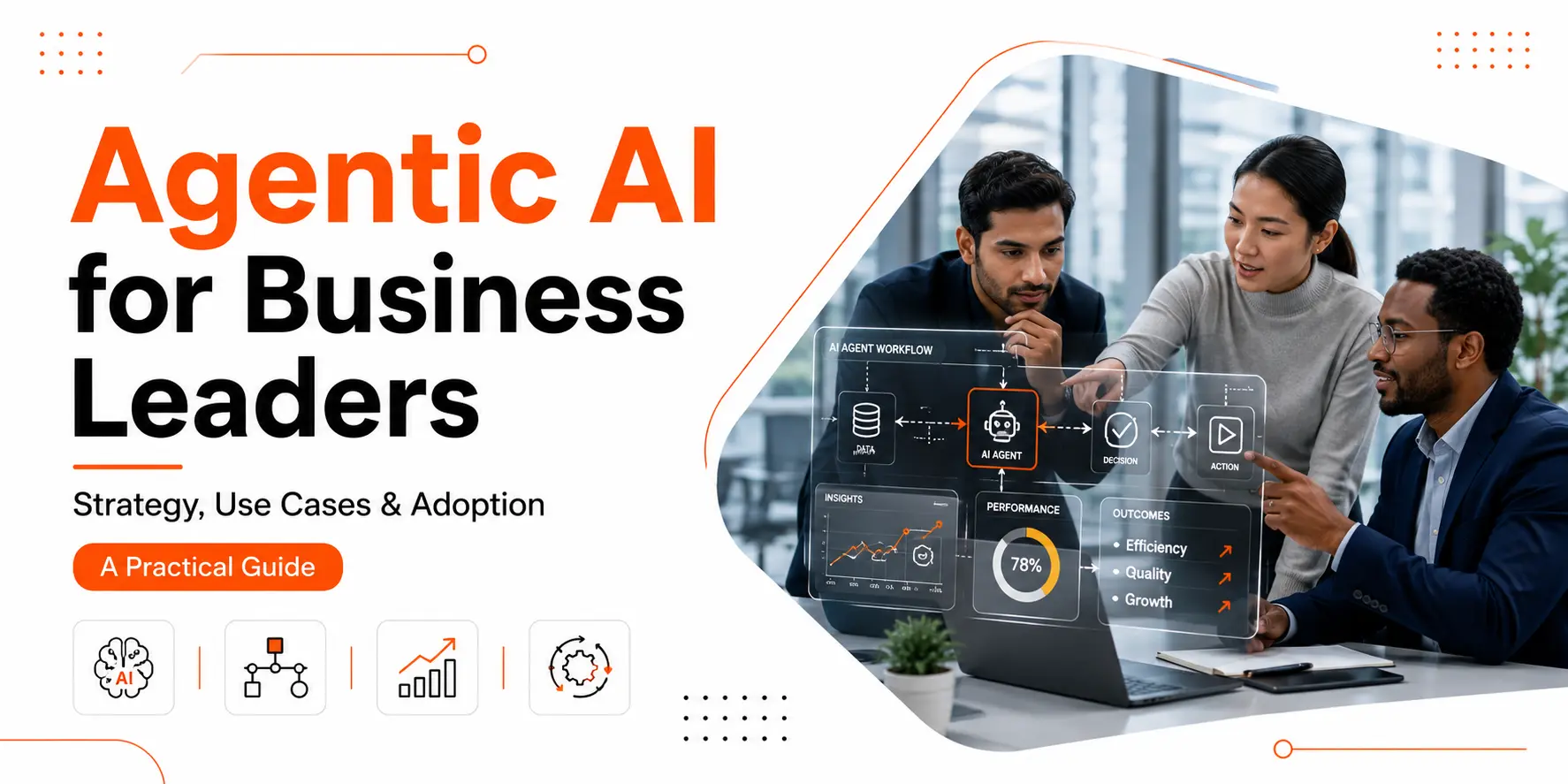
If you’ve spent any time in a leadership meeting this year, you’ve probably heard the term “agentic AI” thrown around at least once. Half the room nods like they get it. The other half quietly Googles it later. Honestly, that’s fair, because the term gets used loosely, and a lot of the marketing around it doesn’t help.
This guide is meant to clear that up. No hype, no buzzword soup. Just a straight explanation of what agentic AI actually is, how it’s different from the chatbots and automation tools you already know, and what it takes to actually build and deploy it in a real business. Whether you’re evaluating an AI automation agency, comparing an AI agent development company, or trying to figure out if agentic AI development services are worth the investment for your business, this article should give you a solid foundation to make that call.
What Is Agentic AI? (Quick Definition)
Agentic AI refers to AI systems that can plan, make decisions, and take multi-step actions toward a goal with little or no human input at each step. Unlike a chatbot that answers one question at a time, an agentic system can break down a task, choose tools, execute actions across systems, check its own results, and adjust its approach until the goal is met.
That’s the short version. Now let’s unpack what that actually means for a business.
Agentic AI vs. Traditional AI vs. Automation: What’s the Real Difference?
Traditional automation (think Zapier workflows or basic RPA bots) follows fixed rules: if X happens, do Y. It’s rigid but predictable. Traditional generative AI, like a standard chatbot, responds to a single prompt and stops. It doesn’t remember what it did five minutes ago unless you build that in separately, and it doesn’t take action in the real world on its own.
Agentic AI sits a level above both. It’s given a goal, not just a prompt, and it figures out the steps needed to get there. It can call APIs, query databases, send emails, update a CRM record, or hand off to another agent, all without someone manually approving every single move.
Here’s a table that breaks it down simply:
| Capability | Traditional Automation (RPA) | Standard AI Chatbot | Agentic AI |
| Follows fixed rules | Yes | No | No |
| Understands natural language | No | Yes | Yes |
| Plans multi-step tasks | No | No | Yes |
| Takes autonomous action | Limited | No | Yes |
| Learns and adjusts mid-task | No | No | Yes |
| Works across multiple tools/systems | Rarely | Rarely | Yes |
You’ll notice the jump isn’t just “smarter chatbot.” It’s a fundamentally different way of getting work done, closer to hiring a very fast, very literal junior employee than installing a new app.
How Does Agentic AI Actually Work?
Most agentic systems are built around a loop, not a single response. In most cases, the loop looks something like this:
- Goal input – A person or system gives the agent an objective, not just a question.
- Planning – The agent breaks the goal into smaller steps using a reasoning model.
- Tool selection – It decides which tools, APIs, or data sources it needs to complete each step.
- Execution – It carries out the action, whether that’s pulling data, writing code, sending a message, or updating a system.
- Evaluation – It checks whether the result actually matches the goal.
- Iteration – If something’s off, it adjusts and tries again, sometimes asking a human for input if it hits a wall.
That last step is the part people underestimate. The self-checking loop is what separates a real agentic system from a glorified script. From my experience talking with businesses exploring this, the companies that get burned are the ones that skip proper evaluation steps because they want faster deployment. That almost always backfires.
Why Are Business Leaders Paying Attention Now?
The short answer: the technology crossed a usability threshold in the last two years, and the ROI data started backing up the hype, at least in specific use cases.
According to Gartner, 40% of enterprise applications are expected to include task-specific AI agents by the end of 2026, up from less than 5% in 2025. That’s not a small jump. It reflects software vendors racing to bake agent capability directly into the tools businesses already use, from CRMs to ERPs to customer support platforms.
McKinsey’s 2025 State of AI survey found that 88% of organizations now use AI in at least one business function, and 23% are actively scaling agentic AI in at least one part of the business. The gap between those two numbers matters. It tells you most companies are still experimenting, not scaling, which is actually useful context if you’re worried you’re “behind.”
Deloitte’s 2026 State of AI in the Enterprise report, based on a survey of 3,235 leaders across 24 countries, found that 23% of enterprises currently use agentic AI at least moderately, but that figure is expected to jump to 74% within two years. One thing many businesses overlook here: the same report found only 21% of organizations have a mature governance model for these systems. That’s the part nobody puts in the sales deck.
Why does this matter for your business specifically? Because the same reports that show fast growth also show a wide gap between companies that treat agentic AI as a real operational shift versus a bolt-on feature. The winners aren’t the ones who adopted first. They’re the ones who redesigned how a process actually works before automating it.
What Business Problems Does Agentic AI Actually Solve?
This is where things get practical. Agentic AI tends to deliver the clearest value in workflows that are repetitive, rule-based at the core, but require judgment calls along the way. A few real-world categories:
Customer support and service resolution. Agents can handle account questions, order status, returns, and troubleshooting without a human touching every ticket. Gartner has projected agentic AI could autonomously resolve a large share of common customer service issues by 2029, cutting resolution costs meaningfully in the process.
Sales and marketing personalization. Instead of static email sequences, agents can adjust messaging and timing per customer based on behavior, in something closer to a real conversation than a drip campaign.
Back-office operations. Invoice processing, reconciliation, compliance checks, and data entry across disconnected systems are a natural fit, since these tasks are structured but still need exception handling.
Supply chain and inventory decisions. Agents can monitor stock levels, vendor lead times, and demand signals, then place or adjust orders without waiting on a person to notice a problem first.
Internal knowledge and IT support. Employees ask questions in plain language and the agent pulls from internal documentation, resets access, or escalates when it hits something it can’t resolve.
That’s where things change for a lot of leadership teams: once you see agentic AI applied to a specific, narrow, high-friction workflow, it stops feeling abstract and starts feeling like an obvious next step.
Is Agentic AI Actually Reliable Yet?
Short answer: it depends heavily on the use case and how well the system is governed, not on the technology alone. Reliability comes from tight scoping, human review at key checkpoints, and proper testing before full autonomy is granted, not from picking a “better” AI model.
This is the honest part of the conversation nobody selling AI wants to lead with. Gartner has predicted that more than 40% of agentic AI projects will be canceled before the end of 2027, largely due to unclear business value, ballooning costs, or inadequate risk controls, not because the underlying technology fails. Deloitte’s research points to a similar pattern: while adoption is accelerating fast, governance maturity is lagging noticeably behind.
The thing is, this isn’t really an argument against agentic AI. It’s an argument against rushing it. The businesses that succeed generally start with one well-defined process, run it with a human checking outputs, and only expand autonomy once the agent has proven itself over real volume. That’s a very different approach from “let’s automate everything by Q3.”
Agentic AI vs. Generative AI: A Quick Comparison
People mix these up constantly, so here’s a clean answer. Generative AI creates content, text, images, code, in response to a prompt, and then it’s done. Agentic AI uses generative capabilities as one component inside a larger system that plans, acts, checks its work, and pursues a goal across multiple steps, often without a person prompting each stage.
Put another way: generative AI answers a question. Agentic AI completes a task.
| Feature | Generative AI | Agentic AI |
| Primary function | Produces content or responses | Completes multi-step tasks |
| Human involvement | One prompt per output | Set goal once, agent runs the process |
| Memory across steps | Usually none | Maintains context through the task |
| Tool and system access | Limited or none | Connects to APIs, databases, apps |
| Example | Drafting a marketing email | Researching a lead, drafting the email, sending it, logging the response in the CRM |
What Does It Take to Build a Working Agentic AI System?
A lot of businesses assume this means buying a single tool off a shelf. In most cases, it’s closer to building a small, connected system with several parts working together:
A reasoning engine. Usually a large language model that handles planning and decision-making.
Tool and API integrations. Connections to the systems the agent actually needs to touch, your CRM, inventory database, email platform, payment processor, and so on.
Memory and context management. A way for the agent to remember what it already did in a task, and ideally across sessions, so it doesn’t repeat work or lose track of a multi-day process.
Guardrails and permissions. Clear boundaries around what the agent is allowed to do without approval, and what always requires a human to sign off.
Monitoring and evaluation. A way to track what the agent is doing, catch mistakes early, and measure whether it’s actually delivering value, not just activity.
This is exactly why working with a genuine agentic AI development company matters more than picking a trendy tool. Off-the-shelf agent products can handle narrow, well-defined tasks reasonably well. But most real business workflows are messier than the demo video suggests, and that’s usually where custom AI agent development earns its cost. A team that understands your specific systems, data structure, and compliance requirements builds something that survives contact with your actual operations, not just a sandbox environment.
Build In-House, Buy Off-the-Shelf, or Hire an Agency?
There’s no universally right answer here, but there is a reasonably clear way to think about it.
Building in-house makes sense if you already have a mature engineering team, sensitive proprietary workflows, and the patience to invest six months or more before seeing return. Off-the-shelf tools make sense for narrow, common use cases, like basic customer support deflection, where a vendor has already solved the problem for thousands of companies before you.
Working with an AI automation agency or specialized agentic AI services provider tends to make the most sense for businesses that want a system tailored to their actual operations, without carrying the full cost of an internal AI team. In most cases, this is where mid-size and growing businesses land, since they need something more capable than a generic tool but don’t have the internal bandwidth to build and maintain a custom system alone.
One thing worth asking any agency you’re evaluating: how do they handle the gap between pilot and production? Given that McKinsey’s research shows a large share of organizations stuck in experiment mode, this is genuinely the question that separates a good partner from one that will leave you with a nice-looking demo and nothing that survives real usage.
Common Mistakes Businesses Make With Agentic AI
Automating a broken process. If a workflow is messy or poorly defined today, adding an agent on top doesn’t fix that. It just makes the mess move faster.
Skipping governance until something goes wrong. Only about one in five companies currently have a mature governance model for autonomous agents, according to Deloitte’s research. Waiting until after deployment to build oversight is a costly way to learn this lesson.
Trying to automate everything at once. The businesses seeing real returns almost always started with one narrow, well-scoped use case, proved it out, then expanded.
Underestimating integration complexity. Agents are only as good as the systems they connect to. Legacy software, inconsistent data, and siloed departments create friction that no amount of clever prompting solves on its own.
Confusing activity with value. An agent that sends a hundred emails a day isn’t automatically valuable if none of them move the needle. Measuring actual business outcomes, not agent activity, is what separates a real deployment from a science project.
How Much Does Agentic AI Development Cost?
There’s no single number here, and anyone who gives you one without knowing your systems first is guessing. Costs generally scale with three things: how many systems the agent needs to connect to, how much custom logic and guardrail work the use case requires, and how much ongoing monitoring and retraining the workflow needs once it’s live.
A narrow, single-workflow agent connected to one or two existing tools is a meaningfully smaller project than a multi-agent system coordinating across your entire order-to-cash process. This is another reason a proper discovery conversation with an agentic AI development company matters more than a quoted price on a website. The scoping conversation itself usually reveals whether the project is realistic in the timeframe and budget a business has in mind.
Getting Started: A Practical First Step
If you’re a business leader trying to figure out where to begin, don’t start with the technology. Start with the process. Pick one workflow that’s repetitive, costly, and has clear success criteria, something like ticket triage, order reconciliation, or lead qualification. Map out exactly what a good outcome looks like today. Then bring that specific problem to a team that builds custom AI agent development solutions and ask them to show you, concretely, how an agent would handle it end to end, including what happens when it gets something wrong.
That last part matters more than most demos let on. Any vendor can show you the happy path. The ones worth trusting will walk you through the failure path too.
Final Thoughts
Agentic AI isn’t magic, and it isn’t hype either. It’s a genuine shift in how software can handle work, provided it’s scoped carefully and built by people who understand both the technology and your actual operations. The businesses pulling ahead right now aren’t necessarily the ones who moved fastest. They’re the ones who picked the right first problem, built proper oversight in from day one, and treated this as an operational change, not just a tech purchase.
If you’re evaluating agentic AI development services for your business, the best next step isn’t picking a vendor off a search results page. It’s having a real conversation about one specific process you want to fix, and seeing how a team responds when you ask them what happens when the agent gets it wrong.