
Key takeaways
- Agentic commerce is shopping where an AI agent researches, compares and, with permission, buys on a person’s behalf.
- Discovery has already moved into AI assistants. Adobe data shows AI traffic to US retail sites grew 393% year over year in Q1 2026 and converted 42% better than other channels.
- Full autonomy is still rare. In Accenture’s January 2026 survey, 74% of consumers would let an agent handle routine tasks, but only 9% were open to fully autonomous purchases.
- Four protocol families now carry agent shopping: MCP for tools, UCP and ACP for commerce flows, and AP2 plus card-network programs for payments.
- Retailers that publish clean, structured product data and expose agent-ready checkout will capture this demand first.
What is agentic commerce?
Agentic commerce is a model of online shopping in which autonomous AI agents carry out steps of the purchase journey for a user, from finding products to placing the order. The human sets the goal and the limits (budget, brand, delivery date) and the agent does the legwork, returning for approval when the rules require it.
This differs from a chatbot on a product page. A chatbot answers questions about one store. A shopping agent works across stores, holds the shopper’s preferences, compares offers and can complete a transaction through a standard protocol instead of filling in a web form.
The five stages AI agents are taking over
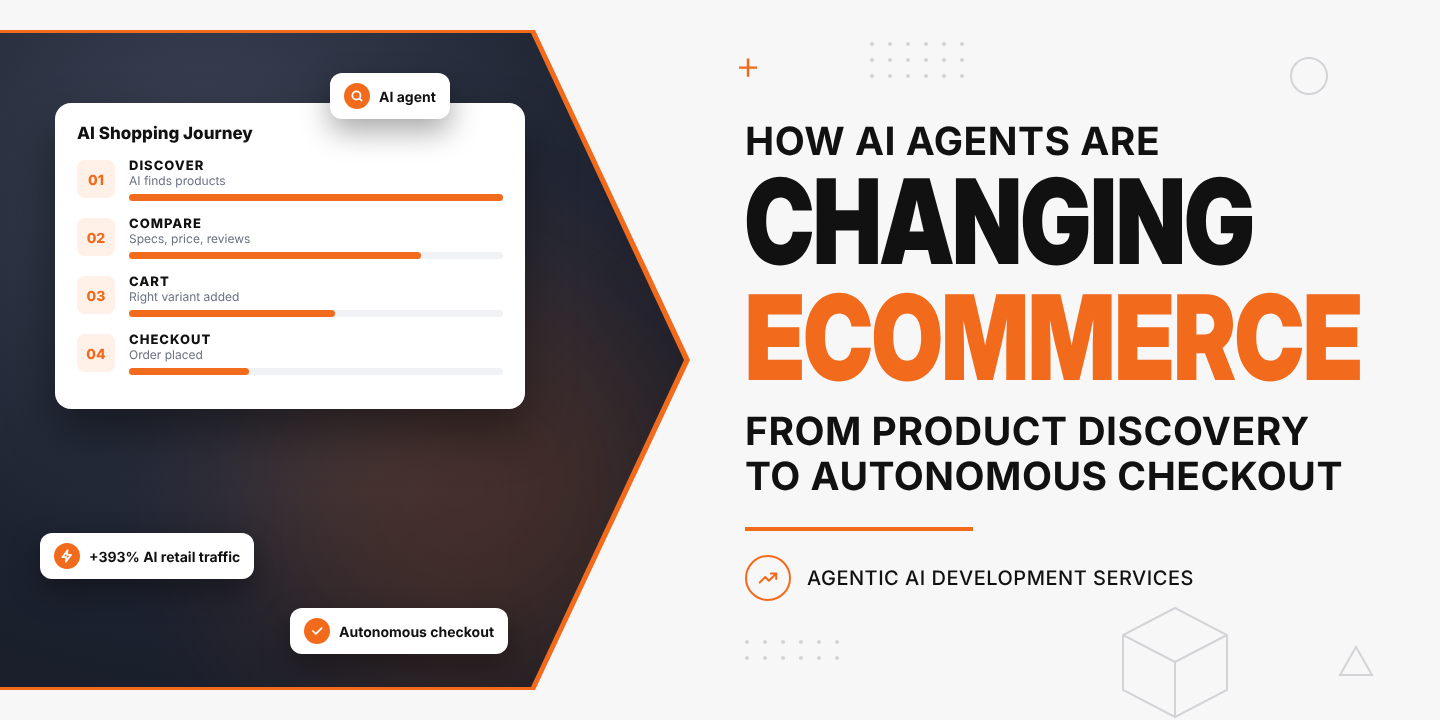
1. Product discovery
Shoppers now open ChatGPT, Gemini, Copilot or Perplexity before they open a retailer’s site. They describe a need in full sentences, and the agent turns it into a shortlist. For merchants, ranking here depends on structured product data and trusted third-party mentions more than on ad spend.
2. Comparison and evaluation
Agents read specs, reviews, return policies and shipping times across retailers in seconds. A January 2026 Clutch survey found that 65% of consumers trust AI to compare prices, far more than trust it to buy.
3. Personalization
Agents remember sizes, preferences and past purchases. A request such as “reorder my usual coffee, but try the decaf version” becomes one message instead of five page loads.
4. Cart building
Through platform servers such as BigCommerce Storefront MCP and Shopify’s Catalog and UCP tools, agents can add the right variant to a real cart on the merchant’s store. Our BigCommerce and Shopify development teams connect stores to both.
5. Checkout and payment
This is the newest and least mature stage. Agents either hand the shopper a checkout link or complete payment inside the conversation using an agent payments protocol and a tokenized card.
How far has autonomous checkout really come?
The numbers show strong discovery and cautious buying.
| Signal | Figure | Source |
| AI traffic growth to US retail sites, Q1 2026 | +393% year over year | Adobe Analytics |
| Conversion of AI traffic vs. non-AI, Q1 2026 | 42% better | Adobe Analytics |
| Consumers who would let an agent handle routine tasks | 74% | Accenture, Jan 2026 |
| Consumers open to fully autonomous purchases | 9% | Accenture, Jan 2026 |
| US agentic commerce forecast, 2030 | $300B to $500B | Bain |
| Enterprise apps embedding AI agents by 2026 | 40% | Gartner |
The market also corrected course. OpenAI launched Instant Checkout in ChatGPT in September 2025 on the Agentic Commerce Protocol, then in March 2026 handed checkout back to merchants and shifted toward a discovery-first model. The lesson for retailers: agents will drive the visit and the decision, while your own checkout stays the place the money moves, at least for now. That is why conversion rate optimization on the checkout page matters more in 2026.
The protocols behind AI shopping agents
Agent shopping needs shared rules so any agent can talk to any store. These are the standards worth knowing in 2026:
| Protocol | Backers | What it does |
| Model Context Protocol (MCP) | Anthropic, now industry-wide | Lets agents discover and call tools, such as a store’s search and cart functions |
| Universal Commerce Protocol (UCP) | Google and Shopify, announced January 11, 2026 | Covers the commerce journey from catalog and cart to checkout; payment-processor agnostic |
| Agentic Commerce Protocol (ACP) | OpenAI and Stripe, September 2025 | Checkout sessions and secure payment handoff for ChatGPT and compatible agents |
| Agent Payments Protocol (AP2) | Google with 60+ partner organizations | Authorizes and processes payments that agents initiate |
| Visa Intelligent Commerce / Mastercard Agent Pay | Card networks | Tokenized credentials and trust signals for agent-initiated payments |
Sources: Shopify’s UCP announcement and public announcements from Google, OpenAI, Stripe, Visa and Mastercard.
You do not need to implement every protocol yourself. Shopify abstracts UCP and ACP through Agentic Storefronts, and BigCommerce exposes Storefront MCP plus Feedonomics feeds to AI channels. WooCommerce, Magento and headless stacks need a developer to wire them in.
What this means for US retailers and brands
Your product data is your new storefront
An agent cannot admire your hero banner. It reads attributes. Complete specs, clear variant names, accurate stock and honest return terms decide whether you make the shortlist.
Third-party trust carries more weight
Agents cross-check reviews, marketplaces and editorial mentions. Thin review profiles and inconsistent pricing across channels push you down the list. Our SEO services and content marketing teams help build the footprint AI assistants look for.
Checkout speed decides the last mile
When an agent hands a shopper to your checkout, the shopper arrives ready to buy. A slow or cluttered page wastes that intent. Our conversion rate optimization service focuses on that handoff.
Your own agent can be a channel
Brands are building their own shopping assistants for guided selling, reorders, B2B quoting and post-purchase support. These agents use your data and your rules, and they keep the customer relationship with you.
Practical use cases you can build in 2026
- Guided-selling agent that asks three to five questions and builds a cart from your catalog.
- Reorder agent for consumables and B2B supplies, triggered by usage or schedule.
- B2B quote agent that drafts quotes from a buyer’s shopping list, inside approval limits.
- Customer service agent that tracks orders, starts returns and offers exchanges.
- Merchandising agent that flags low-stock bestsellers and drafts promotions for human review.
- Catalog enrichment agent that fills missing attributes so external AI agents can match your products.
Each of these is a custom AI agent development project: prompts, tools, data connections, guardrails, evaluation and monitoring. Our AI workflow automation practice handles the back-office side.
How to choose an AI agent development company
The market is full of agencies that wrap a chatbot and call it an agent. When you evaluate an AI agent development company or AI automation agency, check for:
- Commerce platform depth. Can they work inside Shopify, BigCommerce, WooCommerce, Magento and headless stacks, not only call an LLM API?
- Protocol fluency. Do they know MCP, UCP and ACP well enough to tell you which ones matter for your channels?
- Guardrails and evaluation. How do they test for wrong answers, out-of-stock recommendations and spending-limit breaches?
- Data work. Will they clean and enrich your catalog, or expect it to be ready?
- Measurement. Can they attribute revenue to agent sessions?
DIT Interactive is an agentic AI development company with offices in Iselin, New Jersey; London; and Ahmedabad. We pair agentic AI development services with certified Shopify and BigCommerce development, so the agent and the store are built by the same team. Read more on custom AI agent development benefits and process.
Planning your first shopping agent? Talk to our agentic AI services team for a scoped roadmap, or hire dedicated AI and ecommerce developers.