
If you have spent any time this year in a boardroom, a Slack thread, or a LinkedIn feed, you have probably run into the phrase “agentic AI” more times than you can count. Everyone is talking about it. Fewer people can actually explain how it works, and even fewer can tell you what it takes to build one that survives contact with a real business.
Honestly, that is the gap I keep running into with clients. Business owners come to an AI automation agency wanting “an AI agent” the way they might ask for a new website. But an agent is not a page you publish. It is a system that observes, reasons, decides, and acts, often across multiple tools, without a human clicking every button along the way. Understanding the architecture behind that is the difference between hiring a vendor who ships a chatbot with a new name, and one who builds something that actually runs your operations.
This piece walks through what is really happening under the hood of agentic AI development: the architecture, the planning layer, the execution loop, and the practical decisions that separate agents that work from the 40% of projects Gartner expects to get cancelled by the end of 2027 because of unclear value or weak governance.
What Agentic AI Actually Means
Agentic AI refers to AI systems that can independently plan, make decisions, and execute multi-step tasks toward a goal, using tools and data sources, with limited ongoing human input. Unlike a standard chatbot that responds to one prompt at a time, an agent breaks a goal into subtasks, decides which tools to use for each one, and keeps working until the objective is met or it needs human input.
The thing is, most people use “AI agent” and “chatbot” interchangeably, and that is where expectations go sideways. A chatbot answers questions. An agent takes action. If you ask a chatbot to “find late invoices and follow up with vendors,” it will tell you how it would do that. An agent will actually query your accounting system, draft the follow-up emails, and send them, then log what happened.
This distinction matters because it changes what you are actually buying when you hire a custom AI agent development partner. You are not buying a smarter FAQ widget. You are buying a decision-making system that touches your real business processes.
Agentic AI vs. Traditional Automation vs. Generative AI
| Capability | Traditional Automation (RPA) | Generative AI (Chatbots) | Agentic AI |
| Follows fixed rules | Yes | No | Sometimes |
| Understands natural language | No | Yes | Yes |
| Makes multi-step decisions | No | No | Yes |
| Chooses which tools to use | No | No | Yes |
| Adapts when a step fails | No | No | Yes |
| Works without step-by-step prompts | No | No | Yes |
You’ll notice traditional automation is great at repetitive, rule-based work but breaks the moment something unexpected happens. Generative AI is great at language but stops at the conversation. Agentic AI sits above both, using language understanding to decide, then automation to act.
The Core Architecture Behind an AI Agent
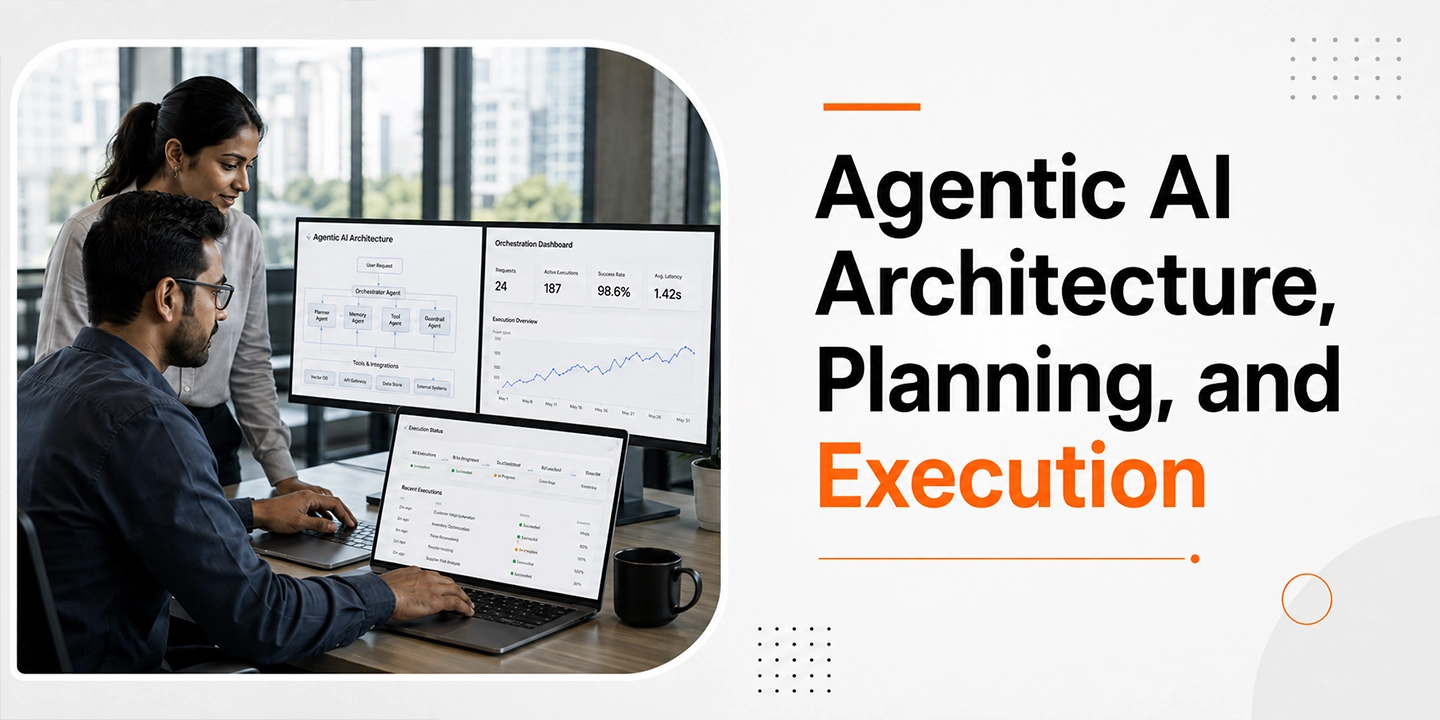
An AI agent is not one model doing everything. It is a stack of components working together. From my experience scoping these projects with clients, the architecture generally breaks down into five layers.
1. The Reasoning Engine (the “Brain”)
This is the large language model at the center of the system, typically a frontier model from a provider like Anthropic, OpenAI, or Google. Its job is not to know everything. Its job is to reason about what to do next given the current situation, the goal, and the tools it has access to.
One thing many businesses overlook here: the model is not the product. The reasoning engine is genuinely a commodity layer that gets swapped out as better models release. What actually makes an agent valuable is everything wrapped around that model, which is where a serious AI agent development company spends most of its engineering time.
2. The Memory Layer
Agents need memory to be useful across more than a single interaction. This typically splits into:
- Short-term memory: the current conversation or task context, held in the active session
- Long-term memory: facts, preferences, and history stored in a vector database or structured database that the agent can retrieve later
- Episodic memory: records of past actions and their outcomes, used to avoid repeating mistakes
Without memory, an agent re-learns your business every time you talk to it. That is not agentic behavior, that is a search engine with a friendlier voice.
3. The Tool and Action Layer
This is where the agent actually does things. Tools are functions the agent can call: sending an email, updating a CRM record, running a SQL query, placing an order, generating a report. In most cases, this layer connects through APIs, and increasingly through standardized protocols like Model Context Protocol (MCP), which lets an agent talk to many different systems in a consistent way rather than needing custom integration code for each one.
If the reasoning engine is the brain, the tool layer is the hands. An agent with a brilliant model and no tools can only talk. An agent with well-built tools can act.
4. The Planning and Orchestration Layer
This layer decides the sequence of steps needed to reach a goal, and coordinates which sub-agent or tool handles each step. In more advanced systems, this is where you see multi-agent orchestration: a planner agent breaks work into subtasks, and specialist agents (a research agent, a data agent, a writing agent) each handle their piece before results get combined.
That’s where things change from a simple automation into something genuinely agentic. The system is not following a fixed script. It is deciding, in real time, what the script should be.
5. The Guardrail and Governance Layer
This is the layer most vendors underinvest in, and it is the one that actually determines whether a business will trust the agent with real work. Guardrails include permission boundaries (what the agent is allowed to touch), approval checkpoints (when a human needs to sign off before an action executes), audit logging, and fallback behavior for when the agent is uncertain.
According to <a href=”https://www.gartner.com/en/articles/hype-cycle-for-agentic-ai” target=”_blank” rel=”noopener”>Gartner’s 2026 Hype Cycle for Agentic AI</a>, governance, security, and cost-focused capabilities have emerged as their own category alongside core agent technology, which tells you something important: the industry itself now recognizes that intelligence without governance does not scale.
How the Planning Process Actually Works
Agentic AI planning works by decomposing a goal into a sequence of smaller, achievable subtasks, then continuously re-evaluating that plan as new information comes in from tool calls or the environment. This is fundamentally different from a fixed workflow because the plan itself can change mid-execution if a step fails or new data changes the picture.
Let’s walk through a real example. Say an ecommerce brand wants an agent to handle abandoned cart recovery end to end, not just send a templated email.
Step 1: Goal interpretation. The agent receives the objective: recover as much abandoned cart revenue as possible without discounting margin-sensitive products.
Step 2: Task decomposition. It breaks this into subtasks: identify abandoned carts from the last 24 hours, segment by customer value and product margin, decide messaging and incentive tier per segment, draft and send communications, track conversion, and report results.
Step 3: Tool selection. For each subtask, the agent chooses tools. Pulling cart data might mean querying Shopify’s API. Segmenting customers might mean querying a customer data platform. Drafting messages uses the language model directly. Sending uses an email or SMS platform’s API.
Step 4: Execution with monitoring. The agent executes each step, checking outcomes as it goes. If the email API returns an error, a genuinely agentic system does not just fail silently. It retries, tries an alternate channel, or flags the exception for a human.
Step 5: Reflection and adjustment. After execution, the agent evaluates results against the goal. If recovery rates on a segment were low, a more advanced system adjusts its approach on the next cycle rather than repeating the same failed tactic.
That reflection step is honestly the part that separates a genuinely agentic system from dressed-up automation. Static workflows do not learn from their own outcomes. Agents, when built correctly, do.
The Execution Loop: Perceive, Reason, Act, Reflect
Most production-grade agents run on some version of a loop that researchers commonly describe with four stages, sometimes shortened to the ReAct pattern (Reason plus Act):
- Perceive: gather current information from the environment, whether that’s a database, an inbox, a support ticket queue, or a live API response
- Reason: the model evaluates the situation against the goal and decides the next action
- Act: the agent calls a tool or takes an action in the real world
- Reflect: the agent evaluates whether the action moved it closer to the goal, then loops back to perceive again
This loop repeats until the goal is met, a limit is reached, or the agent needs a human. In my experience, the businesses that get the most value from agentic systems are the ones that accept this loop needs checkpoints. A fully autonomous loop with no human touchpoint sounds appealing in a sales pitch, but in production, most companies want approval gates on anything involving money, customer communication at scale, or irreversible actions.
Why This Matters for US Businesses Right Now
The market data backs up why this conversation is happening now rather than two years from now. According to a widely cited <a href=”https://www.gartner.com/en/articles/hype-cycle-for-agentic-ai” target=”_blank” rel=”noopener”>Gartner analysis</a>, only 17% of organizations have deployed AI agents to date, yet more than 60% expect to do so within the next two years, which Gartner describes as the most aggressive adoption curve among all the emerging technologies it tracks. That is a narrow window where being an early, competent mover actually means something competitively.
McKinsey’s research tells a similarly split story. 88% of organizations report regular AI use in at least one business function, up from 78% the year before, but a much smaller share, around 23%, have actually scaled an agentic AI system into production. In the US specifically, the appetite is even sharper: 93% of US IT executives at companies with more than a billion dollars in revenue say they are extremely or very interested in exploring agentic AI, and 37% say they are already using it.
That gap between interest and production is not a small detail. It is basically the whole story. Plenty of companies are experimenting. Far fewer have built something that survives real operating conditions. Gartner has gone as far as predicting that more than 40% of agentic AI projects will be cancelled by the end of 2027, usually not because the technology failed but because the business value was unclear or the risk controls were inadequate from the start.
That is exactly why the planning and governance layers described earlier are not academic details. They are the difference between landing in the 23% that scales successfully and the 40% that gets shelved.
What to Look for in an Agentic AI Development Partner
If you are evaluating agentic AI development services in USA, the sales conversation will sound similar across vendors. The differences show up in how they answer a handful of specific questions.
Do they start with a business process or a technology demo? A partner worth hiring will ask about your actual workflow bottlenecks before mentioning a single model name. If the first meeting is a flashy demo with no discovery about your operations, that is a signal.
How do they handle failure states? Ask directly what happens when the agent cannot complete a task, when an API is down, or when it is uncertain. If the answer is vague, the guardrail layer probably has not been built out.
What does the memory and data architecture look like? An agent that cannot retain context about your customers, your pricing rules, or your past decisions will feel impressive in a demo and frustrating in production.
Can they show integration experience with your actual stack? Whether that is Shopify, NetSuite, Salesforce, or a custom internal system, real integration work is where most of the engineering time and cost actually goes, far more than prompt writing.
Do they talk about ROI measurement upfront? One thing many businesses overlook until it is too late: agreeing in advance what success looks like, and how it will be measured, changes the entire project. Teams that deploy agents with a clear ROI metric from day one are consistently the ones who avoid becoming part of that 40% cancellation statistic.
Common Use Cases Where Agentic AI Is Already Working
In most cases, the businesses seeing real returns are not trying to automate everything at once. They are picking bounded, well-defined processes first. Some of the patterns showing up consistently across ecommerce and mid-market businesses right now:
- Customer support triage and resolution, where an agent handles routine tickets end to end and escalates complex cases with full context already gathered
- Inventory and reorder management, where an agent monitors stock levels across channels and initiates purchase orders within pre-set budget rules
- Sales development and lead qualification, where an agent researches inbound leads, scores them, and drafts personalized outreach before a human sales rep engages
- Financial operations, including invoice matching, expense categorization, and flagging anomalies for review
- Content and SEO operations, where an agent researches topics, drafts content briefs, and tracks performance against keyword targets
Notice that every one of these has a clear boundary and a measurable outcome. That is not a coincidence. The agents that survive past the pilot stage are almost always the ones scoped narrowly enough to prove value fast.
Build, Buy, or Partner: How to Approach Custom AI Agent Development
There are really three paths a business can take, and each comes with real tradeoffs.
Building in-house makes sense if you already have a mature engineering team and the process you’re automating is deeply specific to your competitive advantage. It is the slowest and most expensive path upfront, but it gives you full control and no ongoing vendor dependency.
Buying an off-the-shelf agent product works well for common, well-understood processes like customer support or basic sales outreach, where a platform like Salesforce’s Agentforce or a similar vendor has already solved the general case. It is fast and cheap to start, but you inherit the limitations of whatever the platform decided to support.
Partnering with a specialized development team, whether that is a boutique AI automation agency or a broader systems integrator, is usually the right middle path for businesses with process-specific needs that off-the-shelf tools don’t cover, but who don’t have the internal bandwidth to build and maintain the system themselves. This is where most mid-market and growing ecommerce businesses in the USA end up landing, because it balances speed, customization, and ongoing support without requiring a full internal AI team.
There is no universally right answer here. It genuinely depends on how differentiated the process is to your business and how much internal capacity you have to maintain a system after launch.
A Realistic Timeline for Agentic AI Development
People often ask how long this actually takes. Here’s a straightforward breakdown based on typical project scopes:
| Phase | Typical Duration | What Happens |
| Discovery and process mapping | 1 to 3 weeks | Identifying the target workflow, data sources, and success metrics |
| Architecture and tool design | 2 to 4 weeks | Defining the reasoning engine, memory layer, integrations, and guardrails |
| Build and integration | 4 to 10 weeks | Connecting APIs, building the planning logic, developing the tool layer |
| Testing and guardrail validation | 2 to 4 weeks | Stress-testing failure states, edge cases, and permission boundaries |
| Pilot deployment | 2 to 6 weeks | Running in a limited environment with human oversight before full rollout |
Total timelines usually land somewhere between three and six months for a well-scoped single-process agent, though this varies significantly based on how many systems it needs to integrate with and how much historical data needs to be cleaned or structured first.
Where This Is Heading
Gartner’s forecast puts real numbers on the trajectory: by 2028, at least 15% of day-to-day work decisions are expected to be made autonomously through agentic AI, up from effectively zero in 2024, and by the same year 33% of enterprise software applications are projected to include agentic AI capability, up from less than 1% in 2024. Whether or not those exact figures land precisely, the direction is not really in question.
The businesses that come out ahead in this shift are not necessarily the ones with the biggest AI budgets. Based on what the data and my own client work both show, the organizations pulling ahead are the ones treating governance, integration quality, and clear success metrics as foundational rather than an afterthought bolted on after the demo looks good.
If you are evaluating whether to bring agentic AI into your business, the honest advice is to start with one well-bounded process, measure it rigorously, and expand from there. That is a far more reliable path than trying to automate everything at once and hoping the architecture holds together.
A Final Thought
Agentic AI is genuinely one of the more consequential shifts in business software in recent memory, but the hype cycle around it has made it harder, not easier, to evaluate honestly. The architecture matters. The planning layer matters. The guardrails matter more than most vendors will tell you upfront. If you strip away the marketing language, what you are really deciding is whether to trust a system with a piece of your operations, and that decision deserves the same scrutiny you’d give to hiring a key employee, not just a software subscription.