Best BigCommerce Development Agencies in the UK for Enterprise Ecommerce Growth in 2026

The ecommerce space is now in a stage where there is a need for much more than just having a website. There are enterprise brands that will need an ecommerce solution that can handle massive product cataloging, growing consumer expectations, integration, and more.

BigCommerce has emerged as one of the most preferred solutions when it comes to finding the ideal ecommerce platform that is capable of scaling up and allowing for flexibility and growth. With commerce capabilities built-in, BigCommerce makes it easy for brands to create great buying experiences and easier store management.

Choosing a reputable agency to partner with for developing the ideal store is also critical in helping businesses succeed. The best agencies will ensure that the developed stores are scalable, fast, user-friendly, and security-compliant.

There are numerous ecommerce agencies in the UK that help business owners create successful BigCommerce stores.

These are the leading BigCommerce development agencies in the UK.

1. DIT Interactive

DIT Interactive is an interactive digital commerce agency offering assistance to companies to design and develop scalable and high-performance ecommerce stores. The agency partners with brands seeking to develop their ecommerce presence through creative development, design, and use of technology.

The range of services offered by DIT Interactive include ecommerce development, custom ecommerce websites, UX/UI optimization, integrations and ecommerce store optimization among others. The agency focuses on creating high performance, visually attractive, and business oriented ecommerce experiences for businesses.

For any businesses interested in getting professional BigCommerce website design and development in UK, DIT Interactive assists them to build flexible and scalable ecommerce platforms.

Why Choose DIT Interactive?

DIT Interactive recognizes that enterprise ecommerce needs more than just an ordinary website. Enterprises need robust technical setups, smooth customer experience, and solutions that will grow alongside their needs.

Their strong points are:

  • Ecommerce solutions customized according to company objectives
  • Performance and customer experience-driven approach
  • Scalable development process
  • Up-to-date design and technology trends
  • Handling complex ecommerce cases

Companies looking for BigCommerce developers in UK can collaborate with DIT Interactive to develop ecommerce experiences that will be robust and scalable.

2. Magneto IT Solutions

Magneto IT Solutions aids businesses in crafting and refining their digital commerce experiences by way of technical solutions.

They offer a range of services like ecommerce consultation, development, migration, and optimization. The company’s expertise in handling enterprise-scale projects allows brands to set up stores that are ready for the future demands of customers.

Magneto specializes in blending technological insights and ecommerce strategy to craft a platform that works effectively.

3. W3nuts

W3nuts is an agency in digital development, assisting organizations in developing ecommerce capabilities using technological innovations.

These innovations include development, customization, and digital enhancements that assist companies in creating smooth ecommerce experiences for their customers.

This includes the areas of usability, functionality, and performance, allowing companies to develop ecommerce stores that are easier to manage and can be expanded.

4. Fixnhour

Fixnhour offers ecommerce development and technology services to businesses that aim to enhance their digital processes.

The firm assists brands in ecommerce development, customization, and making technical changes. Fixnhour’s technology solutions enable businesses to operate smoothly while catering to their changing needs.

The firm aims to develop ecommerce solutions that are practical and enhance the performance of online stores.

5. RAK Design

RAK Design is an Internet-based agency specializing in developing interesting web and e-commerce solutions.

RAK Design merges creativity and development skills in order to provide brands with a platform that would reflect their identity and engage potential clients.

RAK Design assists organizations seeking to develop attractive e-commerce sites with enhanced usability and client-oriented experience.

Why Businesses Choose BigCommerce for Enterprise Ecommerce Growth

Business ecommerce demands an architecture that will support growth and scalability without any complications. BigCommerce offers companies the means to do that through their flexible architecture.

Among the main advantages of this platform are:

  • Scalable ecommerce infrastructure
  • Solid security mechanisms
  • Customizable architecture
  • Easily integrated third-party solutions
  • Both B2B and B2C sales support

With the help of a competent development company, companies can build robust ecommerce ecosystems on BigCommerce rather than plain ecommerce shops.

What to Look for in a BigCommerce Development Agency?

Choosing the right ecommerce partner can directly impact the success of an online business. A reliable agency should understand both technical requirements and business objectives.

Experience With Ecommerce Projects

A strong agency should have experience working with ecommerce platforms, integrations, and complex business requirements.

Companies searching for a trusted BigCommerce development agency in UK should consider agencies that understand enterprise challenges and customer expectations.

Design and User Experience Skills

A successful ecommerce store should be easy to navigate, visually appealing, and optimized for conversions.

Professional BigCommerce design services in UK help businesses create storefronts that provide better customer engagement and improve the shopping experience.

Long-Term Support

Launching an ecommerce store is only the beginning. Continuous improvements, updates, and optimization are important to maintain performance and competitiveness.

The Future of Enterprise Ecommerce With BigCommerce

In addition to growing, ecommerce businesses are required to use solutions that could handle evolving customer needs and market trends. Enterprise brands do not require only traditional online shops; they seek flexible ecommerce systems that allow personalization and automation and guarantee smooth user experience.

BigCommerce is a powerful solution that could serve as a basis for any business willing to grow while avoiding excessive technical challenges. In case of proper strategy, brands are capable of optimizing website performance, improving business operations, and offering better experiences to customers.

The cooperation with a competent BigCommerce development companies makes it possible for businesses to achieve great results thanks to custom development, integration, and optimization.

These are the agencies that help businesses in building ecommerce systems of the future.

In 2026, the ability of successful ecommerce growth will depend on the choice of the right platform, strategy, and development company.

Shopify Development Process: From Planning to Launch for Growing Brands

Introduction

Launching an ecommerce store is easier today than it was a decade ago. Building a store that can support growth, deliver a strong customer experience, and generate consistent revenue is a different challenge altogether.

This is where understanding the Shopify Development Process becomes important.

Many business owners assume Shopify development simply means choosing a theme, adding products, and launching a website. In reality, successful Shopify store development involves strategic planning, user experience design, technical implementation, integrations, testing, and post-launch improvements.

According to Shopify, millions of businesses worldwide use Shopify to power their online stores. The platform continues to grow because it provides flexibility for startups, direct-to-consumer brands, wholesalers, and enterprise businesses.

For growing brands in the USA, a structured Shopify development process helps avoid costly mistakes, launch faster, and create a better shopping experience from day one.

In this Shopify website development guide, we’ll walk through every stage of the Shopify store development process, from planning and strategy to launch and ongoing growth.

What Is the Shopify Development Process?

Quick Answer

The Shopify Development Process is the step-by-step approach used to plan, design, build, test, launch, and improve a Shopify store. It ensures the store meets business goals, provides a smooth customer experience, and supports long-term growth.

A typical Shopify development process includes:

  1. Business discovery and planning
  2. Requirements gathering
  3. Store architecture planning
  4. UX and UI design
  5. Shopify theme development
  6. Store configuration
  7. Third-party integrations
  8. Product and content migration
  9. Testing and quality assurance
  10. Store launch
  11. Post-launch support and growth

Following these stages helps businesses avoid rushed launches and technical issues that can impact conversions.

Why Planning Matters Before Shopify Development Begins

Many ecommerce projects fail before development even starts.

The reason is simple. Businesses jump directly into design and development without understanding their goals, audience, and operational requirements.

From my experience, one thing many businesses overlook is that ecommerce success starts with strategy, not technology.

Before any Shopify development work begins, brands should answer questions such as:

  • Who is the target customer?
  • What products will be sold?
  • What makes the brand different?
  • What integrations are required?
  • What fulfillment process will be used?
  • How many products need migration?
  • What growth goals exist for the next three years?

Answering these questions early creates a roadmap that guides every development decision.

Phase 1: Discovery and Business Planning

Quick Answer

Discovery is the foundation of the Shopify store development process. During this stage, businesses define objectives, customer profiles, technical requirements, and growth goals.

The discovery phase typically includes:

  • Stakeholder interviews
  • Business analysis
  • Competitor research
  • Customer analysis
  • Technical planning
  • Project scope definition

Understanding Business Goals

Every Shopify project should begin with measurable objectives.

Examples include:

Business Goal Measurement
Increase online sales Revenue growth
Expand into new markets Geographic sales
Improve conversion rates Conversion percentage
Reduce operational work Automation improvements
Increase average order value AOV growth

Clear objectives help development teams prioritize features that actually contribute to business growth.

Competitor Analysis

Studying competitors reveals opportunities and gaps.

Areas to evaluate include:

  • Navigation structure
  • Product presentation
  • Checkout experience
  • Mobile usability
  • Content strategy
  • Loyalty programs
  • Subscription offerings

The goal is not copying competitors. It’s identifying opportunities to provide a better customer experience.

Customer Research

Understanding customer behavior influences:

  • Navigation structure
  • Product organization
  • Search functionality
  • Content placement
  • Checkout experience

According to Baymard Institute, ecommerce usability issues continue to contribute significantly to cart abandonment. Understanding user behavior early helps reduce friction during the buying journey.

Phase 2: Shopify Store Architecture Planning

Quick Answer

Store architecture planning defines how products, categories, navigation, collections, filters, and content will be organized throughout the Shopify store.

A strong architecture improves:

  • User experience
  • Search visibility
  • Product discovery
  • Conversion rates

Product Structure Planning

Before development starts, products should be organized logically.

Example:

Fashion Brand

  • Men’s Clothing
  • Women’s Clothing
  • Accessories
  • New Arrivals
  • Best Sellers

Electronics Store

  • Laptops
  • Smartphones
  • Accessories
  • Gaming
  • Business Devices

A clear structure makes it easier for customers to find products quickly.

Collection Strategy

Collections play a major role in Shopify organization.

Types include:

Manual Collections

Curated by store administrators.

Examples:

  • Holiday Promotions
  • Featured Products
  • Staff Picks

Automated Collections

Generated using predefined conditions.

Examples:

  • Products Under $100
  • New Arrivals
  • Best Sellers

Automated collections save significant management time as catalogs grow.

URL and SEO Planning

SEO should begin before development.

Planning includes:

  • URL structure
  • Collection hierarchy
  • Product naming conventions
  • Category structure
  • Internal linking strategy

This approach prevents future restructuring that can affect search visibility.

Phase 3: UX and UI Design

Quick Answer

UX design focuses on usability and customer journeys, while UI design focuses on the visual appearance of the Shopify store.

Both directly impact customer engagement and conversions.

Why UX Matters

A visually attractive store is not enough.

Customers must be able to:

  • Find products quickly
  • Compare options easily
  • Complete purchases without confusion

The thing is, even small usability issues can reduce sales.

Research published by Baymard Institute regularly highlights checkout and navigation challenges as major contributors to abandoned purchases.

Key UX Elements

Homepage Design

The homepage should answer:

  • Who are you?
  • What do you sell?
  • Why should customers buy?

Navigation Design

Good navigation includes:

  • Clear categories
  • Search functionality
  • Mobile-friendly menus
  • Logical organization

Product Pages

High-converting product pages typically include:

  • Professional images
  • Product videos
  • Reviews
  • Product specifications
  • FAQs
  • Shipping information

Cart Experience

The shopping cart should make checkout simple and transparent.

Important elements include:

  • Shipping estimates
  • Coupon support
  • Cross-sell products
  • Trust indicators

Mobile-First Design

Mobile commerce continues to dominate ecommerce growth.

According to Statista, mobile commerce accounts for a significant share of global ecommerce sales and continues growing each year.

For Shopify brands targeting the USA market, mobile usability is no longer optional.

You’ll notice that successful stores often design for mobile first and desktop second.

Phase 4: Shopify Theme Development

Quick Answer

Shopify theme development transforms approved designs into a fully functional ecommerce storefront.

This stage includes:

  • Theme customization
  • Front-end coding
  • Performance improvements
  • Responsive design implementation
  • Feature development

Choosing the Right Theme Approach

Businesses generally choose between:

Approach Best For
Pre-built Theme Faster launches
Customized Theme Growing brands
Fully Custom Theme Unique requirements

Pre-Built Themes

Advantages:

  • Lower cost
  • Faster deployment
  • Proven functionality

Limitations:

  • Less flexibility
  • Design restrictions
  • Potential performance limitations

Custom Shopify Theme Development

Growing brands often require more control.

Custom development allows:

  • Unique user experiences
  • Better performance
  • Specialized functionality
  • Brand differentiation

This is often where professional Shopify development services provide the greatest value.

Performance Considerations

Website speed impacts both user experience and search visibility.

According to Google research, slower pages increase bounce rates and reduce engagement.

Key performance practices include:

  • Image compression
  • Efficient code structure
  • Reduced script usage
  • Lazy loading
  • Asset optimization

A fast store creates a better customer experience and often supports stronger conversion rates.

Phase 5: Shopify Store Configuration

Once the theme is ready, developers begin configuring core store settings.

This stage includes:

Payment Setup

Common payment options include:

  • Shopify Payments
  • PayPal
  • Stripe
  • Apple Pay
  • Google Pay

Offering multiple payment methods often improves checkout completion rates.

Shipping Configuration

Setup includes:

  • Shipping zones
  • Shipping rates
  • Carrier integrations
  • International shipping rules

Tax Configuration

Businesses selling across multiple US states often require detailed tax setup.

Accurate configuration helps avoid compliance issues and customer confusion.

Store Policies

Required pages often include:

  • Privacy Policy
  • Refund Policy
  • Terms and Conditions
  • Shipping Policy

These pages build trust while supporting legal compliance.

What’s Coming Next

In Part 2, we’ll cover:

  • Shopify app integrations
  • ERP, CRM, and marketing integrations
  • Product migration strategies
  • Content migration
  • Shopify testing and QA process
  • Launch checklist
  • Common Shopify development mistakes
  • Shopify development timeline for USA brands
  • Real-world Shopify project examples

Phase 6: Shopify App and Third-Party Integration

Quick Answer

Third-party integrations connect Shopify with the tools businesses use for marketing, inventory management, customer service, accounting, fulfillment, and analytics.

A well-planned integration strategy reduces manual work, improves operational efficiency, and creates a better customer experience.

As a business grows, Shopify becomes more than an ecommerce platform. It often acts as the central hub connecting multiple business systems.

Common Shopify Integrations

Most growing brands in the USA integrate Shopify with:

  • CRM platforms
  • ERP systems
  • Email marketing tools
  • Customer support software
  • Inventory management systems
  • Accounting software
  • Shipping providers
  • Analytics platforms

CRM Integration

Customer Relationship Management systems help brands manage customer interactions.

Popular CRM integrations include:

  • Salesforce
  • HubSpot
  • Zoho CRM

According to Salesforce research, customers increasingly expect personalized shopping experiences. Integrating CRM data allows brands to create targeted marketing campaigns and improve customer retention.

ERP Integration

Enterprise Resource Planning systems become important as operations grow.

ERP integrations help manage:

  • Inventory
  • Purchasing
  • Warehousing
  • Financial reporting
  • Supply chain operations

Without proper integration, teams often spend hours manually updating data across multiple systems.

Email Marketing Integration

Email remains one of the highest-performing ecommerce channels.

Common Shopify integrations include:

  • Klaviyo
  • Mailchimp
  • Omnisend

These platforms support:

  • Welcome emails
  • Abandoned cart campaigns
  • Product recommendations
  • Customer retention programs

Inventory and Fulfillment Integration

For brands managing large inventories, automation becomes essential.

Integrations can help:

  • Prevent overselling
  • Sync stock levels
  • Automate order routing
  • Manage warehouse operations

The thing is, inventory issues can quickly damage customer trust. Accurate synchronization reduces fulfillment mistakes and customer complaints.

Phase 7: Product and Content Migration

Quick Answer

Migration involves transferring products, customer data, orders, content, and media assets into Shopify without disrupting business operations.

For businesses moving from platforms like WooCommerce, Magento, BigCommerce, or custom ecommerce systems, migration is one of the most critical phases.

What Needs to Be Migrated?

Typical migration includes:

  • Product data
  • Product images
  • Categories
  • Collections
  • Customer accounts
  • Historical orders
  • Blog content
  • SEO data
  • Redirects

Product Migration Best Practices

Before importing products:

  1. Clean duplicate data.
  2. Standardize product naming.
  3. Review SKU structure.
  4. Verify pricing accuracy.
  5. Audit product descriptions.

Many businesses discover outdated product information during migration.

This stage provides a good opportunity to improve catalog quality before launch.

SEO Preservation During Migration

One of the biggest concerns during platform migration is losing search traffic.

Proper migration planning should include:

  • URL mapping
  • 301 redirects
  • Metadata transfer
  • Canonical review
  • Internal link updates

According to Google documentation, redirects help preserve ranking signals when URLs change.

Failing to implement redirects correctly can lead to traffic loss after launch.

Content Migration

Content often includes:

  • Blog articles
  • Buying guides
  • FAQ pages
  • Landing pages
  • Resource centers

One thing many businesses overlook is content quality review.

Migration is the ideal time to:

  • Remove outdated content
  • Improve readability
  • Update statistics
  • Strengthen internal linking

Phase 8: Shopify Testing and Quality Assurance

Quick Answer

Quality assurance ensures the Shopify store functions correctly across devices, browsers, and customer journeys before launch.

Testing reduces the risk of revenue-impacting issues after deployment.

Functional Testing

The development team should verify:

  • Product pages
  • Search functionality
  • Cart functionality
  • Checkout flow
  • Account creation
  • Payment processing
  • Contact forms

Every customer-facing feature should be tested thoroughly.

Mobile Testing

Mobile traffic now represents a major portion of ecommerce visits.

According to Statista, mobile shopping continues to grow year after year, making mobile testing essential for online retailers.

Testing should cover:

  • Smartphones
  • Tablets
  • Different screen sizes
  • Mobile navigation
  • Mobile checkout

Browser Testing

Customers use different browsers.

Testing should include:

  • Chrome
  • Safari
  • Firefox
  • Edge

This helps ensure a consistent shopping experience.

Performance Testing

Performance testing evaluates:

  • Page load speed
  • Core Web Vitals
  • Server response times
  • Image loading

Google continues to emphasize page experience metrics as part of website quality evaluation.

Security Testing

Security checks should include:

  • SSL configuration
  • Payment gateway security
  • Form protection
  • User account security

Trust plays a major role in ecommerce success.

Customers are far less likely to purchase if a store appears insecure.

Phase 9: Shopify Launch Preparation

Quick Answer

Launch preparation is the final review process before making the Shopify store publicly available.

A structured launch checklist minimizes risks and prevents avoidable mistakes.

Shopify Launch Checklist

Before launch, verify:

Store Settings

  • Payment gateways active
  • Shipping settings accurate
  • Tax rules configured
  • Currency settings correct

Product Data

  • Product images loaded
  • Inventory levels accurate
  • Pricing verified
  • Product descriptions complete

SEO Settings

  • Meta titles completed
  • Meta descriptions reviewed
  • Redirects active
  • Sitemap generated

Analytics Setup

  • Google Analytics installed
  • Google Search Console connected
  • Conversion tracking configured
  • Ecommerce tracking enabled

Legal Pages

  • Privacy Policy
  • Refund Policy
  • Shipping Policy
  • Terms and Conditions

Soft Launch vs Full Launch

Many growing brands prefer a soft launch.

A soft launch allows:

  • Limited audience testing
  • Bug identification
  • Operational validation

After successful testing, the business proceeds to a full public launch.

From my experience, soft launches often uncover issues that would otherwise affect paying customers.

Phase 10: Shopify Store Launch

Quick Answer

The launch phase involves publishing the Shopify store, monitoring performance, and ensuring all systems operate correctly.

Although launch day feels like the finish line, it is actually the beginning of the store’s growth journey.

Launch Day Priorities

Key launch-day activities include:

  • Monitoring traffic
  • Tracking orders
  • Testing payments
  • Reviewing analytics
  • Checking server performance

Team Coordination

Successful launches often involve:

  • Developers
  • Marketing teams
  • Customer support
  • Operations teams

Clear communication helps resolve issues quickly.

First Week Monitoring

During the first week, businesses should monitor:

  • Conversion rates
  • Cart abandonment
  • Site speed
  • Customer feedback
  • Technical errors

Small adjustments during this period can significantly improve performance.

Common Shopify Development Mistakes to Avoid

Quick Answer

Many Shopify projects face delays or performance issues because of planning mistakes, rushed execution, or insufficient testing.

Avoiding these common problems can save significant time and money.

Mistake 1: Skipping Discovery

Without proper planning:

  • Requirements change frequently
  • Budgets increase
  • Timelines expand

Mistake 2: Ignoring Mobile Users

Mobile-first shopping is now standard.

A desktop-focused approach often creates friction for customers.

Mistake 3: Installing Too Many Apps

Apps add functionality, but excessive app usage can:

  • Slow the site
  • Create conflicts
  • Increase maintenance complexity

Mistake 4: Poor Product Data

Incomplete product information reduces customer confidence.

Strong product pages often include:

  • Clear descriptions
  • Specifications
  • Reviews
  • FAQs

Mistake 5: Rushing the Launch

Businesses sometimes skip testing to launch faster.

This often leads to:

  • Checkout errors
  • Broken integrations
  • Customer frustration

Typical Shopify Development Timeline for USA Businesses

Quick Answer

Most Shopify projects take between 4 and 16 weeks depending on complexity, customization requirements, integrations, and catalog size.

Project Type Estimated Timeline
Basic Shopify Store 2-4 Weeks
Small Business Store 4-8 Weeks
Mid-Market Ecommerce Store 8-12 Weeks
Custom Shopify Store 12-16 Weeks
Shopify Plus Project 16+ Weeks

Factors affecting timelines include:

  • Design complexity
  • Product count
  • Integrations
  • Content migration
  • Approval cycles

One thing many businesses overlook is internal feedback delays. These often add more time than development itself.

Real-World Example: Growing DTC Brand

Consider a direct-to-consumer skincare company launching on Shopify.

Project Scope:

  • 150 products
  • Subscription model
  • CRM integration
  • Loyalty program
  • Custom product pages

Timeline:

  • Discovery: 1 week
  • Design: 2 weeks
  • Development: 4 weeks
  • Integrations: 2 weeks
  • Testing: 1 week
  • Launch preparation: 1 week

Total timeline: approximately 11 weeks.

Because planning was completed before development began, the project avoided major delays and launched successfully.

Coming in Part 3

  • Post-launch growth strategy
  • Conversion rate improvement framework
  • Why businesses choose Shopify development services
  • Future Shopify trends
  • Conclusion
  • 10 SEO FAQs
  • Meta title
  • Meta description
  • URL slug
  • Excerpt
  • SEO tags
  • Internal linking recommendations
  • Schema recommendations
  • AI Citation Optimization Summary

Phase 11: Post-Launch Growth and Continuous Improvement

Quick Answer

The Shopify Development Process does not end after launch. Successful ecommerce brands continuously monitor performance, improve customer experiences, and make data-driven decisions to increase revenue and customer retention.

Many business owners believe the hardest part is launching the store. Honestly, the real opportunity begins after launch.

Key Metrics to Monitor

Growing Shopify brands should regularly track:

  • Conversion rate
  • Average order value (AOV)
  • Customer acquisition cost (CAC)
  • Customer lifetime value (CLV)
  • Cart abandonment rate
  • Repeat purchase rate
  • Revenue per visitor

Monitoring these metrics helps identify growth opportunities and operational challenges.

Conversion Rate Optimization (CRO)

Conversion Rate Optimization focuses on increasing the percentage of visitors who complete a purchase.

Common CRO activities include:

  • Improving product pages
  • Testing call-to-action buttons
  • Simplifying navigation
  • Enhancing checkout experiences
  • Refining mobile usability

According to research from Baymard Institute, checkout friction remains one of the leading causes of cart abandonment. Reducing unnecessary steps can have a direct impact on revenue.

Customer Retention Strategy

Acquiring customers is expensive. Retaining them is often more profitable.

According to research published by Forbes, increasing customer retention can significantly improve long-term profitability because repeat customers tend to spend more over time.

Retention tactics include:

  • Loyalty programs
  • Email automation
  • Personalized recommendations
  • Subscription offerings
  • Exclusive promotions

The most successful Shopify stores focus on both acquisition and retention.

Why Growing Brands Invest in Professional Shopify Development Services

Quick Answer

Professional Shopify development services help businesses build scalable ecommerce stores, avoid technical issues, and create customer experiences that support long-term growth.

Many brands start with DIY solutions. As operations grow, technical requirements become more complex.

Benefits of Professional Shopify Development Services

Strategic Planning

Experienced developers help align technology decisions with business goals.

Better User Experience

Professional teams understand:

  • Customer behavior
  • Ecommerce best practices
  • Conversion-focused design

Custom Functionality

Growing businesses often require:

  • Custom checkout experiences
  • Subscription models
  • Wholesale portals
  • Advanced product configurations

Performance Improvements

Faster stores generally create better customer experiences.

According to Google research, page speed directly influences user engagement and website performance.

Scalability

Professional development ensures the store can support:

  • Higher traffic
  • Larger catalogs
  • More integrations
  • Future expansion

That’s where things change for many growing brands. The focus shifts from simply having an online store to building an ecommerce platform capable of supporting long-term growth.

Shopify Development Trends Shaping the Future

Quick Answer

The Shopify ecosystem continues evolving as customer expectations and ecommerce technology advance.

Understanding these trends helps businesses make smarter development decisions.

Headless Commerce

Headless commerce separates the frontend experience from backend functionality.

Benefits include:

  • Faster performance
  • Greater flexibility
  • Unique customer experiences

Many enterprise brands are exploring headless Shopify implementations.

AI-Powered Personalization

Artificial intelligence is becoming increasingly important in ecommerce.

Applications include:

  • Product recommendations
  • Customer segmentation
  • Dynamic merchandising
  • Personalized content

According to McKinsey, personalization can contribute significantly to revenue growth when implemented effectively.

Mobile-First Commerce

Mobile shopping continues to dominate ecommerce activity.

Statista reports that mobile commerce represents a substantial share of global ecommerce sales and is expected to continue growing in the coming years.

Businesses that prioritize mobile experiences often gain a competitive advantage.

Omnichannel Commerce

Customers expect consistent experiences across:

  • Online stores
  • Social media
  • Marketplaces
  • Physical stores

Shopify’s ecosystem supports this growing demand through multiple sales channels.

Subscription Commerce

Recurring revenue models continue gaining popularity.

Subscription programs can improve:

  • Customer retention
  • Revenue predictability
  • Lifetime value

This trend is particularly strong among health, beauty, pet care, and consumer goods brands.

Shopify Development Process: Step-by-Step Summary

For quick reference, the complete Shopify Development Process includes:

Phase Objective
Discovery & Planning Define goals and requirements
Store Architecture Organize products and navigation
UX/UI Design Create customer-focused experiences
Theme Development Build the storefront
Store Configuration Configure payments, shipping, taxes
Integrations Connect business systems
Data Migration Transfer products and content
Quality Assurance Test functionality and usability
Launch Preparation Final store review
Store Launch Publish and monitor
Post-Launch Growth Improve performance and scale

Conclusion

The Shopify Development Process is much more than building a website.

A successful Shopify store requires planning, research, user experience design, development, integrations, testing, and ongoing improvement. Businesses that follow a structured process are far more likely to launch efficiently, avoid common mistakes, and create a store capable of supporting long-term growth.

According to Shopify, ecommerce continues to expand across industries, creating new opportunities for brands that invest in the right technology and customer experiences. At the same time, research from Statista, McKinsey, and Baymard Institute highlights the growing importance of mobile commerce, usability, personalization, and customer retention.

For growing brands in the USA, Shopify provides a powerful foundation for ecommerce success. The key is approaching development as a strategic business initiative rather than simply a website project.

Whether you’re launching your first online store or migrating from another platform, following a proven Shopify store development process can help turn your ecommerce vision into a sustainable growth engine.


Why US Businesses Choose Shopify for Ecommerce Development in 2026

Introduction: The Platform Question Every US Business Owner Eventually Faces

If you’ve spent any time researching ecommerce platforms, you already know the options are overwhelming. WooCommerce, BigCommerce, Magento, custom builds – the list goes on. But there’s a reason that when US business owners sit down with a Shopify development company in USA and ask what platform actually works, the answer keeps coming back to Shopify.

This isn’t a sponsored observation. It comes from watching hundreds of businesses launch, scale, struggle, and succeed over more than a decade in ecommerce. Shopify has become the default choice for US businesses – from solo founders selling handmade goods to mid-market brands doing eight figures annually – and there are concrete, data-backed reasons why.

In 2026, that dominance has only grown stronger.

The State of Ecommerce in the USA: Why Platform Choice Matters More Than Ever

US ecommerce revenue is projected to surpass $1.7 trillion by 2027, according to eMarketer’s 2025 forecast. That’s not just a big number – it’s a signal that the window for getting your online store right has never been more competitive or more valuable.

The thing is, most businesses don’t lose because of bad products. They lose because of bad infrastructure. A slow-loading site, a checkout that breaks on mobile, an inventory system that doesn’t sync – these are platform problems. And platform problems are expensive to fix after launch.

That’s exactly where platform selection becomes a strategic business decision, not just a technical one.

According to Shopify’s own published merchant data, there are now over 2 million active merchants on Shopify globally, with US businesses representing a significant share of that base. More importantly, Shopify-powered businesses collectively generated over $235 billion in gross merchandise volume in 2023 alone – a figure that has continued to climb into 2025 and beyond.

So why Shopify? Let’s get specific.

  1. Shopify’s Infrastructure Is Built for US Business Realities

US ecommerce has specific requirements that platforms based outside North America often underestimate. Payment processing through Stripe, PayPal, Authorize.net, and Shop Pay needs to be seamless. Sales tax compliance across 50 states – especially in the post-South Dakota v. Wayfair era – is a legal requirement, not optional. Shipping integrations with USPS, UPS, FedEx, and regional carriers have to work reliably at scale.

Shopify was built with these requirements in mind from day one. It’s headquartered in Canada but has invested heavily in US-specific infrastructure, merchant support, and compliance tools.

Shopify’s built-in tax calculation engine, updated in partnership with third-party tax services, handles nexus determination across all US states. For a business selling in multiple states – which most growing ecommerce brands do – this alone saves thousands in accounting and legal fees annually.

From my experience working with ecommerce businesses, the companies that move from legacy platforms to Shopify consistently report one thing: they stop managing their platform and start managing their business.

2. Mobile Commerce Is No Longer Optional – And Shopify Knows It

Here’s a number that should inform every ecommerce decision in 2026: according to Statista, mobile devices accounted for approximately 60% of all ecommerce traffic in the United States in 2024. And that figure continues to rise.

Shopify’s theme architecture is mobile-first by design. Every Shopify theme available through the official theme store is responsive and tested across device types. More importantly, Shopify’s checkout – arguably the most critical page in any store – has been refined over years of A/B testing across millions of transactions to perform on mobile browsers.

The Baymard Institute, which conducts some of the most rigorous checkout UX research in the industry, has consistently found that average cart abandonment rates hover around 70%. Mobile adds friction. A platform that doesn’t handle mobile checkout gracefully will hemorrhage revenue quietly, and most business owners won’t trace it back to the root cause.

Shopify’s one-page checkout (rolled out to all merchants in 2023 and refined through 2024-2025) directly addresses this. Merchants who switched to the new checkout consistently reported conversion lifts in the 2-5% range, which at any meaningful volume translates to real money.

3. The Shopify App Ecosystem: Flexibility Without Custom Development Costs

One thing many businesses overlook when evaluating platforms is the true cost of customization. A platform might be cheap to license, but if every feature you need requires custom development, you’re not saving money – you’re deferring costs.

Shopify’s app store contains over 8,000 apps as of 2025. Email marketing, loyalty programs, reviews, subscriptions, upsells, returns management, ERP integrations, 3PL connections – nearly every business requirement has a vetted, plug-and-play solution.

That said, apps aren’t a complete substitute for expert development. The best Shopify development agency in USA will tell you the same thing: apps solve standard problems. When your business has custom requirements – complex B2B pricing, multi-warehouse logic, custom product configurators – you need development expertise layered on top of Shopify’s foundation.

The key insight is that Shopify gives you a genuinely strong starting point. You’re not building from zero. You’re building on a platform that handles payments, hosting, security, CDN delivery, and basic commerce logic out of the box. Every dollar you invest in custom development goes toward differentiation, not infrastructure.

According to Gartner’s 2024 Digital Commerce report, businesses using composable commerce approaches – which Shopify supports through its headless and API-first capabilities – can reduce time-to-market for new features by up to 40% compared to monolithic platforms.

4. Shopify Plus: The Enterprise Layer US Brands Actually Need

There’s a persistent misconception that Shopify is only for small businesses. That’s simply not accurate in 2026.

Shopify Plus is the enterprise tier of the platform, and it’s where some serious US brands operate. Gymshark, Heinz, Staples, and thousands of other mid-market and enterprise brands run on Shopify Plus. The platform handles Black Friday-level traffic spikes – we’re talking tens of thousands of transactions per minute – without going down.

For US businesses crossing $1 million in annual revenue, Shopify Plus offers:

  • Dedicated merchant success managers
  • Custom checkout scripting through Shopify Functions
  • Multi-store management for international or multi-brand operations
  • Exclusive automation tools through Shopify Flow
  • Priority API access and higher rate limits
  • B2B commerce tools that handle wholesale pricing, net payment terms, and company accounts

Shopify Plus pricing starts at $2,500/month, which sounds significant until you price what equivalent infrastructure would cost on an open-source platform – hosting, security patches, developer maintenance, downtime costs. The math typically favors Plus for businesses at that revenue level.

5. SEO and Content Capabilities: Closing the Gap

Historically, Shopify had a reputation for being weaker on SEO compared to platforms like WooCommerce that sit on top of WordPress. That reputation was partially deserved five years ago. It’s much less accurate today.

Shopify now supports:

  • Fully customizable meta titles and descriptions at the product, collection, and page level
  • Clean URL structures (though the /products/ and /collections/ prefixes are still there and generally not a ranking issue)
  • Blogging functionality built in, which supports content marketing strategies
  • Schema markup integration through themes and apps
  • Core Web Vitals optimization through Shopify’s CDN and next-gen image formats

That said, Shopify isn’t a replacement for a CMS like WordPress for content-heavy businesses. If your primary revenue model is content-first with ecommerce as a secondary function, that nuance matters. But for businesses where ecommerce is the core model and content supports it, Shopify’s SEO capabilities are more than sufficient.

According to research from Semrush’s 2024 ecommerce report, Shopify stores that implement structured data markup and optimize product page content see an average of 23% more organic traffic compared to those that rely on default settings alone.

6. Shopify’s Checkout Conversion Rates Outperform the Industry Average

Let’s talk about the metric that matters most: conversion rate.

Shopify published data showing that its accelerated checkout options – Shop Pay, in particular – convert at rates up to 50% higher than guest checkout across mobile devices. That’s not a small margin. That’s the difference between a business that’s profitable and one that’s burning through ad spend wondering why CAC keeps rising.

The reason is friction reduction. Shop Pay stores billing and shipping information for repeat shoppers. One click and the order is placed. For businesses that invest in paid acquisition, every percentage point of conversion improvement multiplies the return on ad spend across the entire channel.

This is something a knowledgeable Shopify development agency in USA will prioritize during store builds – setting up accelerated checkout options, reducing form fields, and ensuring the payment flow is tested across all major browsers and devices before launch.

7. Multi-Channel Selling: Where Shopify Truly Separates Itself

In 2026, selling only on your website isn’t a growth strategy. US consumers discover and buy across Instagram, TikTok Shop, Amazon, Walmart Marketplace, and dozens of other channels. Managing inventory, orders, and customer data across all of them manually is a logistical nightmare.

Shopify’s multi-channel selling infrastructure connects your Shopify store to:

  • Meta (Facebook and Instagram) shops
  • TikTok Shop
  • Google Shopping
  • Amazon (via third-party apps)
  • Walmart Marketplace
  • Pinterest
  • YouTube Shopping

All inventory and order management stays centralized in Shopify. When a product sells on Instagram, your Shopify inventory updates. When you fulfill through Shopify, the order status syncs across channels.

According to Salesforce’s State of Commerce report, brands selling on three or more channels see 494% higher purchase frequency compared to single-channel sellers. The infrastructure to support that kind of multi-channel presence is built into Shopify’s core functionality.

8. Shopify Markets: International Expansion Without the Headaches

For US businesses ready to sell internationally, Shopify Markets has become a genuine differentiator.

Shopify Markets handles:

  • Multi-currency pricing and checkout
  • Automatic currency conversion with live exchange rates
  • Localized domains and language support
  • International shipping configuration
  • Duty and import tax calculation at checkout

Before Shopify Markets, expanding internationally typically meant building separate stores for each market, which meant separate inventory management, separate theme maintenance, and significant development overhead.

Now, a Shopify development company in USA can configure international market settings within a single Shopify store, dramatically reducing both launch costs and ongoing maintenance.

9. The Real Cost of Shopify Store Development Services in 2026

Honestly, one of the most common questions businesses ask before engaging Shopify store development services is: what is this actually going to cost?

The answer is a range, and it’s worth being clear about what drives the variation.

Basic Shopify setup (theme customization, product upload, payment/shipping setup): $2,000 – $8,000

Mid-market custom Shopify development (custom theme, app integrations, custom functionality): $15,000 – $50,000

Shopify Plus enterprise projects (headless commerce, complex integrations, multi-store): $75,000 – $250,000+

Ongoing retainer costs with a Shopify development agency in USA for support, maintenance, and growth optimization typically run $1,500 – $10,000/month depending on scope.

These aren’t arbitrary numbers. They reflect development hours, expertise levels, and the complexity of building something that actually performs at scale. A business that tries to cut costs by hiring the cheapest developer available typically ends up paying twice – once for the cheap build and once to fix it.

From my experience, the most successful Shopify implementations come from businesses that treat development as an investment with an expected ROI, not a cost to minimize.

10. Why US Businesses Specifically Prefer a Shopify Development Company in USA

There’s a practical reason US businesses prefer working with a Shopify development company based in the USA, beyond just time zones.

US-based developers understand US-specific requirements: state sales tax rules, ADA compliance for accessibility, CAN-SPAM and email marketing regulations, FTC disclosure requirements for affiliate and influencer content, and industry-specific compliance considerations for categories like health, food, and finance.

A Shopify development agency in USA also understands the US consumer: what checkout flows work, what trust signals matter (SSL badges, return policy placement, customer reviews), and what payment methods US shoppers expect to see.

That cultural and regulatory fluency has real business value. It’s the difference between a store that’s technically functional and one that’s built to convert US customers specifically.

Shopify vs. Competitors: A Direct Comparison

Feature Shopify WooCommerce BigCommerce Magento (Adobe)
Hosting Included Self-managed Included Self-managed
Transaction fees 0% with Shopify Payments None None None
Mobile checkout Excellent Variable Good Variable
App ecosystem 8,000+ apps 59,000+ plugins 1,000+ apps 3,000+ extensions
Scalability Enterprise-ready Server-dependent Enterprise-ready Enterprise-ready
Setup complexity Low High Medium Very High
US tax compliance Built-in Plugin required Built-in Plugin required
Ideal for SMB to Enterprise Content-first Mid-market Large enterprise

The thing is, no platform is universally the best choice for every business. But for US businesses looking for a balance of ease of use, performance, scalability, and total cost of ownership, Shopify wins more evaluations than any other platform. That’s not opinion – it’s reflected in market share data.

How to Choose the Right Shopify Development Agency in USA

Not all Shopify development agencies are equal. Here’s what to look for:

Portfolio with US-specific case studies. Ask to see stores they’ve built that sell to US consumers and ask about the results – traffic, conversion rates, revenue growth.

Shopify Partner status. Shopify maintains a Partner program with tiered recognition. Shopify Plus Partners have demonstrated higher-level competency and have access to additional resources and Shopify support channels.

Clear project scoping process. A good agency asks a lot of questions before providing a proposal. If someone gives you a quote in the first five minutes without understanding your business model, catalog size, integration requirements, and growth plans, that’s a red flag.

Post-launch support. Your ecommerce store is a living system. It needs ongoing updates, performance monitoring, and optimization. Ask about the agency’s retainer or support offerings before you sign anything.

Transparent pricing. The best agencies are upfront about hourly rates, project minimums, and what’s included versus billed separately.

According to Deloitte’s 2024 Digital Transformation Survey, 67% of businesses that reported failed digital commerce projects cited poor partner selection as a primary contributing factor. Choosing your Shopify development company in USA isn’t a decision to rush.

Conclusion: Shopify Isn’t Just a Platform – It’s a Business Decision

In 2026, choosing Shopify for ecommerce development isn’t a trendy decision – it’s a strategically sound one backed by market data, merchant success stories, and a product roadmap that has consistently delivered on its promises.

US businesses choose Shopify because it handles infrastructure so they can focus on products, customers, and growth. They choose it because the mobile checkout works. Because the app ecosystem covers most needs without custom development. Because Shopify Plus scales to enterprise without a platform migration. Because US sales tax compliance is built in. Because Shop Pay converts.

The question isn’t really whether Shopify is the right platform. For most US ecommerce businesses, it is. The question is whether you’re working with the right Shopify development company in USA to build it correctly from the start.

That decision – your development partner – is the one that actually determines whether your Shopify store becomes a revenue engine or a source of ongoing frustration.

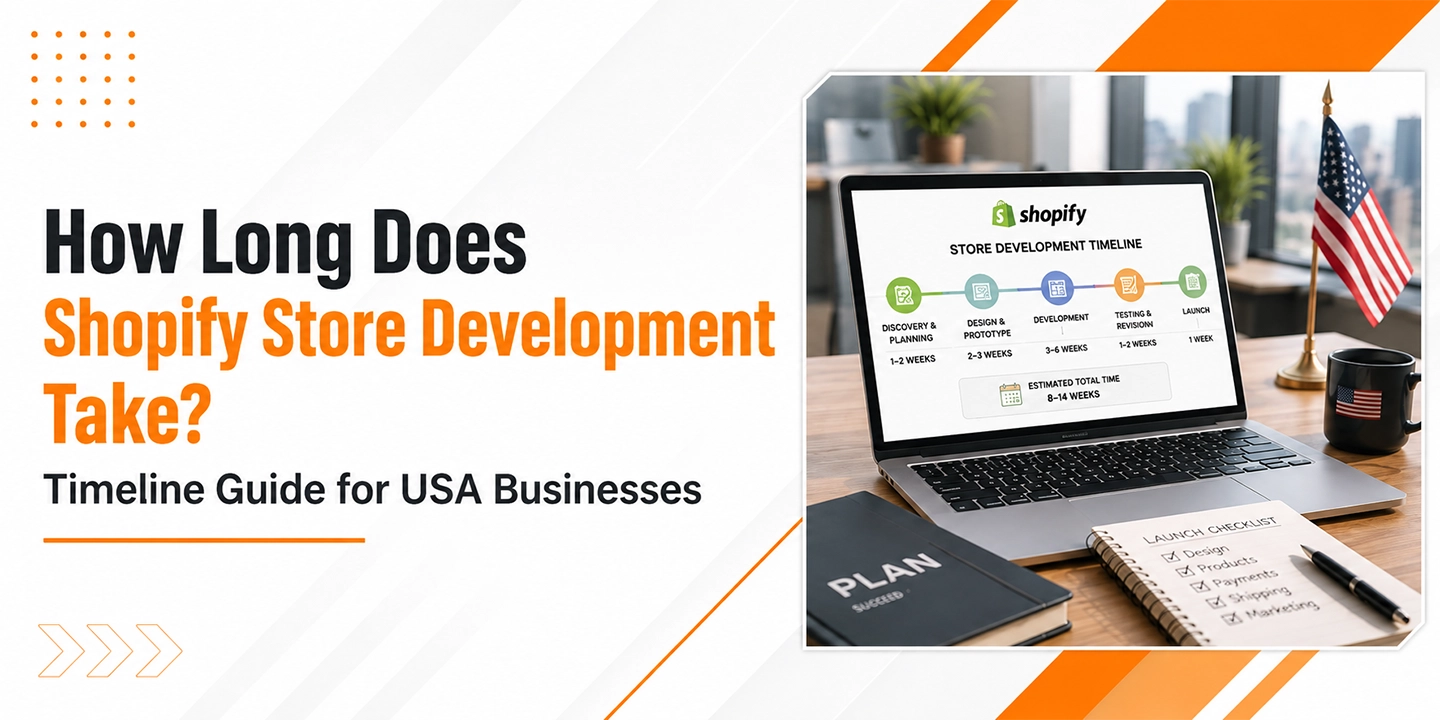
How Long Does Shopify Store Development Take? Timeline Guide for Businesses

If you’ve been searching for a straight answer to this question, you already know how frustrating the vague responses out there can be. “It depends” is technically true, but it’s not exactly useful when you’re trying to plan a product launch, allocate budget, or set expectations with your leadership team.

So let me give you something more actionable.

Shopify store development typically takes anywhere from 2 weeks to 6 months, depending on the complexity of the project, the size of your product catalog, the number of custom features required, and how quickly your internal team can provide content, assets, and approvals. Simple stores with a theme and a small catalog can go live in days. Enterprise-grade builds with custom integrations, multi-currency support, and B2B functionality? Those are multi-month projects.

This guide walks through every phase of the Shopify development timeline, what can speed things up, what commonly causes delays, and how to plan your project realistically.

Why the Timeline Question Matters More Than You Think

Ecommerce is not slowing down. According to Statista, global ecommerce sales are projected to surpass $8.1 trillion by 2026, up from $5.8 trillion in 2023. That kind of growth means that getting your Shopify store live quickly and correctly directly impacts revenue.

One thing many businesses overlook is that timeline planning is also competitive planning. If your competitors launch six weeks before you do, they’re capturing organic traffic, building customer reviews, and refining their conversion funnels while you’re still waiting on developer revisions. In a market where Shopify powers over 4.6 million live stores globally, according to Shopify’s own data, time-to-market isn’t just an operational concern. It’s a strategic one.

That said, rushing a launch creates its own problems. The Baymard Institute has documented through extensive usability research that poor checkout experiences alone account for a checkout abandonment rate of 70.19% on average. Launching fast with a broken or confusing UX can be worse than launching right on time with a polished experience.

The goal is a realistic timeline, not an optimistic one.

The 5 Phases of Shopify Store Development

Phase 1: Discovery and Planning (1 to 3 Weeks)

Before a single line of code gets written or a theme gets selected, there’s work that needs to happen at the strategy level. This phase often gets underestimated, especially by businesses eager to jump into design.

Discovery typically covers:

  • Business requirements: What products are you selling, who is your customer, what markets are you targeting?
  • Technical requirements: Do you need third-party integrations (ERP, CRM, shipping software)? Multi-currency? Wholesale pricing?
  • Platform decisions: Are you migrating from another platform like WooCommerce, Magento, or BigCommerce? Or starting fresh?
  • Content inventory: How many products do you have? Are descriptions and images ready?

From my experience, this phase is where most project delays are born. When a business hasn’t clearly defined its requirements upfront, scope creep becomes almost inevitable. A discovery phase that feels like it’s “slowing things down” is actually the single best investment in keeping the rest of your timeline on track.

For straightforward stores, this phase can compress to a week. For complex builds, three weeks is realistic, and for enterprise projects, it can run longer.

Phase 2: Design and UX (2 to 6 Weeks)

Once the scope is clear, design work begins. Here’s where Shopify gives you real flexibility, but also where the timeline can vary wildly.

Using an existing Shopify theme (with customizations): 1 to 2 weeks Custom theme design from scratch: 4 to 6 weeks or more

Shopify’s theme store offers over 100 professionally designed themes, and many businesses, especially those launching their first store or working with tighter budgets, get excellent results by starting with a paid theme and customizing it to match their brand. That’s a legitimate approach and it saves significant time.

Custom design work means creating wireframes, mockups, and prototypes before any development begins. You’ll be making decisions about navigation structure, product page layouts, mobile responsiveness, and brand consistency across every touchpoint.

That brings up something worth noting about mobile. According to Salesforce’s State of Commerce report, mobile devices account for a growing majority of ecommerce traffic, with some verticals seeing over 70% of visits from smartphones. Your Shopify theme or custom design needs to perform flawlessly on small screens. Cutting corners here is not an option.

Design review cycles are the biggest time variable in this phase. If your team can review and approve designs promptly, you stay on schedule. If reviews drag out over multiple revision rounds and involve multiple stakeholders with conflicting opinions, this phase can double in length.

Phase 3: Development and Build (2 to 12 Weeks)

This is the core of the Shopify development timeline, and the range is genuinely wide.

Here’s a rough breakdown by project type:

Project Type Development Time
Starter store (theme + basic setup) 1 to 2 weeks
Small business store (theme + moderate customization) 3 to 5 weeks
Mid-market store (custom theme or heavy customization) 6 to 10 weeks
Enterprise / Shopify Plus store 10 to 20+ weeks

What drives development time upward? A few key factors:

Custom functionality. If you need features that don’t exist natively in Shopify or its app ecosystem, a developer needs to build them. This includes things like custom product configurators, subscription management built from scratch, complex B2B pricing rules, or a fully custom checkout experience (available on Shopify Plus).

Third-party integrations. Connecting your Shopify store to an ERP system, a warehouse management system, a CRM like Salesforce or HubSpot, or a custom PIM (product information management) system adds significant development time. Each integration requires API work, testing, and error handling.

Product catalog complexity. A store with 50 products is very different from one with 5,000 SKUs across dozens of categories, each needing its own metafields, variant logic, and collection organization.

App configuration. Shopify’s app ecosystem is extensive, but configuring the right apps, making sure they don’t conflict with each other, and customizing their behavior to fit your needs takes real time.

Phase 4: Content Loading and QA (1 to 4 Weeks)

This phase is consistently underestimated, and it’s where projects that look almost done stall out for weeks.

Content loading involves importing your product catalog (titles, descriptions, images, prices, variants, metafields), setting up collections, writing page content, configuring your navigation menus, and making sure everything displays correctly across device types and browsers.

For smaller stores, this is manageable in a week. For stores with hundreds or thousands of products, especially when migrating from another platform, this can be an extended process involving data cleaning, CSV imports, and manual quality checks.

QA (quality assurance) testing then covers:

  • Cross-device and cross-browser testing
  • Checkout flow testing (including payment gateways)
  • Speed and performance testing
  • Broken link and redirect testing
  • Inventory sync validation

According to McKinsey research on digital transformation, inadequate testing before launch is one of the most common causes of post-launch revenue loss in ecommerce. A slow page load, a broken checkout step, or an incorrect shipping rate can all directly reduce conversion rates.

Phase 5: Launch and Post-Launch Stabilization (1 to 2 Weeks)

Launch day is exciting, but it’s not the finish line. The immediate post-launch period typically involves:

  • DNS migration and SSL certificate setup
  • Final domain configuration
  • Post-launch monitoring for errors
  • Speed optimization review
  • Analytics setup (Google Analytics 4, Shopify Analytics, heatmapping tools)
  • Payment processing final confirmation
  • Staff training on order management and fulfillment workflows

That’s where things change for many businesses. They treat launch as the end of the project. In reality, the first two to four weeks after launch are crucial for catching issues that only surface under real traffic conditions.

Budget at least a week for this stabilization period, and keep your developer available for quick fixes.

Shopify vs. Other Platforms: How Does the Timeline Compare?

Honestly, this is one of Shopify’s real strengths. Compared to Magento or a custom-built ecommerce solution, Shopify dramatically reduces development time.

Platform Typical Development Time
Shopify (standard) 4 to 12 weeks
Shopify Plus (enterprise) 12 to 24 weeks
WooCommerce (comparable scope) 8 to 16 weeks
Magento (comparable scope) 16 to 36 weeks
Custom build 6 months to 2+ years

Shopify’s hosted infrastructure, its built-in payment processing through Shopify Payments, and its curated app ecosystem all eliminate categories of development work that other platforms require. You’re not building a server stack, configuring hosting, or coding a payment gateway from scratch. That headstart is real.

According to Gartner’s research on digital commerce platforms, Shopify (and Shopify Plus for enterprise) consistently ranks highly for time-to-value, largely because of its out-of-the-box capabilities and the maturity of its partner ecosystem.

What Causes Shopify Projects to Run Over Timeline

In most cases, timeline overruns don’t come from the technology. They come from the process.

Delayed content delivery is the most common culprit. Development can only move so fast if it’s waiting on product images, copy, or brand assets from the client side. Every week of delay on content is a week added to the timeline.

Scope creep is a close second. A project that starts as “a simple Shopify store” gradually accumulates feature requests, design changes, and new integrations. Without a clearly defined scope and a formal change management process, timelines expand without a corresponding adjustment to budget or schedule.

Multiple revision cycles slow down design and development phases considerably. This is especially common in businesses where multiple stakeholders need to approve work, and those stakeholders have differing opinions.

Third-party dependencies can be surprisingly tricky. Waiting for an ERP vendor to provide API documentation, or a payment provider to complete merchant onboarding can hold up development that’s otherwise ready to proceed.

Platform migrations add complexity. Migrating from WooCommerce, BigCommerce, or Magento to Shopify involves data migration (customer records, order history, product data), URL redirect mapping for SEO preservation, and thorough testing to make sure nothing was lost or corrupted in the move.

How to Accelerate Your Shopify Development Timeline

A few things genuinely move the needle:

Have your content ready before development starts. Product descriptions, high-quality images, brand guidelines, and any existing assets should all be organized and ready to hand off. Waiting until development is complete to start gathering content is a major mistake.

Use a battle-tested Shopify theme. If custom design isn’t a hard requirement, starting with a premium Shopify theme and customizing it can shave weeks off your timeline.

Hire experienced Shopify developers. This sounds obvious, but the difference between a developer who has built 50 Shopify stores and one who is learning on your project is measured in weeks. Shopify’s partner directory and certified agency network are good places to start your search.

Limit the MVP scope. Launch with the core features your customers actually need. Everything else can be added after launch. Getting a working store live in 8 weeks is almost always better than getting a perfect store live in 20 weeks.

Establish a clear approval process. Know who the final decision-makers are before the project starts. Waiting five days for a design approval that should take two hours is a systemic issue that compounds across every phase.

Shopify Plus: What Changes at the Enterprise Level

Shopify Plus is Shopify’s enterprise offering, designed for high-volume merchants, global brands, and businesses with complex operational requirements. As of 2024, Shopify Plus powers brands like Gymshark, Allbirds, and thousands of others doing significant revenue.

The development timeline for Shopify Plus projects is notably longer for a few reasons:

Custom checkout experiences. Shopify Plus merchants can customize the checkout using Checkout Extensibility, which requires specialized development work.

Multi-store and international setups. Many Shopify Plus implementations involve multiple storefronts for different regions, languages, and currencies, each requiring its own configuration.

Headless commerce. Some enterprise brands use Shopify as a commerce backend with a custom-built frontend (often called headless commerce). This approach offers maximum flexibility in design and performance but adds significant development time. A headless Shopify build might run 4 to 6 months.

ERP and custom systems integration. Enterprise businesses often run complex backend systems that need to talk to Shopify. These integrations require careful API work and extensive testing.

A realistic timeline for a full Shopify Plus implementation with custom integrations and multi-regional setup is 4 to 6 months.

B2B Ecommerce on Shopify: Additional Considerations

B2B (business-to-business) ecommerce adds its own layer of complexity to any development timeline.

According to Forrester Research, B2B ecommerce in the US alone is projected to reach $3 trillion by 2027. Many manufacturers, distributors, and wholesalers are now moving significant portions of their order volume online, and Shopify has been building out its B2B capabilities substantially, especially on the Plus tier.

B2B-specific features that impact the development timeline include:

  • Custom pricing by customer account or company
  • Minimum order quantities and pack sizing
  • Net payment terms (Net 30, Net 60)
  • Company accounts with multiple buyers and approval workflows
  • Custom catalogs visible only to specific buyer segments
  • Integration with existing ERP or distributor management systems

A B2B Shopify implementation typically adds 4 to 8 weeks to a comparable B2C project timeline, sometimes more depending on the complexity of pricing logic and systems integration.

A Realistic Shopify Development Timeline at a Glance

Phase Simple Store Mid-Market Store Enterprise / Plus
Discovery and Planning 1 week 2 weeks 3 to 4 weeks
Design and UX 1 to 2 weeks 3 to 4 weeks 6 to 8 weeks
Development 1 to 2 weeks 5 to 8 weeks 10 to 16 weeks
Content and QA 1 week 2 to 3 weeks 4 to 6 weeks
Launch and Stabilization 1 week 1 week 2 weeks
Total Estimate 5 to 7 weeks 13 to 18 weeks 25 to 36 weeks

These are conservative, realistic estimates based on typical project conditions. Your actual timeline may be shorter with excellent preparation and fast approvals, or longer with scope changes and delays.

Final Thoughts

There’s no universal answer to how long Shopify store development takes, but there is a realistic one for your specific situation. The key is being honest about your requirements, your content readiness, your approval process, and the complexity of what you’re building.

From my experience, businesses that invest time in proper discovery and planning before a single design mockup is created consistently deliver their projects closer to the original timeline and budget than those who rush into execution.

Shopify is genuinely one of the fastest paths to a professional, scalable ecommerce store. The platform has earned its market position. But the timeline is still a function of preparation, complexity, and process, not just the technology.

If you’re planning a Shopify project, use this guide as a starting point. Then get specific about your requirements and talk to experienced Shopify professionals who can give you an honest assessment based on what you’re actually building.

Top 10 Headless Commerce Experts in Switzerland for Digital Commerce Success in 2026

Digital commerce is advancing at an unprecedented pace. Today’s customers want easy transactions that can be done on websites, applications, marketplaces, and other digital points of contact. Traditional ecommerce systems fail to do so since businesses require flexibility, improved performance, and total control over their customer experience.

This is when the headless commerce approach becomes relevant.

The headless commerce model decouples the frontend customer experience from the backend commerce system, enabling organizations to create faster, personalized, and scalable digital solutions. Companies can redesign their storefronts, create improved journeys for their users, and integrate technologies irrespective of their ecommerce framework.

The Switzerland region has become a digital innovation center where various experts help businesses implement cutting-edge commerce models. Be it ecommerce development or composable architecture, these specialists help brands develop future-proof digital solutions.

Here are the top 10 headless commerce experts in Switzerland helping businesses achieve digital commerce success in 2026.

1. DIT Interactive

DIT Interactive is a firm offering digital commerce and technology solutions to enterprises in need of scalable, high-performance web experiences. DIT Interactive is an innovation-oriented company focusing on the development of flexible business-driven solutions to enable modern digital platforms to evolve.

DIT Interactive is a leading ecommerce agency offering ecommerce development services and custom digital solutions, along with innovative ecommerce architecture for the growth-oriented business community. The firm has extensive experience in creating scalable ecommerce ecosystems by employing innovative technologies and enhancing the user experience.

DIT Interactive collaborates with businesses requiring more control over their digital platforms and customer experiences. Each firm and business have different needs, and hence, DIT Interactive believes in developing customized solutions rather than relying on the cookie cutter approach.

In today’s era of modern commerce, where more businesses are exploring headless ecommerce solutions, DIT Interactive assists firms to explore this innovative solution for their businesses in Switzerland and elsewhere in the world.

Why Choose DIT Interactive?

Businesses choose DIT Interactive because of its ability to combine technical expertise with a clear understanding of business requirements.

Key strengths include:

  • Custom ecommerce development based on business goals
  • Experience with modern ecommerce technologies and architectures
  • Scalable solutions built for future growth
  • Focus on performance, flexibility, and customer experience
  • Strategic approach to digital transformation

For companies searching for a reliable headless commerce company in Switzerland, DIT Interactive provides the technical knowledge and strategic support required to create future-ready ecommerce experiences.

2. SLY

SLY is an award-winning digital agency specializing in creating outstanding digital experiences and solutions to empower contemporary brands in their businesses. By blending design, strategy, and technology, the agency assists companies in optimizing their digital presence.

In line with the emerging trends in flexible commerce, SLY offers brands opportunities to build digital platforms that ensure seamless customer journeys. The approach adopted by SLY emphasizes the creation of experiences that are aesthetically pleasing and scalable.

The choice of reliable headless commerce development agencies in Switzerland and around the world will be highly rewarding for any business seeking a combination of creativity and efficiency in its technology partner.

SLY brings together content, commerce, and customer experiences using digital innovations.

3. Eminence

Eminence is a Swiss-based digital agency that uses technological innovation to help companies enhance their online visibility.

Through various services such as digital strategies, design, and development, Eminence provides user-friendly e-commerce websites. Eminence’s expertise in the use of new web technologies enables companies to create websites that can grow in the future.

In view of the shift towards more personalized experiences in e-commerce, companies need robust technological infrastructure. Eminence assists businesses interested in headless e-commerce development services in Switzerland and elsewhere to create flexible digital solutions.

They concentrate on creating useful digital experiences that serve customer satisfaction as well as business interests.

4. Crystallize

The platform specializes in providing solutions related to modern commerce through the composable and flexible method. The platform allows companies to handle their products, contents, and digital experiences via an API-first approach.

The headless commerce strategy allows the brands to select the most suitable tools for various aspects of the ecommerce ecosystems. The platform offers its users to utilize this strategy by making it easier to craft unique shopping experiences.

The companies in search of sophisticated headless commerce platforms in Switzerland and worldwide will definitely appreciate the flexibility and control over the digital processes offered by such platforms.

The platform Crystallize is the future of the ecommerce industry.

5. Sanity

Sanity is a contemporary content platform which enables businesses to manage their digital experiences across various channels.

In the context of a headless commerce setup, content plays a significant part in ensuring that consistent interactions are developed between the business and customers. Using Sanity, businesses can easily link content and commerce together and therefore ensure that they develop personalized experiences.

In the event that businesses opt to invest in headless technology in Switzerland, Sanity can be used as one of the options.

6. Commerce UI

Commerce UI works towards designing innovative interfaces for ecommerce platforms and online shopping experiences. Commerce UI works with companies in improving their frontend experience, which involves Switzerlandbility and performance.

The trend of headless architecture among brands makes the frontend play a critical role in delivering superior digital experiences. Commerce UI provides support to businesses in developing flexible and interactive frontend solutions.

Businesses interested in headless commerce development services in Switzerland and internationally need frontend skills to ensure the speed and ease of use of their platforms.

7. Enigma Swiss

With Enigma Swiss, organizations can take advantage of the power of technology, strategy, and innovation in order to optimize their digital presence.

The organization assists brands in enhancing their digital experience in terms of building relationships with consumers. The fact is that e-commerce becomes more sophisticated nowadays, and companies require solutions enabling them to adjust flexibly.

This organization makes its contribution to the rising popularity of headless commerce solutions in Switzerland and around the world, allowing businesses to build flexible digital experience.

8. Spadoom

At Spadoom, we partner with companies to build digital products and solutions that enhance the customer experience.

We believe in building digital experiences that keep our brands relevant and competitive in the evolving business landscape. As ecommerce expectations grow, it becomes necessary for companies to have technology partners who are familiar with scalability and flexibility.

Companies looking for headless commerce development companies in Switzerland should consider partnering with experts in digital who are familiar with the new-age commerce demands.

We enable organizations to build platforms that cater to customers and future possibilities.

9. Valtech

Valtech is an international organization assisting companies with digital transformations to enhance their digital commerce approach.

Valtech partners with companies in various fields in developing digital platforms and customer-centric solutions. Their areas of specialization include digital transformations, ecommerce, and advanced technologies.

For those considering engaging a headless commerce developer or collaborating with professional digital teams, Valtech provides experience in handling complicated commerce projects.

Valtech aims to assist brands in creating interconnected experiences that will facilitate growth.

10. SNCE Group

SNC Group offers digital solutions that assist enterprises in improving their digital presence and customer experience.

The organization assists firms in solving business problems using technology-driven solutions that meet modern business needs. With continuous evolution in ecommerce, there is an increasing need for flexible systems that can meet changing customer demands.

SNC Group recognizes the need for headless commerce solutions that assist firms in transforming digitally.

Why Headless Commerce Is Important for Digital Success in 2026

Ecommerce’s future is not just about having a webshop; it is all about delivering integrated, personalized, and seamless experiences throughout the customer journey.

Headless commerce allows companies to:

  • Speed up their website
  • Provide custom frontend experiences
  • Connect several sales channels
  • Personalize the customer journey
  • Facilitate easy scaling of e-commerce operations
  • Limit constraints on traditional platforms

Different from traditional ecommerce models, headless commerce provides companies with the flexibility to select the right tool for each job for content, payments, customer management, and frontend development.

Final Thoughts

With increasing digital competition, there is a requirement for ecommerce solutions that foster innovation and flexibility. The firms listed above are assisting brands in adopting ecommerce solutions that are more contemporary and improving digital experiences.

It may be a complete ecommerce transformation, customization, or any assistance from the best Headless Commerce agency in Switzerland and technology partners, the right choice can mean all the difference.

In 2026, headless commerce will not just be a trend but a backbone for brands looking to create faster, smarter, and personal digital commerce experiences.

Best WooCommerce Development Companies in Singapore for Online Business Success

E-shoppers have certain expectations from the online store of today. Namely, people prefer the convenience and speed of online transactions; security is another aspect of online shopping. The ecommerce website must be convenient for the customer to use.

Thus, Singapore’s ecommerce market grows and develops constantly as different companies strive to establish their presence in cyberspace. Today many companies implement ecommerce solutions to attract customers and manage their online business effectively.

Among many other ecommerce solutions there is WooCommerce that proves to be popular among companies that create online stores. It is flexible and customizable; moreover, being based on WordPress, it helps to create ecommerce website according to the preferences of company and customer.

Still, developing a successful ecommerce website with WooCommerce does not mean simply installing certain theme. Ecommerce website must be designed professionally, work well, perform efficiently and be developed with regard to the needs of future growth.

WooCommerce development companies play a major role in such processes. They help companies to develop ecommerce websites that are not only attractive but reliable as well.

It is important that your ecommerce development partner understands customer behavior and business needs. They help transform ecommerce ideas into real online experiences.

In this article, we highlight some of the best WooCommerce development companies in Singapore helping businesses build stronger online stores.

Top WooCommerce Development Companies in Singapore

1. DIT Interactive – Ecommerce and WooCommerce Development Specialists

DIT Interactive designs WooCommerce stores for businesses by keeping in mind the practical requirements of both the business as well as its customers.

At DIT Interactive, it is ensured that the ecommerce website designed is attractive and efficient at the same time. They don’t just make websites look visually appealing but also make sure to develop websites that serve the best purpose for the clients.

This ecommerce agency analyzes all aspects of the business and then advises what would be the most suitable ecommerce approach for the client. The client is saved from investing in unwanted functionalities and unnecessary expenses because of the thorough analysis done at the beginning.

In case businesses in Singapore are looking for the development of ecommerce sites using the WooCommerce platform, DIT Interactive offers end-to-end ecommerce solutions.

Businesses in Singapore that need WooCommerce developers can collaborate with DIT Interactive to build robust ecommerce websites.

The company also provides the facility of custom WooCommerce development in Singapore. This allows businesses to add features that suit their brand identity.

It focuses on designing ecommerce websites which are easy to manage and customer friendly too.

Why Choose Them?

  • Business-focused ecommerce approach
  • Custom WooCommerce development solutions
  • Strong focus on customer experience
  • Conversion-friendly designs
  • Scalable ecommerce strategies
  • Long-term technical support

Industries They Support:

  • Ecommerce Brands
  • Retail Companies
  • Fashion & Lifestyle Businesses
  • Product-Based Businesses
  • Growing Online Stores

2. Visible One – Ecommerce Technology Specialists

Visible One makes it easier for enterprises to enhance their online presence by means of professional website development and online shopping experiences.

The company ensures that all websites developed by it combine both attractive appearance and effective functionality. It seeks to make sure that businesses establish online presences that will be convenient for customers to navigate and will be easy to handle.

Visible One is aware of the fact that customers form an impression of a brand according to its online experience. That is why it concentrates on the development of websites that build trust and ensure good user interactions.

Their strategy is based on the combination of design, technology, and business aspects.

Why Choose Them?

  • Focus on professional digital experiences
  • Creative and functional solutions
  • Customer-focused website approach
  • Modern design practices
  • Business-oriented development

Industries They Support:

  • Small Businesses
  • Corporate Brands
  • Service Companies
  • Ecommerce Businesses
  • Digital Startups

3. 9eCommerce – Ecommerce Development Specialists

E-commerce allows businesses to design professional ecommerce websites to ensure growth in the online world along with enhanced customer experience. This business concentrates on the design of secure and manageable ecommerce stores according to the needs of particular businesses.

By having expertise in WooCommerce development, 9eCommerce offers customized ecommerce solution that makes sure the flexibility and scalability of the online store developed by the brand. Since every business has unique requirements, this is the reason why 9eCommerce designs solutions according to particular business needs.

9eCommerce designs ecommerce websites that provide easy navigation and shopping experience along with features that help in managing online activities efficiently.

For the businesses looking for WooCommerce development in Singapore, 9eCommerce can design the solutions of their ecommerce ideas.

Why Choose Them?

  • Custom WooCommerce development solutions
  • User-friendly ecommerce store designs
  • Focus on customer experience
  • Scalable ecommerce solutions
  • Performance-focused development
  • Support for growing online businesses

Industries They Support:

  • Ecommerce Brands
  • Retail Companies
  • Fashion & Lifestyle Businesses
  • Product-Based Businesses
  • Growing Online Stores

4. VueTech SG – Ecommerce Development Experts

VueTech SG engages with companies who need advanced digital solutions to optimize their online operations.

The firm concentrates on developing platforms and websites that are efficient, user friendly, and goal-oriented. The team at VueTech SG assists businesses in overcoming technical hurdles while optimizing their online performance.

VueTech SG is of the view that digital platforms which perform successfully are easy, efficient, and designed for future scalability.

The firm deals with companies seeking to have technology solutions that would help them optimize their business operations.

Why Choose Them?

  • Modern development approach
  • Focus on usability and performance
  • Customized technology solutions
  • Reliable implementation process
  • Growth-focused mindset

Industries They Support:

  • Ecommerce Companies
  • Startups
  • Technology Businesses
  • Online Platforms
  • Service Providers

5. Chillybin – Ecommerce Solutions Specialists

Chillybin helps firms set up digital platforms that will enable them to grow online. The firm is interested in helping firms set up sites that are functional, appealing, and easy to navigate by consumers.

They know very well that ecommerce will require the setting up of an easy experience when purchasing something. Everything from browsing to purchase must be easy.

Chillybin assists businesses looking for professional ecommerce solutions.

Why Choose Them?

  • Practical ecommerce solutions
  • Focus on website usability
  • Clean and modern designs
  • Business-friendly approach
  • Digital improvement strategies

Industries They Support:

  • Retail Brands
  • Ecommerce Stores
  • Professional Services
  • Small and Medium Businesses
  • Online Companies

6. FortuneSoft IT – Digital Commerce Development Specialists

FortuneSoft IT provides companies with solutions that can make their online operations better with technologies, ecommerce platforms, and development services. The company partners with companies that require digital solutions to operate effectively and ensure their growth in the future.

The strategy of FortuneSoft IT involves studying the business first and then creating solutions based on the needs of each particular business. They do not offer the same solutions to all of their clients because they develop customized platforms for the improvement of companies.

The company provides services to companies that need solutions in ecommerce development and software solutions.

Why Choose Them?

  • Customized technology solutions
  • Focus on practical business needs
  • Scalable digital platforms
  • Experience with modern development
  • Support for long-term growth

Industries They Support

  • Ecommerce Businesses
  • Retail Companies
  • Technology Brands
  • Enterprise Solutions
  • Growing Digital Businesses

Comparison of Top WooCommerce Development Companies in Singapore

Company Services Offered Key Strengths Best For
DIT Interactive WooCommerce Development, Ecommerce Solutions, Custom Store Development Business-focused approach, scalable solutions, conversion-friendly ecommerce stores Growing brands, retail businesses, product-based companies
Visible One Website Development, Ecommerce Solutions, Digital Experiences Creative designs, modern technology solutions, professional websites Small businesses, startups, corporate brands
9eCommerce WooCommerce Development, Ecommerce Website Development, Custom Ecommerce Solutions Customer-focused approach, user-friendly stores, scalable ecommerce solutions Ecommerce brands, retail businesses, growing online stores
VueTech SG Ecommerce Platforms, Digital Solutions, Website Development Performance-focused development, customized technology solutions Technology businesses, startups, online platforms
Chillybin Ecommerce Development, Website Solutions, Digital Services Clean designs, usability-focused solutions, practical ecommerce approach Retail companies, SMEs, online businesses
FortuneSoft IT Ecommerce Development, Software Solutions, Digital Platforms Customized solutions, business-oriented development, scalable platforms Enterprises, technology brands, digital businesses


What Makes a WooCommerce Development Company Valuable?

Selecting the right WooCommerce partner does not merely entail the process of creating a website. It involves designing an ecommerce website with features that make the shopping experience enjoyable to the customer.

There are diverse business models in the marketplace and hence it is essential to develop an ecommerce website that will serve a particular business model.

The right WooCommerce developer knows how to do this.

Understanding Your Business

A strong development process starts with understanding your brand, customers, products, and business goals. This helps create a store that matches your actual requirements.

Creating Better Customer Experiences

Customers prefer websites that are simple and easy to use. Better navigation, faster pages, and a smooth checkout process help improve the shopping experience.

Building Stores That Can Grow

Businesses change over time, and their websites should grow with them. A flexible WooCommerce store makes it easier to add new features and improvements later.

For businesses planning to hire WooCommerce experts in Singapore, choosing the right partner can help create a stronger and more successful ecommerce presence.

Why Businesses Continue Choosing WooCommerce?

WooCommerce remains a popular choice because it gives businesses more control over their online stores.

It allows brands to create unique shopping experiences without being restricted by fixed templates or limited options.

Easy Customization

Businesses can customize their store design, features, and functionality based on their brand style and customer expectations.

Simple Store Management

WooCommerce works with WordPress, making it easier to manage products, content, and everyday ecommerce activities.

Supports Business Growth

Whether a business is starting small or expanding quickly, WooCommerce can grow with changing requirements.

Works With Other Tools

WooCommerce connects easily with payment systems, marketing platforms, analytics tools, and other business solutions.

With professional WooCommerce website development services in Singapore, businesses can build online stores that are flexible, secure, and ready for future growth.

Final Thoughts

The market for ecommerce is still expanding, and businesses require ecommerce sites which will be able to offer real value to the users.

An effective ecommerce site involves much more than selling products. It entails establishing credibility, making shopping easy, and increasing the interaction with customers.

The WooCommerce development firms referred to in this article play a role in helping businesses deliver better online experiences through designs, development, customizations, and technological solutions.

Whether you are setting up a new ecommerce site or upgrading the existing one, the proper development firm can help you establish a platform which works for you.

WooCommerce development when done properly can transform into a digital asset for your business.

Leading Shopify Development Firms in Germany for Custom Ecommerce Solutions

The ecommerce industry in Germany keeps growing thanks to the attention businesses pay to improving ecommerce experiences for their customers. These days, the expectations for ecommerce websites have increased and customers demand fast, safe, convenient and personalized websites.

Shopify is a widely used ecommerce platform among businesses as it offers flexible options to set up the online store. For new brands that launch the first website and large organizations that run complex operations, Shopify makes product management, customer service, payment processing and scaling much easier.

Building a successful Shopify store requires more than just choosing a theme. Professional design, development, integrations and optimizations are needed to build a high-performing online store.

That is where Shopify development agencies become extremely useful. The professional Shopify development company will understand all the ecommerce needs and offer a customized solution to improve the customer experience and convert them into paying customers.

Whatever your needs for the Shopify store might be, you can find the right Shopify partner that will bring success to your business.

Here are some of the best Shopify development agencies in Germany.

Top Shopify Development Firms in Germany

1. DIT Interactive

DIT Interactive assists companies in constructing custom Shopify stores with contemporary design, efficient functionalities, and user-oriented experience.

The key idea of the company is the creation of ecommerce platforms which will unite the design and performance of a platform.

Contrary to the creation of the generic store layout, DIT Interactive knows how to consider the business objectives and requirements of a potential customer when creating an ecommerce solution.

As a Shopify website design agency in Germany, DIT Interactive assists businesses in creating professional ecommerce stores optimized for their clients.

Expertise:

  • Shopify Store Development
  • Custom Ecommerce Solutions
  • Shopify Theme Customization
  • Ecommerce Optimization
  • Third-Party Integrations
  • User Experience Improvements

Serving Areas:

  • Germany
  • USA
  • UK
  • India
  • Europe
  • Global Ecommerce Markets

2. Acceleratiq

Acceleratiq aids companies in the creation of ecommerce solutions that help drive growth and enhance digital performance. The company specializes in solutions for Shopify that blend creativity, technology, and business strategy.

Its main concern lies in creating ecommerce solutions that are easy to manage and provide users with seamless experiences.

Companies seeking Shopify developers in Germany can partner with Acceleratiq to develop customized Shopify solutions and ecommerce solutions tailored to particular needs.

The company enables brands to enhance their digital footprint through innovative and scalable Shopify solutions.

Expertise:

  • Shopify Website Development
  • Ecommerce Store Design
  • Shopify Customization
  • Digital Experience Solutions
  • Online Store Optimization

Serving Areas:

  • Germany
  • USA
  • UK
  • India
  • European Markets
  • International Businesses

3. MageCloud Agency

MageCloud Agency offers ecommerce development services to businesses interested in having tailor-made and effective online stores.

It concentrates on aiding companies in going beyond the usual Shopify templates through developing ecommerce stores with enhanced features.

Being a Shopify web development agency in Germany, MageCloud assists businesses in developing, migrating, customizing, and improving their ecommerce stores.

The team aids businesses in creating online stores that can evolve alongside their business growth.

Expertise:

  • Shopify Development
  • Ecommerce Architecture
  • Store Migration
  • Custom Features
  • Performance Optimization

Serving Areas:

  • Germany
  • Europe
  • USA
  • UK
  • International Ecommerce Brands

4. Hyghstreet

Hyghstreet provides a wide range of ecommerce website designs using advanced techniques and solutions.

It concentrates on developing Shopify websites which will represent the corporate image of the brand and be easy and interesting to use for the customer.

Hyghstreet knows that ecommerce website success is not only about its functionality. Proper branding, good user experience, and navigation are crucial in creating a successful online store.

The firm cooperates with companies which require professional web design services of Shopify websites in Germany.

Expertise:

  • Shopify Store Design
  • Ecommerce Experience Design
  • Brand-Focused Solutions
  • User Interface Improvements
  • Digital Commerce Strategy

Serving Areas:

  • Germany
  • UK
  • USA
  • Europe
  • Global Brands

5. Craftberry

Craftberry is a Shopify agency that specializes in developing bespoke ecommerce sites that align with a brand’s identity and customers’ needs.

The company concentrates on providing its clients with unique Shopify experiences. Their strategy involves combining creative designing, web development, and e-commerce solutions.

Craftberry collaborates with those businesses which seek unique online representation and require specialized Shopify development. The company aims at improving customer experience, streamlining online store management and developing ecommerce solutions that help businesses grow.

For those businesses that are looking for a web development company offering Shopify solutions in Germany, Craftberry is the perfect choice.

Expertise:

  • Custom Shopify Store Development
  • Bespoke Ecommerce Design
  • Shopify Theme Customization
  • User Experience Optimization
  • Ecommerce Strategy

Serving Areas:

  • Germany
  • USA
  • UK
  • India
  • Europe
  • International Ecommerce Brands

6. iFlair

iFlair assists organizations in developing an ecommerce website for themselves through Shopify development and digital solutions. The firm specializes in designing online stores that are functional, aesthetically appealing, and provide an excellent user experience.

iFlair collaborates with organizations to develop their Shopify websites based on their products, customers, and needs. Their solutions assist the firms in making their stores more efficient and enhancing their shopping experience.

As a Shopify web design firm in Germany, iFlair helps organizations by offering ecommerce development, customization, and improvement services to help them thrive in the digital space.

The firm specializes in offering practical solutions related to Shopify that are easy to manage.

Expertise:

  • Shopify Website Development
  • Ecommerce Store Customization
  • Shopify Integrations
  • Website Performance Improvement
  • Digital Commerce Solutions

Serving Areas:

  • Germany
  • USA
  • UK
  • India
  • Europe
  • Global Clients

7. SDLC Corp

SDLC Corp offers solutions for technology and ecommerce development for businesses aiming at scalable digital platform development. The company helps organizations in setting up their own customized Shopify stores to grow and enhance customer interactions.

With expertise in software development and ecommerce solutions, SDLC Corp aims at developing flexible online stores that come with advanced functionalities.

The company collaborates with businesses that require something more than just setting up a basic Shopify account to set up an ecommerce store.

For those who want to hire Shopify developers in Germany, SDLC Corp can be considered as a viable option.

Expertise:

  • Shopify Development
  • Custom Ecommerce Solutions
  • Software Development
  • API Integrations
  • Digital Transformation

Serving Areas:

  • Germany
  • USA
  • UK
  • India
  • Middle East
  • Global Enterprises

How to Choose the Right Shopify Development Partner?

Choosing the right Shopify development agency is an important step because your ecommerce store directly affects customer experience, sales, and brand reputation.

A good Shopify partner should understand your business goals and provide solutions that support long-term growth.

Check Their Shopify Experience

A company with strong Shopify experience can better understand ecommerce challenges, customer behavior, and technical requirements.

Look for agencies that have experience with custom Shopify development, store optimization, and integrations.

Focus on Customization

Every business has different needs. Reliable Shopify development companies should create solutions based on specific business requirements instead of offering the same store design for everyone. 

Custom features, personalized designs, and tailored ecommerce strategies help businesses create better customer experiences, improve conversions, and build online stores that support long-term growth. 

Evaluate Design Skills

A successful ecommerce website should not only work well but also look professional.

Strong Shopify web design services in Germany help businesses create attractive stores that improve trust and increase conversions.

Consider Long-Term Support

Launching a Shopify store is only the beginning. Businesses need ongoing updates, improvements, and technical assistance.

Choose a development partner that provides continuous support after the website goes live.

Review Previous Work

Before selecting an agency, review their previous Shopify projects, client results, and ecommerce experience.

This helps you understand their capabilities and whether they are the right fit for your business.

Why Shopify Is a Strong Choice for German Ecommerce Businesses?

Shopify has become one of the most popular ecommerce platforms because it provides businesses with flexibility, reliability, and powerful tools.

For German businesses, Shopify offers several advantages:

Easy Store Management

Shopify allows businesses to manage products, orders, customers, and payments through an easy-to-use dashboard.

Better Customer Experience

With professional design and development, Shopify stores can provide smooth navigation, faster shopping experiences, and mobile-friendly interfaces.

Scalable Platform

Whether you are a small business or a growing brand, Shopify can scale according to your requirements.

Strong Integration Options

Businesses can connect Shopify with payment gateways, marketing tools, inventory systems, and third-party applications.

Secure Ecommerce Environment

Shopify provides secure infrastructure that helps businesses manage online transactions confidently.

With support from an experienced Shopify web development agency in Germany, businesses can maximize the platform’s potential and create ecommerce solutions built for growth.

Final Thoughts

The ecommerce market continues to become more competitive, and businesses need strong digital platforms to stand out.

A professionally developed Shopify store helps brands create better customer experiences, improve conversions, and build a stronger online presence.

The Shopify development firms mentioned in this article support businesses with custom ecommerce solutions, modern designs, technical development, and optimization strategies.

Whether you are launching a new ecommerce store or upgrading an existing one, selecting the right Shopify partner in Germany can help you create a platform that supports your business goals.

A successful Shopify website is not just about selling products y— it is about creating a seamless digital experience that keeps customers coming back.

What Is Shopify Development? A Complete Guide for US Business Owners

If you’ve been thinking about launching or growing an online store, you’ve almost certainly come across Shopify. But there’s a big difference between signing up for a Shopify plan and actually building a high-performing ecommerce store. That’s where Shopify development comes in — and honestly, it’s one of the most important decisions you’ll make as a business owner.

This guide breaks down exactly what Shopify development is, what it involves, what it costs, and how to find the right people to help you build a store that actually drives revenue.

What Is Shopify Development?

Shopify development refers to the process of building, customizing, and maintaining an online store on the Shopify platform. It goes beyond simply choosing a theme. It includes custom design, app integrations, backend logic, performance tuning, and ongoing technical support to create a store that fits your specific business needs.

Out of the box, Shopify gives you the foundation. Shopify development gives you the structure built on top of that foundation — one that reflects your brand, supports your operations, and is engineered to convert visitors into buyers.

According to Shopify’s own data, Shopify powers over 4.5 million businesses in more than 175 countries. That scale tells you the platform is battle-tested. But it also means standing out requires more than a default template.

What Does Shopify Development Actually Include?

When most people say “Shopify development,” they’re talking about a broad category of work. Here’s what falls under that umbrella:

1. Custom Theme Development

Every Shopify store uses a theme as its visual foundation. You can buy a pre-built theme from the Shopify Theme Store, but custom theme development means building or heavily modifying a theme using Shopify’s templating language — Liquid — along with HTML, CSS, and JavaScript.

Custom themes are built when:

  • Your brand has specific design requirements that pre-built themes can’t accommodate
  • You need unique page layouts, product display logic, or navigation structures
  • You want faster load times by stripping out unnecessary code from bloated templates

A well-built custom theme can dramatically affect conversion rates. According to Baymard Institute, the average large-scale ecommerce site has around 67 documented UX issues — many of which are fixable through thoughtful design and development.

2. Shopify App Development and Integration

Shopify has a powerful app ecosystem with over 8,000 apps. Sometimes you need an existing app connected to your store. Other times, no existing app does exactly what you need, and a developer builds a custom one.

App development in Shopify typically covers:

  • Custom loyalty or rewards systems
  • Advanced inventory management tools
  • Specialized checkout experiences
  • B2B pricing and account management portals
  • Custom reporting dashboards

3. Shopify Plus Development

Shopify Plus is the enterprise tier of the platform, designed for high-volume merchants. Development at this level opens up additional capabilities like:

  • Checkout customization using Checkout Extensibility
  • Launchpad for automated campaigns
  • Flow for complex workflow automation
  • Multi-store management across international markets

Gartner has consistently noted that enterprise-level ecommerce platforms are seeing increased adoption among mid-market businesses — and Shopify Plus is one of the biggest beneficiaries of that shift.

4. Headless Shopify Development

Headless commerce separates the frontend (what customers see) from the backend (where data lives). With headless Shopify, developers use Shopify’s Storefront API to pull product and checkout data into a custom-built frontend using frameworks like Next.js or Nuxt.js.

This approach gives brands full creative control and can deliver near-instant page load times. The tradeoff is higher development cost and more complex maintenance.

5. Migration to Shopify

If your business is moving from another platform — WooCommerce, Magento, BigCommerce, or a custom-built system — Shopify development includes data migration, URL mapping, SEO preservation, and integration setup.

According to Statista, US ecommerce revenue is projected to surpass $1.7 trillion by 2027. Businesses that delay platform improvements risk losing ground to competitors who’ve already invested in better infrastructure.

Shopify Development Services in the USA: What to Expect

The US market for Shopify development services has matured significantly. You’ll find a wide range of providers, from solo freelancers to large agencies with dedicated Shopify practices.

Types of Shopify Development Services Available

Design and UX: Creating wireframes, mockups, and final designs tailored to your brand.

Frontend Development: Translating those designs into Liquid templates, with clean, performant code.

Backend and App Development: Building custom functionality that doesn’t exist in the app store.

Shopify Plus Configuration: Setting up enterprise features, custom checkout flows, and multi-store architecture.

Ongoing Maintenance and Support: Keeping your store updated, patching issues, and adding features over time.

Conversion Rate Optimization (CRO): Analyzing where visitors drop off and making data-driven improvements.

One thing many businesses overlook is post-launch support. A store isn’t a one-time project — it’s a living digital asset. The best Shopify development partnerships include ongoing retainers for maintenance and iteration.

How Much Does Shopify Development Cost?

Pricing is probably the question most US business owners have when they start exploring this. The honest answer is: it depends on what you’re building. But here are some realistic ranges based on current market rates.

Project Type Estimated Cost Range
Basic theme customization $1,500 – $5,000
Custom theme development $8,000 – $30,000
Full store build (mid-market) $15,000 – $60,000
Shopify Plus implementation $30,000 – $150,000+
Custom app development $10,000 – $75,000+
Headless Shopify build $50,000 – $200,000+
Platform migration $5,000 – $40,000

These ranges reflect US-based agency pricing. Freelancers, particularly those working offshore, often charge less — but you trade speed and accountability for lower rates.

From my experience, the biggest mistake business owners make is focusing only on the upfront build cost. You also need to factor in:

  • Shopify monthly plan fees ($39 to $2,000+ per month depending on tier)
  • App subscription costs ($0 to $500+/month depending on your stack)
  • Ongoing development retainer ($1,500 to $10,000/month for active iteration)

Forbes reports that the average ecommerce business spends between 7% and 12% of its revenue on technology and development. If you’re doing $1M a year in online sales, a $70,000 to $120,000 annual technology budget is within industry norms.

Agency vs. Freelancer: Which Is Right for You?

This is one of the most common decisions US business owners face when starting a Shopify project. There’s no universal right answer, but there are clear patterns.

When a Freelancer Makes Sense

  • You have a small budget (under $10,000)
  • The project is narrowly scoped and well-defined
  • You have internal team members who can manage the relationship and QA the work
  • You don’t need ongoing support or a long-term partner

When a Shopify Development Agency Makes Sense

  • Your project is complex, involving custom functionality, migrations, or integrations
  • You need a team (designer + developer + project manager) rather than one person
  • You’re building on Shopify Plus or going headless
  • You want accountability, defined timelines, and a support structure post-launch

The thing is, a freelancer might be a great developer but unavailable when you hit a critical issue at 9pm before a product launch. Agencies typically have processes, escalation paths, and dedicated support built in.

McKinsey’s research on digital experience consistently points to operational reliability as a key differentiator for digital service providers — and that applies directly to how you choose a development partner.

How to Choose a Shopify Development Partner in the USA

Here’s a practical framework for evaluating agencies or freelancers before you commit:

1. Check Their Shopify Partner Status

Shopify has an official Partner Program. Agencies listed as Shopify Partners have demonstrated competence on the platform. Look for partners with Plus Partner status if you’re building on Shopify Plus.

2. Review Their Portfolio with a Critical Eye

Don’t just look at pretty screenshots. Ask to see stores they’ve built that are live and performing. Look for:

  • Page load speeds (test with Google PageSpeed Insights)
  • Mobile responsiveness
  • Logical navigation and checkout flow
  • Evidence of custom work, not just out-of-the-box themes

3. Ask the Right Questions

Before signing anything, ask potential partners:

  • What does your discovery and scoping process look like?
  • How do you handle project changes mid-build?
  • Who owns the code after the project is complete?
  • What does post-launch support look like, and what does it cost?
  • Have you worked with businesses in my industry?

4. Evaluate Communication and Process

A technically skilled team with poor communication will cause you frustration and cost you money. Ask about their project management tools (Basecamp, Linear, Jira), how often you’ll have check-ins, and how they handle feedback cycles.

5. Request References

Ask for two or three client references from projects similar to yours in size and scope. A reputable agency will provide these without hesitation.

Shopify Development for Different Business Types

You’ll notice that Shopify gets used very differently depending on the kind of business running on it. Here’s how development priorities shift by business type:

Direct-to-Consumer (DTC) Brands

DTC brands typically need strong brand storytelling, fast-loading product pages, and optimized checkout flows. Development focus is usually on custom theme work, email marketing integrations, and post-purchase upsell flows.

B2B Ecommerce

According to Salesforce’s State of Commerce report, 65% of B2B buyers prefer to self-serve through digital channels for at least part of the buying journey. Shopify Plus has B2B features built in, but custom development is often needed for:

  • Net terms and invoice-based checkout
  • Customer-specific pricing catalogs
  • Quote request workflows
  • Account hierarchy management

Multi-Brand or Multi-Store Operations

Businesses running multiple brands or regional storefronts (US, Canada, UK, etc.) need architecture planning around Shopify’s multi-store setup. Development in this context is heavier and more strategic.

Wholesale and Retail Hybrid

If you sell both direct to consumers and through retail or wholesale channels, Shopify development needs to accommodate different pricing rules, product visibility settings, and account types — often using a combination of Shopify Plus’s B2B features and custom apps.

Shopify Website Development Best Practices

Whether you’re hiring a team or managing a project yourself, these principles apply to any well-executed Shopify build:

Performance first. Google’s research shows that a one-second delay in mobile page load time can reduce conversions by up to 20%. Every Shopify build should be tested for Core Web Vitals before launch.

Mobile-first design. According to eMarketer, mobile commerce accounted for over 43% of US ecommerce sales in 2024. Designing for desktop first is designing for the minority of your customers.

SEO structure from the start. Clean URL structures, proper heading hierarchy, structured data markup, and fast load times aren’t afterthoughts — they should be baked into the build.

Accessibility matters. ADA compliance for ecommerce is increasingly a legal consideration in the US. Development should include proper alt text, keyboard navigation, and color contrast standards.

Integration planning. Your store doesn’t exist in isolation. It connects to your ERP, 3PL, email platform, CRM, and advertising accounts. Planning integrations early prevents expensive rework later.

Shopify E-Commerce Development Trends in 2025

The US ecommerce landscape is evolving fast, and Shopify development is keeping pace. A few trends worth knowing:

AI-powered personalization. Shopify has introduced Sidekick, its AI commerce assistant. Third-party tools are increasingly offering AI-based product recommendations, dynamic pricing, and customer segmentation.

One-page and accelerated checkout. Shopify’s Shop Pay and one-page checkout have significantly improved checkout completion rates. Development work now includes optimizing for these flows rather than building around them.

Composable commerce. More enterprise brands are moving toward headless and composable architectures, pulling the best tools together through APIs rather than relying on a single monolithic platform.

Sustainability features. According to Deloitte’s research, 32% of US consumers have stopped purchasing from brands they perceive as unsustainable. Shopify’s Planet app and carbon-neutral shipping options are increasingly being built into stores.

Final Thoughts

Shopify development isn’t a commodity purchase. It’s an investment in the infrastructure your business runs on. Done well, it pays back in better conversion rates, lower operational friction, and a brand experience that builds customer trust over time.

The US market has no shortage of Shopify developers and agencies. The challenge is finding the right fit for your specific situation — your industry, your complexity, your budget, and your growth plans.

Take your time with the selection process. Ask hard questions. Check references. And treat the relationship with your development partner the same way you’d treat any critical business relationship: with clear expectations, open communication, and a long-term mindset.

If you’re just getting started or re-evaluating your current setup, the frameworks in this guide should give you a solid foundation for making a smarter decision.

Top Signs Your Business Needs Custom BigCommerce Development Services

If you’ve been running your online store on BigCommerce for a while, there’s a good chance you’ve hit a ceiling at some point. Maybe your theme just doesn’t do what you need it to do. Maybe your checkout flow is costing you sales. Maybe your integrations are a patchwork of workarounds that only one person on your team understands.

That’s a sign. And it’s more common than you’d think.

BigCommerce is one of the most capable SaaS ecommerce platforms available today. But out-of-the-box BigCommerce and custom BigCommerce development services are two very different things. This article walks through the clearest signs that your business has outgrown the default setup and why working with a specialized BigCommerce development company may be the single most important investment you make this year.

What Are Custom BigCommerce Development Services?

Custom BigCommerce development services refer to professional development work that goes beyond BigCommerce’s built-in templates, apps, and default configurations. This includes custom theme development, API integrations, headless commerce builds, B2B-specific features, checkout customizations, ERP/CRM connections, and performance engineering specifically designed for your store’s needs.

In short: it’s building BigCommerce to fit your business, rather than forcing your business to fit BigCommerce.

Sign #1: Your Store Looks and Feels Like Everyone Else’s

This one stings a little, but it’s true. If you picked a BigCommerce theme from the marketplace, made a few color changes, and called it a day, you’re probably sharing visual DNA with dozens of other stores.

According to a Baymard Institute study (baymard.com), first impressions from design account for a significant portion of users’ trust decisions, and poor UX is one of the leading causes of cart abandonment. With an average documented cart abandonment rate hovering around 70%, the visual and functional experience of your store is not a cosmetic issue; it’s a revenue issue.

A BigCommerce customization services provider can build you a fully custom theme from scratch, or significantly extend an existing one to match your brand, your customer journey, and your conversion goals. That includes custom product page layouts, advanced filtering experiences, unique homepage structures, and a mobile-first design that actually converts.

Sign #2: You’re Losing Sales at Checkout

The default BigCommerce checkout works well for basic setups. But once you start needing things like multi-step checkout flows, custom field capture, business account pricing at checkout, split shipping, or custom payment logic, you’ll quickly run into walls.

Baymard Institute data also shows that roughly 17% of US adults have abandoned an order specifically because the checkout process was too long or complicated (baymard.com). That’s not a small number.

Custom BigCommerce development can extend the Optimized One-Page Checkout using BigCommerce’s Checkout SDK, allowing your development team to reshape the checkout experience around your customers’ actual needs. For B2B businesses especially, this can mean supporting purchase order numbers, custom net-terms fields, or role-based pricing shown directly at checkout.

If your checkout is creating friction right now and you can’t fix it through the control panel, it’s time to bring in specialized developers.

Sign #3: Your Integrations Are a Mess

Most growing businesses run on more than just their ecommerce platform. You’ve got an ERP. Maybe a CRM. Possibly a warehouse management system, a custom PIM, a loyalty platform, and a returns management tool. Getting all of these to work together cleanly through standard BigCommerce apps is, in most cases, not realistic.

The thing is, poorly integrated systems cause real operational problems. Orders fall through the cracks. Inventory counts are off. Customer data lives in four different places. Your team spends hours manually syncing things that should sync automatically.

McKinsey & Company research has found that businesses that effectively integrate their digital systems see measurable gains in operational efficiency and customer experience outcomes. Integration debt is a real thing, and it compounds over time.

A professional BigCommerce development company will typically build custom API integrations using BigCommerce’s REST and GraphQL APIs, creating bidirectional data flows between your platform and your other business systems. Done right, this eliminates manual work, reduces errors, and gives you a single source of truth across your operations.

Sign #4: You’re Scaling and the Platform Is Slowing You Down

BigCommerce handles scale reasonably well at the platform level, but there’s a difference between the platform handling traffic and your store handling traffic. If you’re running thousands of SKUs, complex product relationships, heavy catalog filtering, or high-volume flash sales, the standard setup often isn’t enough.

According to Google’s research on page experience, a one-second delay in mobile page load time can reduce conversions by up to 20%. And with Google now incorporating Core Web Vitals directly into its ranking algorithm, slow page loads aren’t just a UX problem. They’re an SEO problem too.

Custom BigCommerce development focused on performance includes things like: moving to a headless architecture using BigCommerce’s storefront API, implementing custom caching strategies, lazy-loading product catalog data, optimizing image delivery pipelines, and reducing third-party script bloat.

If your store is getting slower as it grows, that’s a direct sign you need engineering-level attention, not just another app from the marketplace.

Sign #5: You’re Trying to Compete in a B2B Market

BigCommerce has invested heavily in its B2B capabilities, and honestly, it’s one of the platform’s strongest differentiators. But most of the advanced B2B features, things like company account hierarchies, buyer-specific catalogs, custom pricing tiers, quote management, and requisition lists, require meaningful configuration and often custom development to work exactly right for your business model.

According to Statista, global B2B ecommerce sales are projected to surpass $36 trillion by 2026, dwarfing B2C ecommerce by a wide margin. Businesses that win in B2B ecommerce are the ones that give buyers a purchasing experience that mirrors what they’re used to in consumer commerce: easy reordering, transparent pricing, account management, and seamless approval workflows.

Getting that right on BigCommerce typically requires a BigCommerce development company with specific B2B experience. They’ll know how to use BigCommerce’s Customer Groups, Price Lists, and the B2B Edition features in combination, and when to build something custom on top of them.

Sign #6: You Need Headless Commerce

Headless commerce is one of the most significant architectural shifts in ecommerce right now, and BigCommerce is one of the best platforms available for it. In a headless setup, the frontend presentation layer is decoupled from the backend commerce engine, giving developers complete control over the user experience while still using BigCommerce to handle catalog, checkout, payments, and order management.

From my experience, businesses considering headless are usually doing so for one of a few reasons: they need a content-heavy experience that a traditional storefront can’t support, they’re running multiple storefronts across different brands or regions, they want to push commerce into non-traditional surfaces like mobile apps or voice interfaces, or they simply need performance that a traditional SaaS storefront can’t deliver at their traffic levels.

Enterprise BigCommerce development almost always involves headless when the business is sophisticated enough to need it. This isn’t a DIY project. It requires frontend developers experienced in React or Next.js, backend developers who know BigCommerce’s APIs deeply, and a solid DevOps setup to keep everything running.

Sign #7: Your Mobile Experience Is Underperforming

One thing many businesses overlook is the gap between having a “mobile-responsive” store and having a store that actually converts on mobile. Responsive design means your site adjusts to screen sizes. A truly mobile-optimized experience means the entire customer journey has been designed around how mobile users actually shop.

According to Salesforce’s State of Commerce report, mobile devices now account for more than 60% of digital commerce traffic. But conversion rates on mobile still lag significantly behind desktop in most categories, which points directly to experience quality, not intent.

Custom BigCommerce development can close that gap through mobile-specific UX decisions: sticky add-to-cart buttons, swipe-friendly product galleries, thumb-zone navigation, accelerated mobile checkout flows, and performance engineering tuned for lower-bandwidth connections.

If your mobile traffic is high but your mobile conversion rate is noticeably lower than desktop, that’s a clear sign custom development investment would pay off.

Sign #8: You’re Planning a Platform Migration

If you’re currently on Magento, Shopify Plus, WooCommerce, or another platform and considering moving to BigCommerce, this is not a job for a generalist developer or a migration tool you found online.

A BigCommerce migration involves moving your product catalog, customer data, order history, SEO metadata, URL structures, and potentially your third-party integrations, all without losing organic search rankings or disrupting ongoing sales. Done wrong, a platform migration can cost a business more in lost traffic and revenue than it saves in reduced platform costs.

That’s where things change: a qualified BigCommerce development company with migration experience will map your existing data structures to BigCommerce’s schema, build redirect maps to preserve your SEO equity, and run parallel testing before the final cutover. This kind of structured migration is the difference between a smooth launch and a traffic disaster.

Sign #9: Your Team Is Spending Too Much Time on Manual Tasks

If your operations team is manually exporting and importing CSV files to update inventory, copy-pasting orders into a separate system, or spending hours every week on tasks that should be automated, you’re paying a hidden operational tax every single day.

Custom development can automate workflows that standard BigCommerce apps can’t handle. Whether that’s automatically routing orders to different fulfillment centers based on rules, triggering customer segmentation updates based on purchase behavior, or syncing product data from a custom PIM in real time, automation at this level requires custom API work.

Deloitte research on digital transformation consistently finds that operational automation delivers some of the highest ROI of any technology investment, particularly for mid-market and enterprise businesses where labor costs are significant.

Sign #10: You’re Running Multiple Storefronts or International Operations

BigCommerce’s Multi-Storefront feature is genuinely powerful, but managing multiple storefronts across different regions, currencies, languages, and catalogs requires a level of technical setup that goes well beyond what a non-technical team can handle alone.

International ecommerce introduces complexity around localized pricing, tax rules by jurisdiction, language management, region-specific payment methods, and compliance requirements like GDPR. Managing all of that cleanly inside BigCommerce, while maintaining a consistent brand experience across all storefronts, requires deliberate architectural planning and ongoing development support.

If you’re expanding into new markets or managing multiple brands under one platform, enterprise BigCommerce development is essentially a requirement at that point.

What to Look for in a BigCommerce Development Company

Not all agencies are the same, and the BigCommerce partner ecosystem has a wide range of capability levels. When you’re evaluating who to work with, look for:

  • BigCommerce Partner status (Elite, Certified, or Select tiers indicate vetted experience)
  • Demonstrated experience with projects similar in scope and industry to yours
  • A process that starts with discovery and technical planning, not just development estimates
  • References or case studies with measurable outcomes (conversion lift, load time improvement, revenue growth)
  • Ongoing support capabilities, not just launch-and-leave engagements
  • Transparent communication about timelines, scope, and costs

One thing to be honest about: the cheapest option rarely wins in custom ecommerce development. You’re investing in work that directly affects your revenue, and cutting corners on quality creates technical debt that costs more to fix later.

BigCommerce by the Numbers: Why the Platform Matters

Before you commit to significant development investment, it’s worth understanding why BigCommerce is worth building on in the first place.

BigCommerce powers over 60,000 online stores across more than 150 countries. The platform consistently ranks among the top SaaS ecommerce solutions for mid-market and enterprise businesses, particularly in categories like B2B commerce, multi-channel selling, and API-first architecture.

According to data from eMarketer, US ecommerce sales are projected to exceed $1.7 trillion by 2027, with mid-market and enterprise merchants driving a significant share of that growth. Businesses that invest in platform performance and customization now are positioning themselves to capture a much larger share of that market than those running on out-of-the-box configurations.

BigCommerce’s open API architecture, combined with its SaaS reliability and native features, makes it one of the most customization-friendly platforms available without requiring you to host and maintain your own infrastructure. That’s a meaningful advantage compared to Magento or custom-built platforms.

Final Thoughts

The signs are usually pretty clear, even if it takes a while to acknowledge them. When your store is slowing down, your integrations are breaking, your checkout isn’t converting, or your team is doing work that should be automated, that’s the platform telling you something needs to change.

Custom BigCommerce development services exist for exactly this reason. Whether you need a custom storefront that actually reflects your brand, a technical architecture that can support your next five years of growth, or integrations that finally make your operations run the way they should, the right development partner can get you there.

The businesses that win in ecommerce are not the ones with the biggest budgets. They’re the ones who invest strategically in the right places at the right time. If any of the signs in this article sound familiar, now is probably that time.

Top 11 AI Automation Agencies in the USA for Business Growth in 2026

Today, artificial intelligence is not anymore some technology from the future but one of the crucial parts of the functioning of any modern business. From the automation of repetitive actions to better customer service and better decision making, AI can be useful in many ways.

The statistics prove that AI technology is becoming more popular and its implementation can already show great results. For example, according to the industry studies, the total value of the global market of AI will exceed $800 billion by 2030 and more than 80% of businesses will be using some AI technologies for automation in 2026. It was also found out that the automation allows decreasing the cost of operations up to 30%.

With the rise in the level of competition, any business needs to find a partner that can provide them with good assistance in implementing the AI solutions. That is why the services of an AI automation agency become especially valuable nowadays.

In case you need to automate your customer support, marketing campaigns or internal processes or even build your own solutions powered by AI, the choice of the agency becomes really important.. To help you find the right partner, we’ve compiled a list of the top AI automation agencies in the USA helping businesses drive growth, improve efficiency, and stay competitive in 2026.

Top 11 AI Automation Agencies in the USA

1. DIT Interactive

Through DIT Interactive, businesses can implement AI automation solutions that will boost their operational efficiency, make workflows more effective, and deliver a better digital experience. This is a company that is oriented at the creation of AI solutions that solve actual problems rather than implementing new technologies without setting clear objectives.

DIT Interactive works together with businesses and analyzes the processes they have in place, customer journeys and growth objectives before creating automation strategies. Thus, through artificial intelligence, custom software development, and business acumen, DIT Interactive can provide scalable solutions.

The company assists in the automation of repetitive actions, communication between business and clients, optimizing ecommerce operations and implementation of AI into business platforms. All these solutions are based on the creation of adaptive automation systems.

If you need an experienced AI automation agency in USA that knows how to integrate technology and business processes, DIT Interactive will be your solution.

Key Services:

  • AI Automation Services
  • Custom AI Solutions
  • Workflow Automation
  • AI Chatbot Development
  • Ecommerce Automation
  • CRM Integration
  • Business Process Optimization

2. CodeStore Technologies

CodeStore Technologies offers business solutions and automation for the development of AI solutions which can help improve businesses’ digital performance. It offers intelligent systems that provide business solutions by automating repetitive tasks and improving workflows.

The company develops solutions with the help of understanding the needs of each business organization and offers its services to them in adopting the use of modern technologies.

CodeStore Technologies offers solutions that can help improve the efficiency of the work processes, save time, and increase productivity. Its AI development solutions offer opportunities to make smart processes possible.

CodeStore Technologies helps businesses that want to automate their activities through the process of software development and AI solutions.

Key Services:

  • AI Development
  • Automation Solutions
  • Custom Software Development
  • AI Integration
  • Business Process Automation

3. Beam AI

Beam AI is an organization dedicated to providing AI-enabled automation services which assist businesses in making their workflow smarter and more efficient. The organization specializes in AI agents and intelligent systems which can take care of business-related chores.

The services offered by the organization automate tasks, make decisions, and ensure operational efficiency. The organization creates AI systems which can understand business needs and can accomplish the task with the least possible interference from human operators.

By providing such services, the organization enables businesses to explore the possibilities of AI automation. Beam AI is an ideal partner for organizations which are considering introducing AI agents and intelligent automation in their workflows.

Key Services:

  • AI Agents
  • Intelligent Automation
  • Workflow Automation
  • AI Solutions
  • Process Optimization

4. Automaly

Automaly assists businesses in improving their operations through automation and artificial intelligence solutions. This company is concerned with streamlining business operations through minimizing manual work and developing digital workflows.

Automaly’s automation solutions assist companies in managing repetitive tasks, becoming more productive, and developing better internal processes. Automaly collaborates with businesses in finding the ways in which automation can provide an improvement.

This company pays attention to delivering solutions that will enable business teams to become more effective. Automaly takes into consideration business needs and develops useful solutions.

For the businesses in need of optimizing their workflows and becoming more productive, Automaly offers AI automation solutions.

Key Services:

  • AI Automation
  • Workflow Automation
  • Process Improvement
  • Business Automation
  • Digital Solutions

5. UiPath

One of the names that comes into mind when discussing the automation industry is UiPath. This company aims to make business organizations more productive using intelligent automation solutions. UiPath concentrates on bringing together robotic process automation and artificial intelligence in order to assist organizations in getting rid of repetitiveness and inefficiencies.

UiPath offers assistance to companies in automating their daily processes, increasing efficiency and precision and enabling employees to concentrate on other tasks. The automation platform provided by the company can be used in various sectors like finance, healthcare, retail, manufacturing and others.

With the help of UiPath, businesses are able to identify potential automation areas, create digital workflows and manage the automation process. Thanks to the company’s AI features, the efficiency of business operations can be increased.

Key Services:

  • Intelligent Automation
  • Robotic Process Automation
  • AI Workflow Solutions
  • Process Management
  • Document Automation

6. Axe Automation

Axe Automation assists businesses in streamlining their operations using AI-based automation as well as tailored workflow solutions. The business aims to assist firms in cutting down manual tasks and creating more efficient business processes.

Through analysis of current workflows, Axe Automation assists organizations in identifying places where AI and automation will enhance efficiency. Their solutions aim at simplifying repetitive tasks, increasing accuracy, and improving productivity.

This firm assists companies that wish to modernize their operations and automate their processes. From workflow optimization to AI-driven solutions, Axe Automation assists organizations in building systems that save time and improve efficiency.

Its practical approach makes it a good choice for businesses that wish to automate without complicating their operations.

Key Services:

  • AI Automation Solutions
  • Workflow Optimization
  • Business Process Automation
  • AI Integration
  • Digital Transformation

7. Verint Systems

Verint Systems is an organization offering AI-driven automation tools designed to optimize customer experience and business operations. The organization assists companies in using artificial intelligence technologies to improve customer engagement, streamline processes, and extract insights from data.

These solutions are extensively used by companies seeking to boost their customer service operations and workflow optimization. Verint combines artificial intelligence and analytics to assist companies in understanding customer needs and delivering enhanced customer experiences.

The firm assists firms in automating customer engagements, boosting workforce performance, and optimizing operational processes through the use of its AI technologies to create more integrated business environments.

Verint is a good choice for firms looking to integrate customer experience management with intelligent automation.

Key Services:

  • Customer Experience Automation
  • AI Analytics
  • Workflow Automation
  • Contact Center Solutions
  • Business Intelligence

8. TekRevol

TekRevol is a technological company offering services of AI development and automation to businesses interested in enhancing their digitalization process. The company helps businesses to design AI-powered apps and automation solutions.

The team of experts at the company cooperates with the business to determine the opportunities where AI can be used to optimize the processes and enhance the performance. The main aim of the company is the creation of the solutions that correspond to the business objectives.

From the AI-powered apps to the automation processes, the company helps startups and enterprises to design digital solutions. It offers services to businesses that want to apply AI technologies in order to optimize the processes and improve user experience.

Key Services:

  • AI Development
  • Custom Software Solutions
  • AI Applications
  • Automation Consulting
  • Digital Transformation

9. EliseAI

EliseAI is a company that provides automated customer communication and workflow automation services to organizations through the use of artificial intelligence. The company specializes in providing AI-based systems that increase response rate, improve customer engagement and automate manual work.

EliseAI has gained popularity through its provision of AI systems that assist businesses in sectors where communication is essential, thereby improving their communication process and management.

Through the use of artificial intelligence, EliseAI automates repetitive communication processes while ensuring that customers receive personalized attention. The company’s solutions enable business teams to become productive by saving time and delivering quick responses.

For businesses seeking to automate communication processes and engage customers, EliseAI offers solutions.

Key Services:

  • AI Communication Automation
  • AI Chat Solutions
  • Customer Support Automation
  • Workflow Automation
  • Business Process Optimization

10. Azumo

Azumo develops AI tools and implements automation processes to enable businesses to generate smart digital products and streamline internal operations. It is known for developing AI-based software solutions depending on the demands of particular businesses.

Azumo partners with businesses aiming to implement AI into their existing software or design a new application with the use of AI technologies. The company concentrates on providing practical solutions to business problems.

The company assists businesses with streamlining workflows, enhancing customer experience, and optimizing data usage. The company’s AI capabilities are helpful for businesses seeking the implementation of modern technologies.

Thanks to its software development and AI expertise, Azumo enables businesses to transform ideas into solutions.

Key Services:

  • AI Development
  • Machine Learning Solutions
  • Custom Software Development
  • AI Integration
  • Automation Solutions

11. SoluLab

SoluLab assists firms to deploy artificial intelligence and automation solutions to increase efficiency and enable digital transformation. SoluLab emphasizes the creation of bespoke technology solutions for its clients.

AI solutions from SoluLab assist firms in automating their operations, improving decision making, and enhancing customer experience. SoluLab collaborates with start-ups as well as enterprise firms to build AI-based systems.

SoluLab blends technical skills with business acumen to come up with solutions that yield tangible benefits. SoluLab’s services range from AI applications to automation flows.

SoluLab offers the solution that companies looking for an AI automation partner are seeking.

Key Services:

  • AI Development
  • AI Automation
  • Machine Learning
  • Custom Software Solutions
  • Digital Transformation

Comparison Table of AI Automation Agencies


Agency Focus Area Best For
DIT Interactive AI Automation & Custom Solutions Growing Businesses
CodeStore Technologies AI Development & Automation Businesses
Beam AI AI Agents & Automation Process Automation
Automaly Workflow Automation SMEs
UiPath Intelligent Automation Enterprises
Axe Automation AI Workflow Solutions Business Operations
Verint Systems Customer Experience Automation Large Organizations
TekRevol AI Development Startups & Enterprises
EliseAI Communication Automation Service Businesses
Azumo AI Development Solutions Custom AI Projects
SoluLab AI & Digital Transformation Businesses

How to Choose the Right AI Automation Agency in USA?

Choosing the right AI automation company is an important decision because every business has different processes, goals, and technology requirements. The ideal partner should understand your challenges and provide solutions that create real business value.

Industry Experience

An agency with experience in your industry can better understand your workflow challenges and recommend automation strategies that match your business goals.

Technical Expertise

AI automation requires strong knowledge of artificial intelligence, integrations, software development, and business systems. Choose a company with proven technical capabilities.

Customization Ability

Every organization operates differently. A good AI automation agency should provide customized solutions instead of offering the same approach for every business.

Long-Term Support

AI solutions require continuous improvements, updates, and optimization. Working with a partner that offers ongoing support helps maintain long-term success.

Proven Results

Before selecting an agency, review previous projects, case studies, and client experiences to understand their ability to deliver successful AI automation solutions.

Why Are Businesses Investing in AI Automation in 2026?

Automation through AI has become a prominent business growth strategy for companies seeking efficiency and competitiveness.

There are several reasons why companies are automating their processes due to the following advantages:

  • Decreasing repetitive manual work
  • Increasing productivity
  • Faster customer service
  • Better data analysis
  • Saving on operation costs
  • Business process scalability

Through automation, AI allows companies to think smarter as it handles routine activities, while employees can concentrate on strategy and customer relationships.

Further development of AI technologies makes automation a mandatory element of business digital transformation.

Final Thoughts

In 2026, the introduction of artificial intelligence into business processes is being revolutionized through AI automation. Artificial intelligence is not anymore used by companies for trials and tests but as a solution to various business problems.

A good AI automation agency in USA will be able to help businesses recognize their areas of opportunity and develop systems that help them grow in the future.

No matter whether a company wants to automate its workflows, customer service solutions, data processing or digitize the whole process, the choice of a tech partner is crucial to achieve success.

The following AI agencies are assisting businesses in adopting the AI automation technologies in the USA.