If you’ve been running your online store on BigCommerce for a while, there’s a good chance you’ve hit a ceiling at some point. Maybe your theme just doesn’t do what you need it to do. Maybe your checkout flow is costing you sales. Maybe your integrations are a patchwork of workarounds that only one person on your team understands.
That’s a sign. And it’s more common than you’d think.
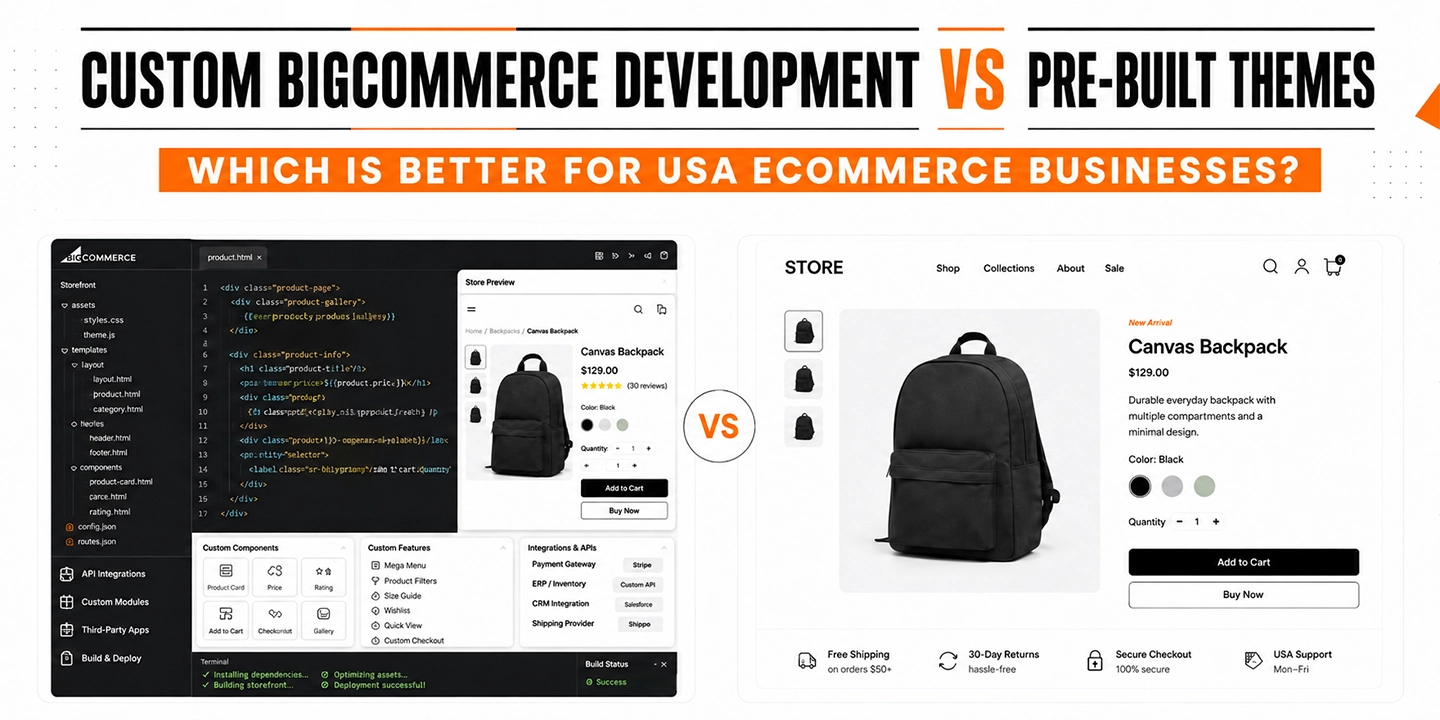
BigCommerce is one of the most capable SaaS ecommerce platforms available today. But out-of-the-box BigCommerce and custom BigCommerce development services are two very different things. This article walks through the clearest signs that your business has outgrown the default setup and why working with a specialized BigCommerce development company may be the single most important investment you make this year.
What Are Custom BigCommerce Development Services?
Custom BigCommerce development services refer to professional development work that goes beyond BigCommerce’s built-in templates, apps, and default configurations. This includes custom theme development, API integrations, headless commerce builds, B2B-specific features, checkout customizations, ERP/CRM connections, and performance engineering specifically designed for your store’s needs.
In short: it’s building BigCommerce to fit your business, rather than forcing your business to fit BigCommerce.
Sign #1: Your Store Looks and Feels Like Everyone Else’s
This one stings a little, but it’s true. If you picked a BigCommerce theme from the marketplace, made a few color changes, and called it a day, you’re probably sharing visual DNA with dozens of other stores.
According to a Baymard Institute study (baymard.com), first impressions from design account for a significant portion of users’ trust decisions, and poor UX is one of the leading causes of cart abandonment. With an average documented cart abandonment rate hovering around 70%, the visual and functional experience of your store is not a cosmetic issue; it’s a revenue issue.
A BigCommerce customization services provider can build you a fully custom theme from scratch, or significantly extend an existing one to match your brand, your customer journey, and your conversion goals. That includes custom product page layouts, advanced filtering experiences, unique homepage structures, and a mobile-first design that actually converts.
Sign #2: You’re Losing Sales at Checkout
The default BigCommerce checkout works well for basic setups. But once you start needing things like multi-step checkout flows, custom field capture, business account pricing at checkout, split shipping, or custom payment logic, you’ll quickly run into walls.
Baymard Institute data also shows that roughly 17% of US adults have abandoned an order specifically because the checkout process was too long or complicated (baymard.com). That’s not a small number.
Custom BigCommerce development can extend the Optimized One-Page Checkout using BigCommerce’s Checkout SDK, allowing your development team to reshape the checkout experience around your customers’ actual needs. For B2B businesses especially, this can mean supporting purchase order numbers, custom net-terms fields, or role-based pricing shown directly at checkout.
If your checkout is creating friction right now and you can’t fix it through the control panel, it’s time to bring in specialized developers.
Sign #3: Your Integrations Are a Mess
Most growing businesses run on more than just their ecommerce platform. You’ve got an ERP. Maybe a CRM. Possibly a warehouse management system, a custom PIM, a loyalty platform, and a returns management tool. Getting all of these to work together cleanly through standard BigCommerce apps is, in most cases, not realistic.
The thing is, poorly integrated systems cause real operational problems. Orders fall through the cracks. Inventory counts are off. Customer data lives in four different places. Your team spends hours manually syncing things that should sync automatically.
McKinsey & Company research has found that businesses that effectively integrate their digital systems see measurable gains in operational efficiency and customer experience outcomes. Integration debt is a real thing, and it compounds over time.
A professional BigCommerce development company will typically build custom API integrations using BigCommerce’s REST and GraphQL APIs, creating bidirectional data flows between your platform and your other business systems. Done right, this eliminates manual work, reduces errors, and gives you a single source of truth across your operations.
Sign #4: You’re Scaling and the Platform Is Slowing You Down
BigCommerce handles scale reasonably well at the platform level, but there’s a difference between the platform handling traffic and your store handling traffic. If you’re running thousands of SKUs, complex product relationships, heavy catalog filtering, or high-volume flash sales, the standard setup often isn’t enough.
According to Google’s research on page experience, a one-second delay in mobile page load time can reduce conversions by up to 20%. And with Google now incorporating Core Web Vitals directly into its ranking algorithm, slow page loads aren’t just a UX problem. They’re an SEO problem too.
Custom BigCommerce development focused on performance includes things like: moving to a headless architecture using BigCommerce’s storefront API, implementing custom caching strategies, lazy-loading product catalog data, optimizing image delivery pipelines, and reducing third-party script bloat.
If your store is getting slower as it grows, that’s a direct sign you need engineering-level attention, not just another app from the marketplace.
Sign #5: You’re Trying to Compete in a B2B Market
BigCommerce has invested heavily in its B2B capabilities, and honestly, it’s one of the platform’s strongest differentiators. But most of the advanced B2B features, things like company account hierarchies, buyer-specific catalogs, custom pricing tiers, quote management, and requisition lists, require meaningful configuration and often custom development to work exactly right for your business model.
According to Statista, global B2B ecommerce sales are projected to surpass $36 trillion by 2026, dwarfing B2C ecommerce by a wide margin. Businesses that win in B2B ecommerce are the ones that give buyers a purchasing experience that mirrors what they’re used to in consumer commerce: easy reordering, transparent pricing, account management, and seamless approval workflows.
Getting that right on BigCommerce typically requires a BigCommerce development company with specific B2B experience. They’ll know how to use BigCommerce’s Customer Groups, Price Lists, and the B2B Edition features in combination, and when to build something custom on top of them.
Sign #6: You Need Headless Commerce
Headless commerce is one of the most significant architectural shifts in ecommerce right now, and BigCommerce is one of the best platforms available for it. In a headless setup, the frontend presentation layer is decoupled from the backend commerce engine, giving developers complete control over the user experience while still using BigCommerce to handle catalog, checkout, payments, and order management.
From my experience, businesses considering headless are usually doing so for one of a few reasons: they need a content-heavy experience that a traditional storefront can’t support, they’re running multiple storefronts across different brands or regions, they want to push commerce into non-traditional surfaces like mobile apps or voice interfaces, or they simply need performance that a traditional SaaS storefront can’t deliver at their traffic levels.
Enterprise BigCommerce development almost always involves headless when the business is sophisticated enough to need it. This isn’t a DIY project. It requires frontend developers experienced in React or Next.js, backend developers who know BigCommerce’s APIs deeply, and a solid DevOps setup to keep everything running.
Sign #7: Your Mobile Experience Is Underperforming
One thing many businesses overlook is the gap between having a “mobile-responsive” store and having a store that actually converts on mobile. Responsive design means your site adjusts to screen sizes. A truly mobile-optimized experience means the entire customer journey has been designed around how mobile users actually shop.
According to Salesforce’s State of Commerce report, mobile devices now account for more than 60% of digital commerce traffic. But conversion rates on mobile still lag significantly behind desktop in most categories, which points directly to experience quality, not intent.
Custom BigCommerce development can close that gap through mobile-specific UX decisions: sticky add-to-cart buttons, swipe-friendly product galleries, thumb-zone navigation, accelerated mobile checkout flows, and performance engineering tuned for lower-bandwidth connections.
If your mobile traffic is high but your mobile conversion rate is noticeably lower than desktop, that’s a clear sign custom development investment would pay off.
Sign #8: You’re Planning a Platform Migration
If you’re currently on Magento, Shopify Plus, WooCommerce, or another platform and considering moving to BigCommerce, this is not a job for a generalist developer or a migration tool you found online.
A BigCommerce migration involves moving your product catalog, customer data, order history, SEO metadata, URL structures, and potentially your third-party integrations, all without losing organic search rankings or disrupting ongoing sales. Done wrong, a platform migration can cost a business more in lost traffic and revenue than it saves in reduced platform costs.
That’s where things change: a qualified BigCommerce development company with migration experience will map your existing data structures to BigCommerce’s schema, build redirect maps to preserve your SEO equity, and run parallel testing before the final cutover. This kind of structured migration is the difference between a smooth launch and a traffic disaster.
Sign #9: Your Team Is Spending Too Much Time on Manual Tasks
If your operations team is manually exporting and importing CSV files to update inventory, copy-pasting orders into a separate system, or spending hours every week on tasks that should be automated, you’re paying a hidden operational tax every single day.
Custom development can automate workflows that standard BigCommerce apps can’t handle. Whether that’s automatically routing orders to different fulfillment centers based on rules, triggering customer segmentation updates based on purchase behavior, or syncing product data from a custom PIM in real time, automation at this level requires custom API work.
Deloitte research on digital transformation consistently finds that operational automation delivers some of the highest ROI of any technology investment, particularly for mid-market and enterprise businesses where labor costs are significant.
Sign #10: You’re Running Multiple Storefronts or International Operations
BigCommerce’s Multi-Storefront feature is genuinely powerful, but managing multiple storefronts across different regions, currencies, languages, and catalogs requires a level of technical setup that goes well beyond what a non-technical team can handle alone.
International ecommerce introduces complexity around localized pricing, tax rules by jurisdiction, language management, region-specific payment methods, and compliance requirements like GDPR. Managing all of that cleanly inside BigCommerce, while maintaining a consistent brand experience across all storefronts, requires deliberate architectural planning and ongoing development support.
If you’re expanding into new markets or managing multiple brands under one platform, enterprise BigCommerce development is essentially a requirement at that point.
What to Look for in a BigCommerce Development Company
Not all agencies are the same, and the BigCommerce partner ecosystem has a wide range of capability levels. When you’re evaluating who to work with, look for:
- BigCommerce Partner status (Elite, Certified, or Select tiers indicate vetted experience)
- Demonstrated experience with projects similar in scope and industry to yours
- A process that starts with discovery and technical planning, not just development estimates
- References or case studies with measurable outcomes (conversion lift, load time improvement, revenue growth)
- Ongoing support capabilities, not just launch-and-leave engagements
- Transparent communication about timelines, scope, and costs
One thing to be honest about: the cheapest option rarely wins in custom ecommerce development. You’re investing in work that directly affects your revenue, and cutting corners on quality creates technical debt that costs more to fix later.
BigCommerce by the Numbers: Why the Platform Matters
Before you commit to significant development investment, it’s worth understanding why BigCommerce is worth building on in the first place.
BigCommerce powers over 60,000 online stores across more than 150 countries. The platform consistently ranks among the top SaaS ecommerce solutions for mid-market and enterprise businesses, particularly in categories like B2B commerce, multi-channel selling, and API-first architecture.
According to data from eMarketer, US ecommerce sales are projected to exceed $1.7 trillion by 2027, with mid-market and enterprise merchants driving a significant share of that growth. Businesses that invest in platform performance and customization now are positioning themselves to capture a much larger share of that market than those running on out-of-the-box configurations.
BigCommerce’s open API architecture, combined with its SaaS reliability and native features, makes it one of the most customization-friendly platforms available without requiring you to host and maintain your own infrastructure. That’s a meaningful advantage compared to Magento or custom-built platforms.
Final Thoughts
The signs are usually pretty clear, even if it takes a while to acknowledge them. When your store is slowing down, your integrations are breaking, your checkout isn’t converting, or your team is doing work that should be automated, that’s the platform telling you something needs to change.
Custom BigCommerce development services exist for exactly this reason. Whether you need a custom storefront that actually reflects your brand, a technical architecture that can support your next five years of growth, or integrations that finally make your operations run the way they should, the right development partner can get you there.
The businesses that win in ecommerce are not the ones with the biggest budgets. They’re the ones who invest strategically in the right places at the right time. If any of the signs in this article sound familiar, now is probably that time.