
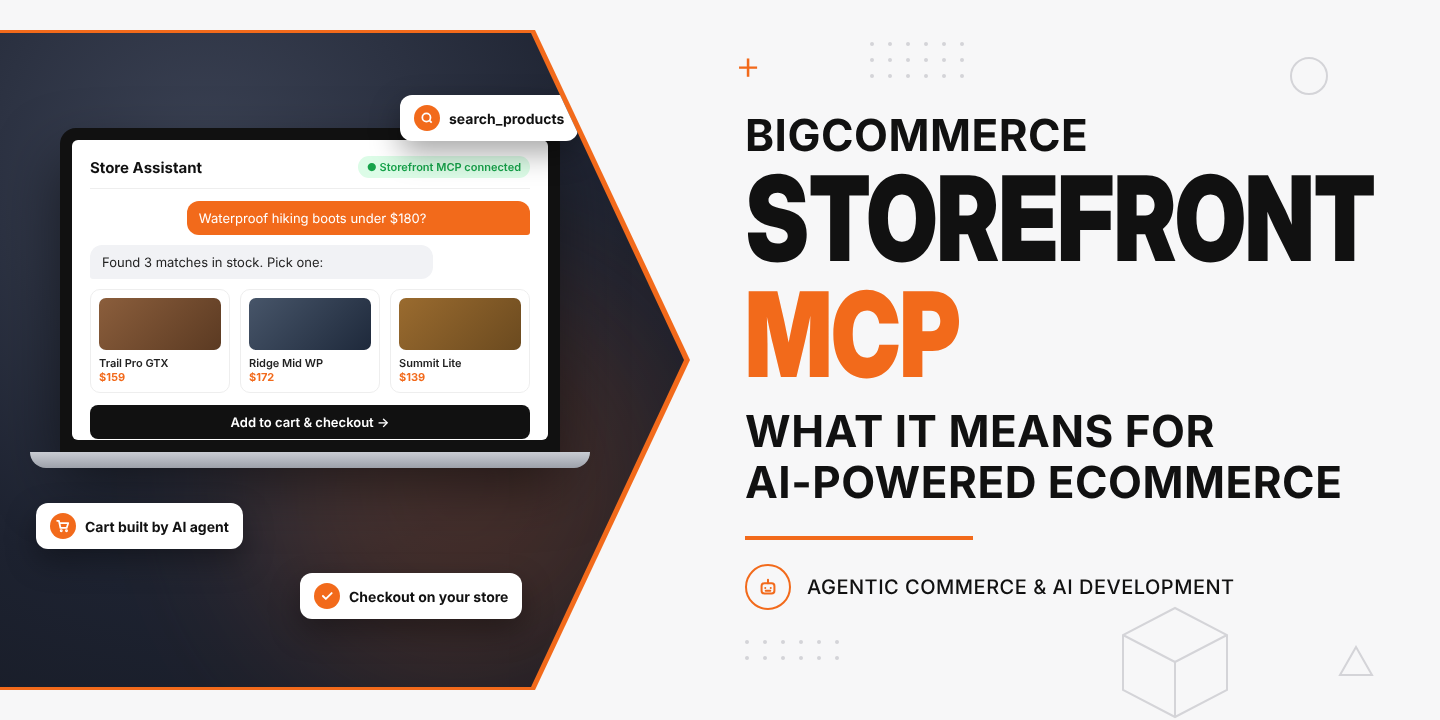
BigCommerce Storefront MCP: What It Means for AI-Powered Ecommerce

Key takeaways

  • BigCommerce Storefront MCP is an official Model Context Protocol server that lets AI agents search a BigCommerce catalog, read product details, build a cart and send the shopper to checkout.
  • BigCommerce made it available to every live, transacting store on May 11, 2026. Merchants opt in from the control panel, and each storefront gets its own MCP endpoint.
  • Guest shopping works with no login. B2B Edition stores also get permission-gated tools for shopping lists and quotes.
  • Checkout still happens on your store. Your payment, tax, shipping and fraud rules stay in force.
  • The stores that win in AI channels will be the ones with clean product data, fast checkout and a team that can build and test agents against the endpoint.

What is BigCommerce Storefront MCP?

BigCommerce Storefront MCP is a hosted server, provided by BigCommerce, that exposes a store’s shopping functions to AI agents through the Model Context Protocol (MCP). An agent such as Claude, ChatGPT or a custom shopping assistant can call it to search products, check variants, manage a cart and generate a checkout link on behalf of a shopper.

MCP is an open standard for connecting AI models to outside tools. Instead of scraping your pages, an agent asks your store directly through named functions. BigCommerce’s developer documentation describes the server as a set of purpose-built commerce tools, and BigCommerce announced on its blog that the feature is open to every store on the platform.

For a US merchant, the practical meaning is simple. Your catalog becomes something an AI assistant can shop, with your store’s rules intact.

Why it matters now

Shoppers already start product research inside AI assistants, and that traffic converts. Adobe Analytics data reported in 2026 shows AI traffic to US retail sites grew 393% year over year in Q1 2026 and converted 42% better than non-AI channels. Bain forecasts that agentic commerce in the US could reach $300 billion to $500 billion by 2030, or 15% to 25% of ecommerce sales. That makes agent readiness a 2026 priority for every BigCommerce store.

BigCommerce has placed this at the center of its roadmap. At Commerce Live 2026 in Chicago (April 28 to 30), its parent company, Commerce, announced agent-ready product data through Feedonomics and distribution to AI discovery surfaces including ChatGPT, Gemini, Microsoft Copilot, Perplexity, PayPal and Stripe. Storefront MCP is the piece that lets an agent act on that data inside your store, and it is where custom AI agent development starts to pay off.

How BigCommerce Storefront MCP works

The server exposes tools, which are functions an agent can call. A typical guest session runs like this:

  1. Search. The agent calls search_products with a keyword (minimum three characters). It can pass non-personal context such as occasion or climate to sharpen results, and page through large catalogs with a cursor.
  2. Inspect. The agent calls get_product_details to fetch variants and images. If the product has options such as size or color, the agent asks the shopper to choose first.
  3. Build the cart. The agent adds, updates or removes line items.
  4. Hand off checkout. The agent generates a checkout URL and sends the shopper to your BigCommerce checkout to pay.

Source: BigCommerce B2C Storefront MCP developer reference. Want this flow tested on your catalog? Our BigCommerce development services team can set it up.

Because the final step lands on your own checkout, your payment gateway, promotions, tax calculation, shipping rules and fraud screening all apply as they do today.

B2C vs. B2B tools at a glance

Capability B2C (guest) B2B Edition buyers
Login required No Yes, through Storefront Session Sync
Product search and details Yes Yes
Cart and checkout link Yes Yes
Shopping lists No Yes, if the buyer has the permission
Quotes No Yes, permission-gated
Tool set per user Same for all guests Can differ by buyer role on the same company account

Source: BigCommerce B2B Storefront MCP developer reference.

The B2B detail matters for US distributors and manufacturers. A purchasing manager can ask an assistant to rebuild last quarter’s shopping list or request a quote, and the agent only sees the actions that buyer is allowed to take.

How to enable Storefront MCP on your store

  1. Sign in to the BigCommerce control panel as the store owner.
  2. Go to Settings, then API and MCP, then MCP. (BigCommerce’s launch post also points owners to Settings → Early Access.)
  3. Turn on the Storefront MCP toggle and accept the terms of service.
  4. Under Select storefront, choose a storefront to view its MCP API Endpoint. Each storefront has its own URL.
  5. Allow up to 10 minutes for the server to become available, then connect your agent or MCP client.

Source: BigCommerce MCP developer documentation. If you would rather not handle setup in-house, you can hire BigCommerce developers from DIT to enable, connect and test it.

Turning it on takes minutes. Making agents sell well takes product data work, testing and design, which is where most of the effort goes.

What you can build with it

BigCommerce lists several use cases in its launch announcement. Here is how each plays out for a US brand, and each one benefits from strong UI/UX design so shoppers trust the assistant:

  • Conversational product discovery. A shopper describes a need (“waterproof hiking boots for wide feet under $180”) and the agent returns matching SKUs from your live catalog.
  • Vertical shopping agents. A fashion stylist, outdoor gear advisor or auto-parts fitment assistant trained on your category language.
  • Quiz-to-cart flows. A short guided quiz that ends in a pre-filled cart, measured by add-to-cart rate.
  • Gift finders. Seasonal assistants for Mother’s Day, Father’s Day or the holidays, with shareable lists and embeddable widgets.
  • Cross-storefront experiences. For groups running several brands on BigCommerce multi-storefront, one assistant can shop across them.

Each of these needs a front end, prompt design, guardrails and analytics. That is agent development work, and our agentic AI development services team builds it on top of the MCP endpoint.

What Storefront MCP does not do (yet)

Be clear-eyed about the current scope:

  • It is shopper-side. The server is built for shopping agents, not for store administration. Catalog edits, order management and reporting still run through the BigCommerce admin and APIs.
  • Authenticated B2C shopping is next. BigCommerce says personalized pricing, order history and account features for logged-in consumers are coming.
  • Agent-native payment is separate. Storefront MCP hands off to your checkout. In-chat payment depends on protocols such as Google and Shopify’s Universal Commerce Protocol (UCP) and OpenAI and Stripe’s Agentic Commerce Protocol (ACP), plus Commerce’s PayPal and Perplexity integrations.

How to prepare your BigCommerce store for AI agents

Agents read data, not design. If your attributes are thin, an agent cannot match your product to a detailed request. Start here:

  1. Enrich product data. Fill in materials, dimensions, compatibility, use cases and care instructions as structured attributes, not only in description text.
  2. Clean up variants and options. Agents must ask the shopper to pick options before adding to cart. Confusing option names cause dropped sessions.
  3. Sync inventory and pricing in real time. An agent that recommends an out-of-stock item loses the sale and the shopper’s trust.
  4. Speed up checkout. The handoff lands on your checkout page. Every extra field costs conversions. Our conversion rate optimization service audits that last step.
  5. Feed AI discovery channels. Use Feedonomics or a similar feed tool so your products appear in ChatGPT, Gemini and Copilot in the first place.
  6. Track AI-referred sessions. Tag checkout URLs generated by agents so you can measure conversion and average order value by channel.
  7. Consider a headless front end. Brands on Catalyst or a custom React or Next.js storefront can embed agent experiences more freely. See our headless commerce solutions.

Choosing a BigCommerce development company for agentic commerce

Most in-house teams can flip the toggle. Fewer can design a shopping agent that converts, connect it to clean data and keep it safe. When you evaluate a BigCommerce development company or BigCommerce development agency, ask:

  • Have they shipped production BigCommerce builds, including B2B Edition and multi-storefront?
  • Can they build and evaluate AI agents, not only themes?
  • Do they handle product data and feed management?
  • Will their BigCommerce design services cover the conversational UI as well as the storefront?
  • Can you hire BigCommerce developers on a dedicated or white-label basis to extend your team?

DIT Interactive is a BigCommerce Certified partner rated 4.9 from 39 reviews on the BigCommerce partner directory, with a US office in Iselin, New Jersey. Our BigCommerce development services cover store builds, migrations, B2B, headless storefronts and now Storefront MCP agent projects. As a BigCommerce web design company, we also design the conversational interfaces your shoppers will use.

Ready to put your catalog in front of AI shoppers? Book a BigCommerce MCP consultation or hire BigCommerce developers to start this quarter.

Best BigCommerce Development Agencies in the UK for Enterprise Ecommerce Growth in 2026

The ecommerce space is now in a stage where there is a need for much more than just having a website. There are enterprise brands that will need an ecommerce solution that can handle massive product cataloging, growing consumer expectations, integration, and more.

BigCommerce has emerged as one of the most preferred solutions when it comes to finding the ideal ecommerce platform that is capable of scaling up and allowing for flexibility and growth. With commerce capabilities built-in, BigCommerce makes it easy for brands to create great buying experiences and easier store management.

Choosing a reputable agency to partner with for developing the ideal store is also critical in helping businesses succeed. The best agencies will ensure that the developed stores are scalable, fast, user-friendly, and security-compliant.

There are numerous ecommerce agencies in the UK that help business owners create successful BigCommerce stores.

These are the leading BigCommerce development agencies in the UK.

1. DIT Interactive

DIT Interactive is an interactive digital commerce agency offering assistance to companies to design and develop scalable and high-performance ecommerce stores. The agency partners with brands seeking to develop their ecommerce presence through creative development, design, and use of technology.

The range of services offered by DIT Interactive include ecommerce development, custom ecommerce websites, UX/UI optimization, integrations and ecommerce store optimization among others. The agency focuses on creating high performance, visually attractive, and business oriented ecommerce experiences for businesses.

For any businesses interested in getting professional BigCommerce website design and development in UK, DIT Interactive assists them to build flexible and scalable ecommerce platforms.

Why Choose DIT Interactive?

DIT Interactive recognizes that enterprise ecommerce needs more than just an ordinary website. Enterprises need robust technical setups, smooth customer experience, and solutions that will grow alongside their needs.

Their strong points are:

  • Ecommerce solutions customized according to company objectives
  • Performance and customer experience-driven approach
  • Scalable development process
  • Up-to-date design and technology trends
  • Handling complex ecommerce cases

Companies looking for BigCommerce developers in UK can collaborate with DIT Interactive to develop ecommerce experiences that will be robust and scalable.

2. Magneto IT Solutions

Magneto IT Solutions aids businesses in crafting and refining their digital commerce experiences by way of technical solutions.

They offer a range of services like ecommerce consultation, development, migration, and optimization. The company’s expertise in handling enterprise-scale projects allows brands to set up stores that are ready for the future demands of customers.

Magneto specializes in blending technological insights and ecommerce strategy to craft a platform that works effectively.

3. W3nuts

W3nuts is an agency in digital development, assisting organizations in developing ecommerce capabilities using technological innovations.

These innovations include development, customization, and digital enhancements that assist companies in creating smooth ecommerce experiences for their customers.

This includes the areas of usability, functionality, and performance, allowing companies to develop ecommerce stores that are easier to manage and can be expanded.

4. Fixnhour

Fixnhour offers ecommerce development and technology services to businesses that aim to enhance their digital processes.

The firm assists brands in ecommerce development, customization, and making technical changes. Fixnhour’s technology solutions enable businesses to operate smoothly while catering to their changing needs.

The firm aims to develop ecommerce solutions that are practical and enhance the performance of online stores.

5. RAK Design

RAK Design is an Internet-based agency specializing in developing interesting web and e-commerce solutions.

RAK Design merges creativity and development skills in order to provide brands with a platform that would reflect their identity and engage potential clients.

RAK Design assists organizations seeking to develop attractive e-commerce sites with enhanced usability and client-oriented experience.

Why Businesses Choose BigCommerce for Enterprise Ecommerce Growth

Business ecommerce demands an architecture that will support growth and scalability without any complications. BigCommerce offers companies the means to do that through their flexible architecture.

Among the main advantages of this platform are:

  • Scalable ecommerce infrastructure
  • Solid security mechanisms
  • Customizable architecture
  • Easily integrated third-party solutions
  • Both B2B and B2C sales support

With the help of a competent development company, companies can build robust ecommerce ecosystems on BigCommerce rather than plain ecommerce shops.

What to Look for in a BigCommerce Development Agency?

Choosing the right ecommerce partner can directly impact the success of an online business. A reliable agency should understand both technical requirements and business objectives.

Experience With Ecommerce Projects

A strong agency should have experience working with ecommerce platforms, integrations, and complex business requirements.

Companies searching for a trusted BigCommerce development agency in UK should consider agencies that understand enterprise challenges and customer expectations.

Design and User Experience Skills

A successful ecommerce store should be easy to navigate, visually appealing, and optimized for conversions.

Professional BigCommerce design services in UK help businesses create storefronts that provide better customer engagement and improve the shopping experience.

Long-Term Support

Launching an ecommerce store is only the beginning. Continuous improvements, updates, and optimization are important to maintain performance and competitiveness.

The Future of Enterprise Ecommerce With BigCommerce

In addition to growing, ecommerce businesses are required to use solutions that could handle evolving customer needs and market trends. Enterprise brands do not require only traditional online shops; they seek flexible ecommerce systems that allow personalization and automation and guarantee smooth user experience.

BigCommerce is a powerful solution that could serve as a basis for any business willing to grow while avoiding excessive technical challenges. In case of proper strategy, brands are capable of optimizing website performance, improving business operations, and offering better experiences to customers.

The cooperation with a competent BigCommerce development companies makes it possible for businesses to achieve great results thanks to custom development, integration, and optimization.

These are the agencies that help businesses in building ecommerce systems of the future.

In 2026, the ability of successful ecommerce growth will depend on the choice of the right platform, strategy, and development company.

Global Checkout Revolution: Why Stripe Partnered with BigCommerce in 2026

The e-commerce industry has spent years trying to solve one persistent problem: checkout friction.

Brands invest heavily in advertising, website design, product pages, and customer acquisition. Yet many potential customers still abandon their carts during the final few minutes of the buying process. Sometimes the payment options aren’t available. Sometimes international transactions fail. Sometimes the checkout experience simply feels slow or unfamiliar.

That’s exactly why the announcement of Stripe’s deeper partnership with BigCommerce in 2026 is attracting so much attention across the e-commerce industry.

This isn’t just another technology partnership. It’s a strategic move aimed at improving global commerce, simplifying cross-border payments, and helping merchants create faster purchasing experiences for customers around the world.

For businesses already operating on BigCommerce or planning a migration, the implications are significant. Many brands are now looking toward a reliable BigCommerce web design company in USA and experienced providers of BigCommerce development services to fully benefit from these new capabilities.

Let’s explore why this partnership matters and how it could reshape e-commerce over the next few years.

What Is the Stripe and BigCommerce Partnership?

Quick Answer

Stripe and BigCommerce have expanded their collaboration to provide merchants with improved payment infrastructure, broader international payment support, faster checkout experiences, and better tools for global ecommerce growth.

The partnership focuses on solving some of the biggest challenges facing online retailers:

  • International payment acceptance
  • Checkout abandonment
  • Currency management
  • Payment security
  • Mobile checkout performance
  • Cross-border commerce

The thing is, modern e-commerce is no longer limited to local customers.

A store based in Texas may receive orders from Germany, Australia, India, and Canada on the same day. Managing payments across multiple countries can become surprisingly complicated.

Stripe has become one of the world’s most recognized payment platforms because of its ability to simplify those challenges. BigCommerce, meanwhile, continues to position itself as a flexible e-commerce platform for growing businesses and enterprise brands.

Bringing these strengths together creates a more unified shopping experience.

Why Global Checkout Has Become a Critical Ecommerce Challenge

Many online stores focus heavily on attracting traffic.

But traffic alone doesn’t generate revenue.

Revenue happens when customers complete purchases.

You’ll notice that many businesses spend thousands of dollars acquiring visitors, only to lose them at checkout.

Common checkout problems include:

  • Limited payment methods
  • Slow payment processing
  • Currency confusion
  • Security concerns
  • Complex checkout forms
  • Mobile usability issues

According to various e-commerce studies conducted over the past several years, checkout friction remains one of the leading causes of cart abandonment worldwide.

That’s where things change with integrated payment ecosystems.

Instead of treating checkout as a separate process, platforms are beginning to build payment experiences directly into the shopping journey.

Stripe and BigCommerce are moving aggressively in that direction.

Why Did Stripe Choose BigCommerce?

A Strategic E-commerce Growth Opportunity

From Stripe’s perspective, BigCommerce represents a rapidly growing ecommerce ecosystem with merchants ranging from startups to enterprise organizations.

The platform is especially popular among:

  • B2B companies
  • Mid-market retailers
  • Fast-growing ecommerce brands
  • International merchants
  • Headless commerce adopters

Stripe’s payment infrastructure becomes even more valuable when integrated into platforms that support large transaction volumes.

By strengthening its relationship with BigCommerce, Stripe gains access to merchants seeking advanced payment functionality without the limitations often found in traditional e-commerce systems.

Honestly, it makes business sense for both companies.

Stripe gets broader adoption.

BigCommerce gets stronger payment capabilities.

Merchants get a better checkout experience.

Everyone benefits.

Why BigCommerce Needed a Stronger Payment Ecosystem

Competition in e-commerce platforms has become intense.

Businesses today compare platforms based on much more than product management features.

They look at:

  • Checkout performance
  • International selling capabilities
  • Payment flexibility
  • Customer experience
  • Mobile commerce readiness

BigCommerce understands that payment experiences directly influence conversion rates.

A customer who cannot use their preferred payment method often leaves immediately.

A customer facing a confusing international payment process may never return.

This is where advanced payment integrations become valuable.

Many businesses working with a Bigcommerce development company have already been investing in checkout customization, payment integrations, and user experience improvements.

The Stripe partnership makes those efforts more powerful by providing additional infrastructure and payment intelligence directly within the ecommerce environment.

Key Benefits of the Stripe and BigCommerce Partnership

1. Faster Checkout Experiences

Speed matters.

Every extra second spent during checkout increases the likelihood of abandonment.

The partnership focuses on reducing unnecessary steps and helping customers complete transactions quickly.

Benefits include:

  • Faster payment authorization
  • Simplified checkout flows
  • Better mobile responsiveness
  • Reduced transaction delays

In most cases, even small improvements in checkout speed can have a noticeable impact on conversion rates.

2. Expanded Global Payment Options

International customers expect local payment methods.

A customer in Europe may prefer one payment option, while a customer in Asia may prefer something completely different.

The collaboration enables merchants to offer broader payment choices, helping stores serve customers in multiple regions without requiring separate payment systems.

This is especially valuable for businesses expanding internationally.

3. Improved Mobile Commerce Performance

Mobile shopping continues to dominate ecommerce growth.

Yet many stores still struggle with mobile checkout optimization.

Small screens create challenges that don’t exist on desktop devices.

The Stripe-BigCommerce integration aims to reduce friction through:

  • Mobile-friendly payment flows
  • Faster authentication
  • Simplified form entry
  • Responsive checkout experiences

Customers can move from product discovery to purchase with fewer interruptions.

4. Better Cross-Border Commerce Support

Cross-border ecommerce often introduces complexities such as:

  • Currency conversion
  • Local regulations
  • Payment acceptance issues
  • Fraud prevention requirements

Stripe’s global infrastructure helps simplify many of these processes.

For merchants, this means fewer barriers when selling internationally.

For customers, it creates a more familiar purchasing experience.

5. Enhanced Security and Fraud Protection

Security remains a major concern for online shoppers.

Customers want confidence that their payment information is protected.

Businesses want protection against fraudulent transactions.

The partnership helps merchants access sophisticated fraud detection capabilities while maintaining a smooth checkout experience.

This balance is important because overly aggressive security measures can sometimes create additional checkout friction.

How This Impacts Ecommerce Brands

Small Businesses

Small merchants gain access to enterprise-level payment infrastructure without building complex systems from scratch.

This lowers the barrier to global expansion.

A smaller business can now compete more effectively with larger retailers.

Mid-Sized Companies

Mid-market brands often reach a stage where payment limitations begin affecting growth.

International expansion becomes difficult.

Payment management becomes more complex.

The Stripe and BigCommerce partnership provides tools that help support scaling operations without introducing unnecessary technical challenges.

Enterprise Retailers

Enterprise brands typically require:

  • Advanced payment routing
  • Global transaction support
  • Multiple currencies
  • High transaction volumes
  • Strong security controls

These organizations stand to benefit significantly from a more integrated payment ecosystem.

The Growing Role of Bigcommerce Development Services

Technology alone isn’t enough.

Many businesses still need expert implementation.

That is why demand for Bigcommerce development services continues to grow.

A successful e-commerce store requires more than simply installing a platform.

Businesses often need assistance with:

  • Checkout customization
  • Payment integrations
  • Performance improvements
  • Conversion-focused design
  • API development
  • Headless commerce implementation

The Stripe partnership creates additional opportunities for merchants to improve their online stores through strategic development work.

Why Businesses Are Hiring BigCommerce Experts in 2026

The e-commerce landscape is becoming increasingly specialized.

Many businesses are choosing to hire Bigcommerce developers rather than relying solely on internal teams.

There are several reasons for this trend.

Faster Deployment

Experienced developers understand platform best practices and can accelerate project timelines.

Custom Checkout Experiences

Every business has unique requirements.

Developers can build checkout flows that align with customer expectations and business goals.

Payment Optimization

Integrating payment systems properly often requires technical expertise.

A knowledgeable team can help avoid common implementation issues.

Scalability Planning

As transaction volumes grow, infrastructure decisions become more important.

Experienced developers can build systems that support long-term growth.

The Connection Between Checkout Experience and Web Design

Many people think checkout performance is purely a payment issue.

It isn’t.

Design plays a major role.

A confusing checkout layout can hurt conversions even if payment processing works perfectly.

This is one reason businesses frequently work with a BigCommerce web design company in USA when redesigning ecommerce stores.

Effective checkout design focuses on:

  • Clear navigation
  • Trust indicators
  • Mobile usability
  • Fast loading speeds
  • Reduced distractions
  • Simple form structures

When design and payments work together, conversion rates often improve.

How Bigcommerce Design Services Support Conversion Growth

Creating Trust

Customers buy when they feel comfortable.

Professional design helps establish credibility throughout the purchasing journey.

Reducing Friction

Good design removes obstacles.

Customers should never have to guess what happens next.

Improving Mobile Experiences

Mobile commerce continues growing every year.

Designing specifically for mobile shoppers has become essential.

Supporting Brand Identity

Checkout pages should feel like part of the overall shopping experience, not a disconnected payment screen.

This consistency helps increase customer confidence.

That’s one reason many businesses invest in Bigcommerce design services alongside payment improvements.

What This Partnership Means for International Expansion

Perhaps the biggest long-term impact of the Stripe-BigCommerce collaboration is its support for global commerce.

Selling internationally used to require:

  • Multiple payment providers
  • Regional integrations
  • Complex compliance processes
  • Significant technical resources

Today, platforms are making global selling much more accessible.

Businesses can reach new markets faster and provide localized experiences without rebuilding their entire ecommerce infrastructure.

For growing brands, this creates exciting opportunities.

The Future of Ecommerce Checkout

The checkout experience of the future will likely look very different from what many stores use today.

Customers increasingly expect:

  • One-click purchasing
  • Local payment options
  • Instant transaction confirmation
  • Mobile-first experiences
  • Faster authentication

The Stripe and BigCommerce partnership reflects these evolving expectations.

Instead of treating checkout as a separate stage, ecommerce platforms are working to make payments feel like a natural continuation of the shopping experience.

You’ll notice more brands focusing on reducing checkout friction because even small improvements can create meaningful revenue gains.

How Businesses Can Prepare

If you’re running a BigCommerce store, now is a good time to evaluate your checkout experience.

Ask questions such as:

  • Are customers abandoning carts at checkout?
  • Do international customers face payment barriers?
  • Is the mobile checkout experience smooth?
  • Are payment options aligned with customer preferences?
  • Is checkout performance limiting growth?

Answering these questions can reveal opportunities for improvement.

Many businesses partner with a Bigcommerce development agency to conduct checkout audits and identify areas where customer experience can be improved.

The goal isn’t simply adding new technology.

The goal is making it easier for customers to buy.

Conclusion

The Global Checkout Revolution is already underway, and the Stripe partnership with BigCommerce in 2026 highlights where ecommerce is heading next.

Consumers expect faster transactions, more payment choices, stronger security, and smoother purchasing experiences regardless of where they live. Businesses that can meet those expectations will be better positioned for growth.

For merchants looking to take advantage of these changes, investing in the right technology, design, and development support will be important. Whether you’re working with a BigCommerce web design company in USA, exploring Bigcommerce development services, partnering with a Bigcommerce development company, or planning to hire Bigcommerce developers, the focus should remain on creating a checkout experience that removes barriers and builds customer confidence.

In ecommerce, the final click matters more than ever.