
AI Shopping Statistics 2026: 20 Black Friday Data Points on AI Agents, AI Referrals & Conversion

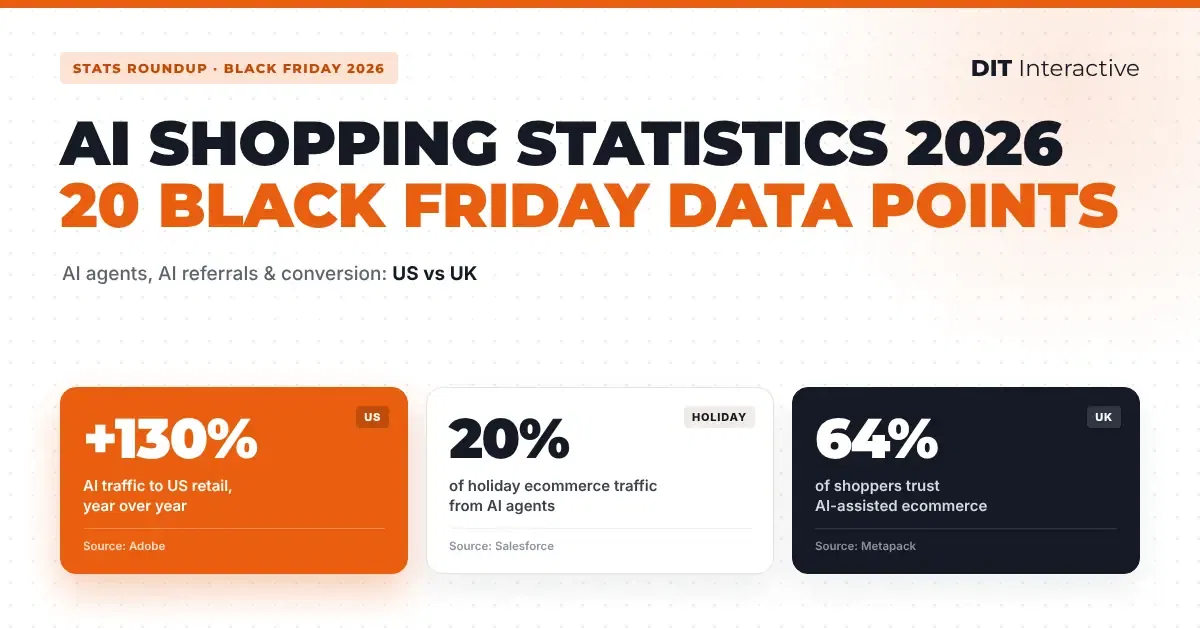
Key numbers: AI shopping statistics for 2026 point one way. Adobe expects AI traffic to US retail sites to rise 130% this holiday season and 95% on Black Friday. In September 2026, that traffic converted 90% better than other visits. Salesforce expects AI and agents to influence $75.8 billion of global Cyber Week sales.

Two years ago, AI referrals were a rounding error in most analytics dashboards. This Black Friday, they are one of the fastest-growing traffic sources in retail, and the shoppers they send arrive ready to buy.

We pulled together the 20 most useful AI shopping statistics 2026 has produced so far, from Adobe, Salesforce, Shopify and Metapack. Every figure below gives the number, the source, the date and a link, split into US, global and UK data. Under each group we explain what it means for your store. We will refresh this page with actual Black Friday and Cyber Monday results in early December.

AI shopping statistics 2026 at a glance

# Statistic Source Date Market
1 AI traffic to retail sites forecast to rise 130% YoY (Nov–Dec 2026) Adobe 28 Sep 2026 US
2 AI traffic forecast to rise 159% YoY on Thanksgiving Adobe 28 Sep 2026 US
3 AI traffic forecast to rise 95% YoY on Black Friday Adobe 28 Sep 2026 US
4 AI traffic forecast to rise 88% YoY on Cyber Monday Adobe 28 Sep 2026 US
5 AI traffic converted 90% better than non-AI traffic (Sep 2026) Adobe 29 Oct 2026 US
6 AI traffic generated 83% higher revenue per visit (Sep 2026) Adobe 29 Oct 2026 US
7 77% of AI shoppers feel more confident in their purchase Adobe survey of 5,000 consumers Sep 2026 US
8 69% are less likely to return an item bought with AI help Adobe 2026 US
9 $75.8B of $357B global Cyber Week sales influenced by AI and agents (21%) Salesforce Nov 2026 Global
10 AI-driven traffic to retailer sites up 104% YoY Salesforce Nov 2026 Global
11 31% of consumers have tried a personal AI agent Salesforce Nov 2026 Global
12 20% of holiday ecommerce traffic predicted to come from AI chat agents Salesforce 2026 Global
13 AI-referred orders up 3.3x and AI traffic up 2.6x YoY Shopify Q3 2026 results 3 Nov 2026 Global
14 AI-referred visits convert 64% more often than organic search Shopify Q3 2026 call 3 Nov 2026 Global
15 74% of AI-attributed purchases come from outside the top 100 categories Shopify Q3 2026 call 3 Nov 2026 Global
16 AI-referred retail traffic forecast to rise 214% YoY (Nov–Dec 2026) Adobe 5 Nov 2026 UK
17 37% of UK consumers use AI assistants to shop; 34% of them buy inside the assistant Adobe 25 Sep 2026 UK
18 AI-referred conversion overtook web search in May 2026 and led non-AI traffic by 20% in August Adobe 25 Sep 2026 UK
19 64% of UK consumers trust AI-assisted ecommerce, the highest in Europe Metapack 4 Feb 2026 UK
20 ChatGPT and other chat platforms drive 50.2M monthly UK shopping-intent visits Metapack 4 Feb 2026 UK

How much AI-referred traffic will Black Friday 2026 get?

Adobe expects AI-referred traffic on Black Friday 2026 to be 95% higher than last year in the US, as part of a 130% rise across the holiday season. The jump is steepest on Thanksgiving.

  1. AI traffic to US retail sites is forecast to rise 130% year on year in November and December 2026. Adobe measures this as shoppers clicking a link from an AI tool to a retail site. Source: Adobe, 28 September 2026.
  2. Thanksgiving is forecast to see the biggest jump, at 159%. Source: Adobe, 28 September 2026.
  3. AI-referred traffic on Black Friday is forecast to rise 95%. Source: Adobe, 28 September 2026.
  4. Cyber Monday AI traffic is forecast to rise 88%. Source: Adobe, 28 September 2026.

What it means for your store: AI referred traffic on Black Friday will be one of your fastest-growing sources, even if it is still a small share of total visits. Shoppers often research on Thanksgiving and buy on Friday, so your product data needs to be accurate by Wednesday. Our Black Friday ecommerce checklist for 2026 covers the last-minute fixes, including making product data readable by AI tools.

Does AI-referred traffic convert better than other traffic?

Yes. In 2026, AI-referred visitors buy more often and spend more per visit than shoppers from most other sources, in both the US and the UK.

  1. In September 2026, AI traffic to US retail sites converted 90% better than non-AI traffic, the highest level Adobe has recorded. Source: Adobe, 29 October 2026.
  2. AI traffic generated 83% higher revenue per visit than non-AI traffic in the US. Source: Adobe, 29 October 2026.
  3. 77% of US shoppers who have used AI for online shopping say it made them more confident in their purchase. Source: Adobe survey of 5,000 consumers, reported by Digital Commerce 360, September 2026.
  4. 69% of shoppers say they are less likely to return an item they bought with help from an AI assistant. Source: Adobe 2026 holiday forecast.

What it means for your store: AI shoppers arrive late in their decision. They have already compared options, so the product page has one job: confirm the facts the AI promised. Price, stock, delivery dates and return terms must match what the AI said. Fewer returns from these shoppers also makes this traffic worth more than its conversion rate alone suggests.

What are the key agentic commerce statistics for 2026?

The key agentic commerce statistics for 2026 show AI agents moving from recommending products to buying them. Salesforce and Shopify both report fast growth in orders, not only traffic.

  1. Salesforce expects $75.8 billion of the record $357 billion in global Cyber Week 2026 online sales to be influenced by AI and agents, about 21% of the total and up 13% on 2025. Source: Salesforce, November 2026.
  2. AI-driven traffic to retailer sites is up 104% year on year globally. Source: Salesforce, November 2026.
  3. 31% of consumers have already tried a personal agent such as Meta’s Muse or OpenAI’s Dots, and nearly 20% use AI tools as the first stop in their holiday shopping. Source: Salesforce Consumer Shopping survey, November 2026.
  4. Salesforce predicts that 20% of all 2026 holiday ecommerce traffic will come from AI chat agents. Source: Salesforce, 2026.
  5. On Shopify, AI-referred orders grew 3.3x year on year in Q3 2026, while AI traffic grew 2.6x. Shopify described the base as small. Source: Shopify Q3 2026 results via PPC Land, 3 November 2026.
  6. AI-referred visits to Shopify stores convert to a purchase 64% more often than visits from organic search. Source: Shopify Q3 2026 earnings call, reported by Stellagent, 3 November 2026.
  7. 74% of AI-attributed purchases on Shopify came from outside its top 100 product categories. Source: Shopify Q3 2026 earnings call, reported by AI Weekly, 3 November 2026.

What it means for your store: Orders are growing faster than traffic, which means agents are getting better at closing sales. Statistic 15 is the most encouraging one for smaller and niche brands: AI tools surface specific products, not just bestsellers. For a deeper look at how this shift works, read our guide on how AI agents are changing ecommerce, from product discovery to autonomous checkout.

How do UK shoppers use AI for online shopping?

UK shoppers are among the most confident AI shoppers in Europe. More than a third already use AI assistants to shop, and AI-referred traffic is converting better than web search.

  1. Adobe forecasts AI-referred traffic to UK retail sites will rise 214% year on year in November and December 2026, up from 111% growth in September. Source: Adobe UK holiday forecast, reported by Retail Tech Innovation Hub, 5 November 2026.
  2. 37% of UK consumers now use AI assistants to shop, and 34% of those shoppers complete purchases inside the AI assistant. Source: Adobe Digital Insights UK, 25 September 2026.
  3. In May 2026, the conversion rate for AI-referred traffic in the UK overtook traditional web search for the first time, and by August it held a 20% lead over non-AI traffic. Source: Adobe Digital Insights UK, 25 September 2026.
  4. 64% of UK consumers say they trust AI-assisted ecommerce, the highest level among the European markets in the study. Source: Metapack Ecommerce Delivery Benchmark Report 2026, 4 February 2026.
  5. Chat platforms including ChatGPT generate 50.2 million monthly shopping-intent visits in the UK, putting them alongside the country’s biggest ecommerce sites. Source: Metapack via Business Wire, 4 February 2026.

What it means for your store: UK shoppers already buy inside AI assistants, so the facts an assistant repeats about your delivery and returns matter as much as your own website copy. The same Metapack research found 30% of UK adults are open to AI acting as a personal shopping agent.

How should you read AI shopping forecasts?

Treat forecasts as direction, not as exact numbers. Last year Adobe forecast UK AI-referred holiday traffic would rise 410%, and the reported result was 329%: still strong growth, but lower than predicted. Growth percentages also look large because they start from a small base. Shopify, for example, has not disclosed what share of its orders come from AI.

Three rules help:

  1. Compare like with like. Adobe counts clicks from AI tools to retail sites. Salesforce’s “influenced” figure includes recommendations and agents, so it is much broader.
  2. Check the date. AI shopping data changes every quarter, so note the date of every statistic you cite.
  3. Measure your own store. Set up an AI-referral segment in GA4 (ChatGPT, Perplexity, Gemini, Copilot and Claude referrers) and compare its conversion rate and order value with organic search.

What should ecommerce stores do with these numbers?

These AI shopping statistics for 2026 lead to four practical steps:

  1. Fix product data first. Titles, prices, stock and shipping details must be accurate and machine-readable, because AI tools quote them directly.
  2. Publish clear policies. Returns, delivery cut-offs and warranty terms are the facts agents repeat most.
  3. Track AI referrals separately so you can see the conversion advantage in your own data.
  4. Plan for agents that buy, not just recommend. That means structured feeds, reliable checkout APIs and, for larger retailers, your own shopping agent. Our guide on how to build an AI shopping agent for your ecommerce business walks through the options.

If you need help with this, DIT Interactive works as an AI automation agency in USA and UK markets, building agentic AI tools for ecommerce brands. Our SEO services also cover visibility in AI search tools such as ChatGPT, Gemini and Perplexity.

Want to know how much of your traffic already comes from AI? Book a free call and we will show you how to segment AI referrals in GA4 and where your product data is holding you back. Book a free call

Turn AI shopping traffic into sales DIT Interactive is an AI automation agency in USA and UK markets. We build shopping agents, AI workflows and AI-ready product data for ecommerce brands. Talk to our AI team · Explore agentic AI development

Shopify Editions Fall 2026 (“Exponential”): 12 Updates US & UK Merchants Should Use Before BFCM

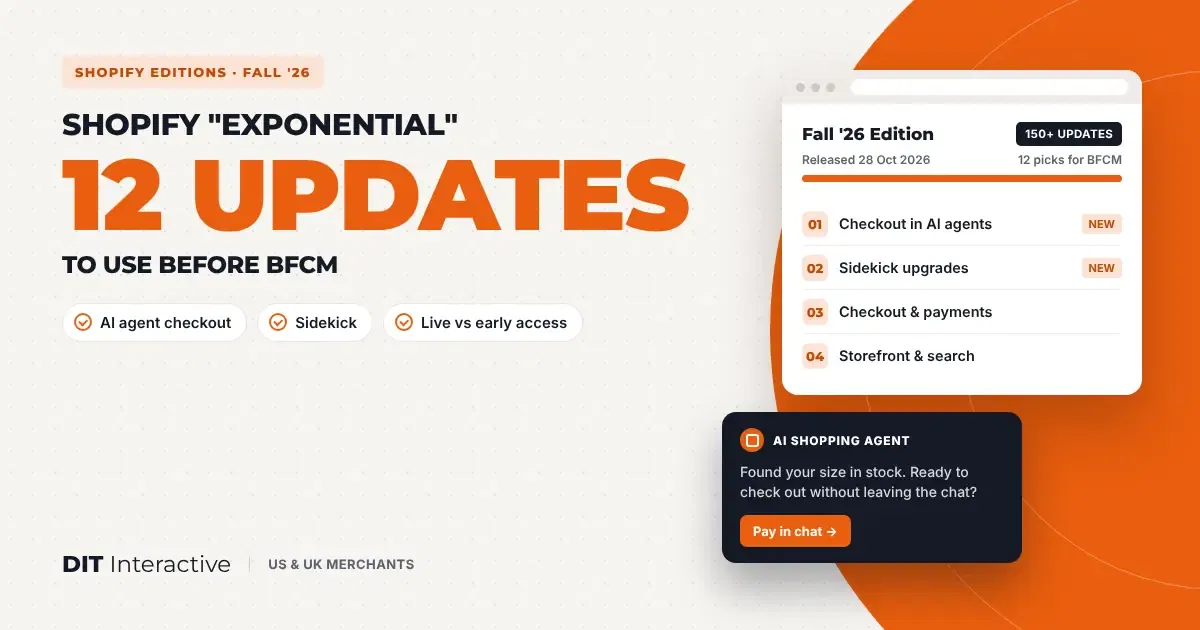
In short: Shopify Editions Fall 2026, named “Exponential”, launched on 28 October 2026 with more than 150 updates. The headline is agentic commerce: shoppers can now check out with Shop Pay inside AI agents. Before Black Friday, focus on the updates that are already live (compare-at prices for agents, the AI knowledge base, Catalog eligibility, Shopify Protect and Rollouts) and leave early-access tools until January.

A shopper in Ohio asks an AI assistant for a waterproof jacket under $150, compares three options, approves the purchase and pays with Shop Pay. She never opens your website, yet the order lands in your Shopify admin as yours. Since the Shopify Fall ’26 Edition, that journey is real.

The release is big. Shopify counts more than 150 updates across 11 categories, and some trackers list over 200 line items once sub-features are split out. With Black Friday on 27 November, nobody has time to read them all. This guide picks the 12 that matter for US and UK merchants, shows what is live versus early access, and tells you what to do with each one this week.

What is Shopify Editions Fall 2026?

Shopify Editions Fall 2026 is Shopify’s autumn product release, published on 28 October 2026 under the name “Exponential”. Shopify Editions is the company’s regular showcase of new features, and this is its tenth. The name reflects Shopify’s view that every new merchant, shopper and developer makes the network more useful for everyone else.

Three themes run through the Shopify Fall ’26 Edition:

  1. Agentic commerce: AI agents can now find products, recommend them and complete checkout.
  2. A rebuilt Shopify Sidekick: the admin AI assistant can plan and apply many store changes at once.
  3. Network-powered protection: Shopify uses data from across its merchants to block fraud and card testing.

Why does this matter now? In its Q3 2026 results, Shopify reported AI-referred orders up 3.3x year on year, with AI-referred sessions converting 64% more often than organic search. AI shopping is no longer a side channel, and this release is Shopify’s answer to it.

Which Fall ’26 updates are live now and which are early access?

Seven of the 12 updates below are live, two are rolling out and three are in early access. Use the live ones before Black Friday and leave early-access tools until after Cyber Monday.

# Update Status (Nov 2026) Best for Effort Before BFCM?
1 Shop Pay checkout in personal AI agents Live Stores using Shop Pay None Yes: check Shop Pay is on
2 shop.md skill for any AI agent Live Stores in Shopify Catalog None Yes: passive
3 Checkout in Google AI Mode and Gemini Rolling out (US, Canada, Australia) Eligible US stores 30 min Yes, if eligible
4 Compare-at prices shared with agents Live since 9 Oct 2026 Anyone running a sale 30 min Yes: audit prices
5 Shopify Catalog eligibility check Live Every store 15 min Yes
6 Knowledge base for AI channels Live Every store 30–60 min Yes
7 Shopify connectors for nine AI agents Live Owners and ops teams 15 min Optional
8 Sidekick staged plans Early access Large catalogs Varies No: wait
9 “Tested by Sidekick” (SimGym) Early access CRO teams Varies No: wait
10 Canvas design workspace Early access Redesign projects High No: wait
11 Shopify Protect On for Shopify Payments, features rolling out Stores on Shopify Payments 15 min Yes
12 Rollouts (Launch, Event, Experiment) Live Anyone scheduling a sale 30 min Yes

Statuses come from Shopify’s Editions page and help centre as reported in late October and November 2026. Check your own admin, because early-access tools appear store by store.

Shop Pay AI agents: the updates that change how shoppers buy

The biggest shift in Shopify Editions Fall 2026 is that the sale can now happen inside an AI conversation. Updates 1 to 4 cover this channel.

1. Shop Pay checkout in personal AI agents

What it does: Shoppers can approve and pay with Shop Pay inside personal AI agents. Shopify launched this with Meta’s Muse, Claude Duet and Instinct, and the Editions page also lists Grok Bot. The shopper approves each purchase by default and the agent never sees the full card number. Shoppers can also set weekly, monthly or total budgets for an agent.

Who it’s for: Every store that offers Shop Pay.

Status: Live.

Do this week: Confirm Shop Pay is active in Settings > Payments. There is nothing else to install. This is the clearest case for Shop Pay AI agents: if Shop Pay is off, you are invisible at the moment of purchase.

2. The shop.md skill

What it does: shop.md is a skill a shopper can add to ChatGPT, Claude or another agent. It turns that agent into a personal shopper that searches more than a billion products in Shopify Catalog, checks out with Shop Pay and tracks orders.

Who it’s for: Stores that appear in Shopify Catalog (see update 5).

Status: Live.

Do this week: Nothing to switch on. Your work is in the product data that the skill reads: titles, images, prices and variants.

3. Checkout in Google AI Mode and Gemini

What it does: Shoppers can buy inside Google AI Mode and the Gemini app through Shopify-powered checkout. Orders appear in your admin like any other order.

Who it’s for: Stores selling to shoppers in the US, Canada and Australia. UK merchants are not covered yet.

Status: Rolling out. It is on by default for eligible stores, and you can opt out under Sales channels > Agentic. It needs Google Merchant Center, Shopify Catalog eligibility, agreement to the agentic terms and complete store policies. It does not support subscriptions, bundles, customisable products or B2B-only products.

Do this week: If you sell in the US, check whether Google has emailed you about eligibility and make sure your shipping, returns and privacy policies are filled in.

4. Compare-at prices shared with agents

What it does: Your compare-at (“was”) prices now pass to AI agents, so they can show your markdown to shoppers.

Who it’s for: Anyone running a Black Friday sale.

Status: Live since 9 October 2026, with no setup needed.

Do this week: Audit every compare-at price on your sale products. An agent will repeat a fake or outdated “was” price to shoppers, and in the UK, misleading reference prices carry legal risk. Review the mapping under Sales channels > Agentic > Sources > Shopify Catalog.

Before you go further: If your store is not yet set up for AI discovery, start with our guide on how to make your Shopify store ready for AI search and AI shopping agents. It covers the product data work that updates 1 to 6 depend on.

How do you get your store ready for AI agents in Fall ’26?

Getting ready takes two quick admin checks: make sure your store is eligible for Shopify Catalog, then publish the facts you want agents to repeat. Updates 5 to 7 handle this.

5. Shopify Catalog eligibility check

What it does: A new admin view tells you whether your store is in Shopify Catalog and, if not, why.

Who it’s for: Every store. To qualify you need the Starter plan or higher, no storefront password, products with a title, image and a price above zero, and an account in good standing.

Status: Live.

Do this week: Open the check, fix any listed issues, and confirm your sale products show as eligible.

6. Knowledge base for AI channels

What it does: Shopify drafts facts about your store, such as shipping destinations, return windows and FAQs, from your storefront. Nothing reaches an agent until you review and publish it.

Who it’s for: Every store, especially those with holiday returns or delivery cut-offs.

Status: Live, now under Sales channels > Agentic. The old standalone Knowledge Base app shuts down on 15 January 2027.

Do this week: Publish your extended holiday returns window and Christmas delivery dates for each market. If an agent tells a UK shopper the wrong last order date, the complaint comes to you.

Is your store agent-ready for Black Friday? Book a free call and our Shopify team will check your Catalog eligibility, knowledge base and compare-at prices with you, so AI agents show the right deal. Book a free call

7. Shopify connectors for nine AI agents

What it does: You can manage products, inventory and discounts from the AI assistant you already use. The connectors work with nine agents: ChatGPT, Claude, Claude Duet, Microsoft Copilot, Google Gemini, Grok, Grok Bot, Muse and Perplexity. Orders and customer data are read-only.

Who it’s for: Owners and operations teams who want quick answers during peak week.

Status: Live.

Do this week: Optional. It is useful for questions like “which sale products are under 20 units?” Limit write access to staff who already manage the catalog.

What does the new Shopify Sidekick do, and should you use it before BFCM?

Shopify Sidekick was rebuilt in this release. It can now plan and apply many changes at once and test ideas on a copy of your theme, but the biggest features are in early access. Treat them as January projects, not Black Friday fixes.

8. Sidekick staged plans

What it does: Sidekick drafts several store changes as one set, for example rewriting every product description in a collection, and you approve them together. A set can hold up to 50 changes. Sidekick can also write and run code to forecast or summarise store data, though not in every store yet.

Who it’s for: Stores with large catalogs.

Status: Early access for some stores.

Do this week: Do not run bulk Sidekick changes during your code freeze. One approval can now change many products, so agree who reviews Sidekick plans before peak.

9. “Tested by Sidekick” (SimGym)

What it does: Sidekick builds a proposed storefront change on an unpublished copy of your theme and compares it with your live theme using Shopify’s AI shoppers. It labels a change as tested only if the copy shows a higher add-to-cart rate.

Who it’s for: Conversion teams that want quick test ideas.

Status: Early access, desktop only. It is a simulation, not a live A/B test with real shoppers.

Do this week: Nothing. Use it in January to shortlist ideas, then confirm winners with a real experiment (see update 12).

10. Canvas

What it does: Canvas is a design workspace that shows every page of your store in one place. You click to edit or ask Shopify Sidekick for anything from a small tweak to a full redesign.

Who it’s for: Stores planning a redesign.

Status: Early access since 1 October 2026. A theme edited in Canvas opens only in Canvas and stops receiving theme updates, and app blocks and app embeds are not supported yet.

Do this week: Do not open your live theme in Canvas. If you want to try it, use a duplicate theme after Cyber Monday. If a redesign is on your 2027 list, our Shopify store redesign guide explains when an upgrade is worth it.

What else in the Shopify Fall ’26 Edition matters for Black Friday?

Two operational updates are worth turning on before peak: Shopify Protect for fraud and Rollouts for scheduling your sale.

11. Shopify Protect

What it does: Shopify Protect uses data from across Shopify’s network to block near-certain fraud before payment is authorised, stop card-testing bots and explain each order’s risk in plain language. It also drafts AI dispute responses and adds delivery photos when you ship with Shopify Shipping. A separate Rule Builder app lets you create custom fraud rules and preview them against your last 90 days of orders, for $0.07 per screened transaction.

Who it’s for: Stores on Shopify Payments.

Status: Shopify says it is on for every Shopify Payments business. The Editions page lists some features as rolling out.

Do this week: Read the new risk explanations on a few recent orders so your team knows what they mean before the weekend rush.

12. Rollouts

What it does: One rollout can schedule or test your theme, checkout settings, discounts and market catalogs together. There are three types: a Launch (permanent), an Event (rolls back automatically when it ends) and an Experiment (splits traffic 50/50 by default; Grow plan or higher).

Who it’s for: Anyone scheduling a Black Friday or Cyber Monday sale.

Status: Live.

Do this week: Set your sale up as an Event so prices and banners switch back on time. Keep it at 100% reach so checkout, POS and your Google and YouTube feeds update too. An Event at less than 100% reach changes only the online store, so ads could show a different price.

Also worth knowing

  • Checkout custom fields (gift messages, delivery notes without an app) will not ship before or during BFCM. Plan for 2027.
  • Search suggestions as shoppers type: Shopify says add-to-carts from search rose 8%.
  • Shopify Messaging includes a pre-built Black Friday email campaign and automated WhatsApp abandonment messages.
  • Shop universal checkout lets shoppers buy from several brands in one cart in the Shop app, while each store still gets its own order.

How does Shopify Editions Fall 2026 differ for US and UK merchants?

US merchants get more of the agentic features today, while UK merchants get the same admin and fraud tools but wait for some AI checkout channels.

Feature United States United Kingdom
Shop Pay in personal AI agents Available Available where the agent and Shop Pay are offered
Checkout in Google AI Mode and Gemini Rolling out Not yet (US, Canada and Australia only)
Shop Promise badge Eligible US stores Not available
Shopify Tax Handles US sales tax for new businesses Not applicable
Compare-at prices, knowledge base, Catalog check Live Live
Shopify Protect and Rollouts Live Live
Pricing rules to watch FTC rules on fake reviews DMCC Act rules on drip pricing and reference prices

For UK stores, the practical priority is accuracy: make sure the facts and “was” prices that agents repeat are genuine.

What should developers and agencies do about Fall ’26?

Developers should note two deadlines that matter more than any new feature. Script tags stop loading on storefronts on 1 March 2027, so apps must move to app embed blocks or web pixels. Public apps must switch to expiring offline access tokens before 1 January 2027, and requests using old tokens fail from 1 April 2027. The new Liquid-first theme format is in developer preview with no general-availability date yet.

If your store relies on older apps or a custom theme, a Shopify web development agency in USA and the UK, such as our team, can audit your app stack for these deadlines in December.

Related reading: For the bigger picture of where this is heading, read our explainer on Shopify agentic commerce and how AI agents are changing the way customers buy. If you are still preparing for this week, our Black Friday ecommerce checklist for 2026 lists 15 last-minute store fixes.

Turn Fall ’26 into a 2027 roadmap Our certified team works as your Shopify web development agency in USA and the UK: we set up agentic channels, plan safe Sidekick and Canvas rollouts, and clear the 2027 app deadlines. Talk to our Shopify team · Explore Shopify development

Top Signs Your Business Needs Custom Shopify Development

If your Shopify store loads slowly, your checkout feels clunky, or your team spends more time fighting your website than growing sales, you likely need custom development, not another app. Common signs include app conflicts, slow page speed, inflexible checkout, poor mobile experience, and a theme that can’t scale with your catalog or traffic.

Honestly, most Shopify merchants don’t wake up one day and decide they need custom development. It’s usually a slower realization. You add another app to fix a problem, then another, then another, and six months later your store is a patchwork of workarounds held together with duct tape and hope. The thing is, by the time most business owners search for agentic shopify web development services, their store has already been quietly losing them money for months.

I’ve spent over a decade working with Shopify merchants, from small direct-to-consumer brands to multi-million dollar operations, and the pattern is almost always the same. There’s a moment where the free theme and the app-stack approach stop being enough. This article walks through exactly what that moment looks like, why it happens, and what working with a proper Shopify web development company actually looks like in practice.

What Is Custom Shopify Development?

Custom Shopify development means building or modifying your store’s theme, backend logic, checkout, and integrations with original code instead of relying only on pre-built themes and third-party apps. It gives you control over site speed, design, functionality, and how your store connects to inventory, ERP, CRM, and AI-driven shopping tools.

In most cases, this isn’t an all-or-nothing decision. A store might need a custom theme but standard checkout. Another might need a fully custom subscription flow but a mostly default product page. That’s where things change from a template mindset to an engineering mindset. You start asking what your business actually needs instead of what the theme marketplace has available.

Why This Topic Matters Right Now

Ecommerce isn’t optional anymore, and the platform you build on matters more than ever. According to Shopify’s own research, online sales made up roughly 20.5% of worldwide retail sales in 2025, with that share projected to keep climbing toward 22.5% by 2028. That’s not a niche channel. That’s a huge and growing part of how people buy things, period.

Shopify itself has become the backbone for a huge share of that growth. According to industry tracking, there are roughly 5.5 to 5.8 million live Shopify stores worldwide as of 2025, and in the US specifically, Shopify leads the ecommerce platform market with about 29% share, ahead of WooCommerce, Wix, BigCommerce, and Magento.

That scale is exactly why the “default theme plus a dozen apps” approach stops working past a certain size. When you’re competing against thousands of stores using the same three or four popular themes, differentiation and performance become the things that actually separate winners from everyone else scrolling past on page two of Google.

There’s also a newer force reshaping what “good” Shopify development even means: AI-driven shopping. According to Adobe Analytics, AI-referred traffic to U.S. retail sites grew 393% year over year in the first quarter of 2026, and that traffic converted 42% better than traditional search traffic during the same period. Shoppers are increasingly discovering and even completing purchases through AI agents and chat assistants, not just Google search. If your store’s product data, structure, and checkout aren’t built to be read cleanly by both humans and machines, you’re leaving a fast-growing channel on the table.

From my experience, this is the part most merchants haven’t caught up to yet. They’re optimizing for Google rankings from 2019 while an entirely new discovery layer, powered by AI agents, is quietly reshaping how people shop.

The Top Signs Your Business Needs Custom Shopify Development

1. Your Site Is Slow, and It’s Costing You Sales

Speed isn’t a nice-to-have. It’s revenue. A joint Google and Deloitte study found that a mere 0.1-second improvement in mobile load time increased retail conversions by roughly 8.4%, with a similar lift in average order value. On the flip side, a one-second delay in mobile load time can reduce conversions by around 7%.

Here’s the part that stings: if your Shopify store is stacked with a dozen apps, each one injecting its own scripts, tracking pixels, and stylesheets, that bloat is very likely the reason your Lighthouse score looks embarrassing. You’ll notice it especially on mobile, where most of your traffic probably lives now. Mobile commerce already makes up close to 44% of US ecommerce sales, and globally it’s closer to 59% of all online retail sales.

Sign it’s time for custom development: your homepage or product pages take more than 3 seconds to load on mobile, you’ve disabled apps just to test if they’re the bottleneck, or your developer keeps saying “the theme wasn’t built for this.”

2. You’re Stuck in “App Stack Jenga”

One thing many businesses overlook is how much technical debt builds up from stacking apps to solve problems the theme should have handled natively. A subscription app here, a bundle builder there, a custom currency switcher, a review widget, a size chart plugin. Each one adds a database call, a script, and a potential conflict.

I’ve audited stores running 30+ apps, most of which were duct-taping over gaps that custom code could close permanently, faster, and with far less monthly cost. This is one of the most common reasons businesses eventually hire a Shopify web design company instead of continuing to add apps.

A simple way to check where you stand:

Situation App-Based Fix Custom Development Fix
Product bundles with dynamic pricing Third-party bundle app Native bundle logic in theme + metafields
Complex shipping rules Multiple shipping apps Custom checkout extension
B2B wholesale pricing tiers Wholesale app subscription Custom customer tagging + price rules
Subscription products Recurring app fees Native subscription API integration
Personalized product recommendations AI recommendation app Custom logic tied to your actual data

3. Your Checkout Doesn’t Match Your Business Model

Checkout abandonment is one of the most well-documented problems in ecommerce, and it hasn’t improved much in a decade. Baymard Institute’s meta-analysis of 50 separate studies puts the average cart abandonment rate at 70.22%, meaning roughly seven out of every ten shoppers who add something to their cart never complete the purchase. Mobile abandonment runs even higher, around 80%, compared to about 66% on desktop.

A big chunk of that isn’t about your product or your price. It’s friction. Surprise fees, too many form fields, a checkout that doesn’t reflect how your business actually sells (subscriptions, made-to-order items, B2B net terms, local delivery windows) all push people away right at the finish line. Baymard’s research also suggests that solving documented checkout usability issues can lift conversion by more than 35% on large ecommerce sites.

If your checkout needs custom shipping logic, custom payment routing, loyalty point redemption, or age verification, and Shopify’s default checkout can’t flex to match, that’s a clear sign you need developers who can build checkout extensions, not another workaround app.

4. Your Design Looks Like Everyone Else’s

Quick answer: If your store uses an unmodified Shopify theme that hundreds or thousands of other merchants also use, customers may subconsciously associate your brand with generic templates rather than a distinct business, which can quietly hurt trust and conversion, especially for premium or DTC brands.

That’s where things change for brands trying to build real recognition. A custom-built storefront, even one that starts from a solid theme foundation and gets heavily modified, signals investment and credibility. Real-world example: I worked with a skincare brand that switched from a popular free theme to a custom build with a distinct product page layout, custom filtering, and a completely rebuilt homepage. Their conversion rate improved not because the products changed, but because the site finally looked like it belonged to a serious brand instead of a weekend side project.

5. You’re Scaling Fast and the Theme Can’t Keep Up

Growth exposes weaknesses that were invisible at a smaller scale. A theme that handled 200 SKUs might completely choke at 5,000. A store that ran fine at 500 daily visitors might time out or slow to a crawl during a viral moment or a big promotional push. During BFCM weekend 2025 alone, Shopify merchants generated $14.6 billion in global sales, a 27% year-over-year increase, with over 81 million shoppers buying from Shopify stores across that single weekend. Stores that weren’t built to handle traffic spikes at that scale lost real money during the exact moment they needed performance most.

Signs your theme has hit its ceiling:

  • Collection pages slow down noticeably as your catalog grows
  • Your team can’t launch a new landing page without a developer manually rebuilding sections
  • Your site crashes or slows during high-traffic sales events
  • International expansion requires multi-currency or multi-language support your theme doesn’t handle well

6. You Need Integrations Your Theme and Apps Can’t Handle

In most cases, once a business grows past a certain point, Shopify stops being a standalone tool and becomes one piece of a bigger operational puzzle: ERP systems, warehouse management, custom CRM data, proprietary pricing engines, or legacy B2B systems that were never built with ecommerce in mind. Off-the-shelf apps are built for common use cases. They’re not built for your specific data structure, your specific fulfillment partner, or your specific pricing logic.

This is where you’d typically hire Shopify developers who can build custom API connections between Shopify and your other systems, rather than trying to force a generic integration app to do something it was never designed for.

7. Your Store Isn’t Built for AI-Powered Shopping

This is genuinely one of the newer signs, and it’s growing fast. Consumer behavior is shifting toward AI-assisted shopping in a way that would have sounded far-fetched even two years ago. Research compiled from Adobe, Salesforce, and OpenAI shows ChatGPT alone processes tens of millions of shopping-related queries every week, and Salesforce’s holiday season analysis found AI agent-influenced sales reached roughly $67 billion, with AI touching about 20% of all Cyber Week orders. Retailers with a branded AI agent presence saw sales grow around 32% faster than those without one during that period.

Here’s the catch: a lot of that AI-driven discovery depends on whether a machine can actually read your product pages properly. Industry analysis using Adobe’s scoring found the average US product page is only about 66% machine-readable, meaning roughly a third of the content shoppers use to decide on a purchase can’t be parsed cleanly by an AI agent. If your structured data, metafields, and product schema are a mess, agents simply won’t recommend your products, no matter how good they are.

This is exactly the gap that agentic shopify web development services are built to close: structuring your store’s data, schema markup, and backend architecture so both search engines and AI shopping agents can understand, trust, and recommend your products.

8. Your Team Wastes Time Fighting the Backend

If your marketing team needs a developer every time they want to launch a new landing page, adjust a promotion, or update a bundle, that’s a sign your backend isn’t built for how your business actually operates day to day. Custom development done right includes building flexible content sections, custom metafields, and admin tools that let your non-technical team move fast without breaking things or waiting in a developer queue.

9. Your Mobile Experience Feels Like an Afterthought

Given that mobile now drives the majority of ecommerce traffic and a huge share of sales, a store that was clearly designed desktop-first and just squeezed onto mobile is leaving real money on the table. You’ll notice this in small but costly details: buttons too small to tap accurately, forms that are painful to fill out on a phone keyboard, images that take forever to load on cellular connections. Mobile cart abandonment sits around 80%, notably higher than desktop’s roughly 66%, and a huge chunk of that gap traces back to exactly these kinds of friction points.

10. You’ve Outgrown Shopify’s Default Reporting and Personalization

Generic analytics and generic product recommendations work fine when you’re small. Once you have real customer history, repeat purchase patterns, and enough data to actually act on, a custom-built recommendation engine or reporting dashboard tied to your specific business logic starts to pay for itself. This is less about vanity metrics and more about making smarter inventory, marketing, and pricing decisions based on your own numbers instead of generic industry averages.

Custom Development vs. Themes and Apps: A Quick Comparison

Factor Off-the-Shelf Theme + Apps Custom Shopify Development
Speed Often slowed by app bloat Built and optimized for your specific store
Design uniqueness Shared with thousands of other stores Fully distinct to your brand
Scalability Breaks down at higher SKU or traffic volume Built to handle your growth trajectory
Integrations Limited to what apps support Custom API connections to any system
Ongoing cost Monthly app subscription stacking Upfront investment, often lower long-term cost
AI/agent readiness Rarely optimized for structured data Can be built with clean schema and metafields
Checkout flexibility Limited to Shopify’s native options plus apps Custom checkout extensions where needed

How to Know If You’re Ready (Self-Assessment)

Ask yourself these questions honestly:

  1. Has your page speed gotten worse as you’ve added more apps?
  2. Do customers complain about checkout friction or abandoned carts at a high rate?
  3. Does your store look nearly identical to competitors using the same theme?
  4. Are you paying for five or more apps that overlap in functionality?
  5. Does scaling your catalog or traffic cause visible slowdowns?
  6. Do you need data to flow between Shopify and an ERP, CRM, or custom system?
  7. Is your product data structured well enough for AI shopping agents to read it?

If you answered yes to three or more of these, it’s a strong signal that working with an experienced Shopify web development agency would pay for itself relatively quickly, both in recovered conversion and in time your team gets back.

What Working With the Right Shopify Development Partner Looks Like

A genuinely good Shopify website development company doesn’t start by pitching a redesign. They start by auditing what’s actually broken. From my experience, the process that works looks something like this:

  1. Technical audit – page speed, app conflicts, Core Web Vitals, checkout flow, and mobile experience get reviewed first, before any code gets written.
  2. Data and structure review – product schema, metafields, and how machine-readable your catalog actually is, especially given how much traffic now comes through AI-referred channels.
  3. Scoped custom build – not a full rebuild for the sake of it, but targeted custom development where the theme and apps genuinely can’t do the job.
  4. Integration mapping – connecting Shopify cleanly to whatever other systems your business already depends on.
  5. Testing across real devices and traffic conditions – not just a staging environment that never sees real load.
  6. Handoff and training – so your team can actually manage the store day to day without needing a developer for every small change.

One thing I always tell clients: the goal isn’t custom code for its own sake. It’s removing friction between your business and your customers, wherever that friction actually lives.

Final Thoughts

Honestly, most businesses don’t need a complete rebuild. They need someone experienced enough to identify exactly where friction is costing them sales, whether that’s page speed, checkout, integrations, or how well their product data reads to both search engines and AI agents. According to Shopify’s own data, the platform now processes hundreds of billions in merchant sales every year, and that scale means the difference between a generic theme-based store and a properly built custom one is only getting bigger.

If several of the signs above sound familiar, it’s worth getting a real technical audit before spending another dollar on apps that are only patching symptoms. Working with a team that understands both traditional Shopify development and where agentic, AI-driven commerce is heading puts your store in a much stronger position, not just for this year’s Google rankings, but for the next wave of how people actually discover and buy products online.