
Key takeaways
- Shopify agentic commerce lets AI assistants such as ChatGPT, Microsoft Copilot, Google AI Mode and Gemini find, recommend and sell products from Shopify stores.
- It runs on three pieces: Agentic Storefronts (the admin control panel for AI channels), Shopify Catalog (structured product data across merchants) and the Universal Commerce Protocol (UCP), co-developed with Google.
- Shopify reports that AI-attributed orders on its platform grew 11x between January 2025 and January 2026.
- Eligible merchants are UCP-enabled by default, so the work now is data quality, channel settings, checkout and custom agent experiences.
What is Shopify agentic commerce?
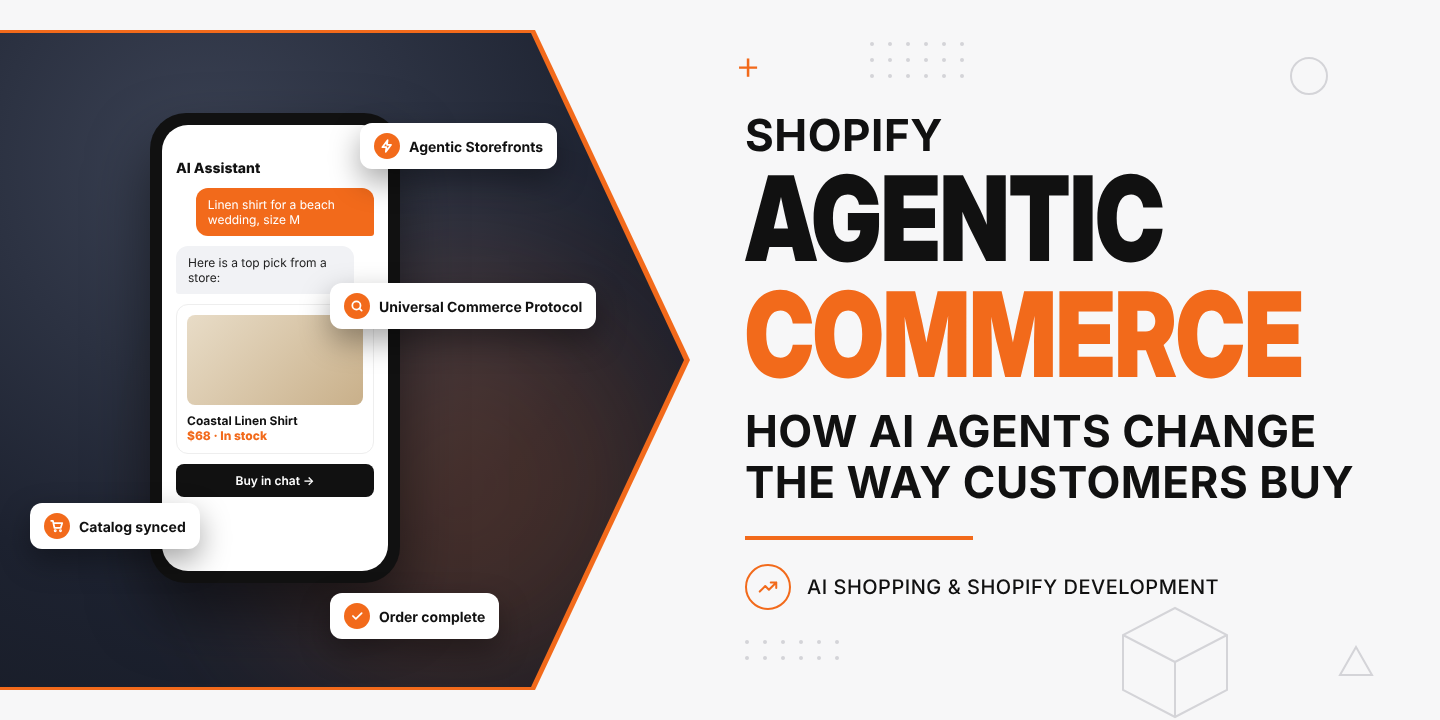
Shopify agentic commerce is Shopify’s system for making merchants’ products discoverable and purchasable by AI agents. A shopper asks an assistant for a product, the assistant queries Shopify’s catalog through a standard protocol, and the shopper can buy from the merchant without browsing the store’s website first.
Shopify describes it as connecting “any merchant to every AI conversation” in its January 11, 2026 announcement. Merchants set up their data once, and Agentic Storefronts surfaces it across ChatGPT, Microsoft Copilot, Google AI Mode and Gemini.
How Shopify agentic commerce works
Agentic Storefronts
Agentic Storefronts debuted in Shopify’s Winter ’26 Edition on December 10, 2025. It is the admin screen where merchants turn AI channels on or off and control how their brand, catalog and checkout appear inside AI conversations. Merchants find it under Settings → Sales channels → Agentic storefronts.
Shopify Catalog and the Catalog API
Shopify Catalog turns products from millions of merchants into structured, queryable data. In the Spring ’26 Edition, Shopify described the Catalog API as UCP’s discovery layer across AI surfaces (Shopify Spring ’26 developer edition). Through the Agentic plan, brands that do not run on Shopify can also list products in the Catalog.
The Universal Commerce Protocol (UCP)
UCP is an open standard, co-developed by Shopify and Google and endorsed at launch by more than 20 retailers and platforms. It covers the full journey from discovery to cart to checkout. Shopify says UCP works over REST, Model Context Protocol (MCP), Agent Payments Protocol (AP2) or Agent2Agent (A2A), and with any payment processor, including Shopify Payments.
How ChatGPT fits in
OpenAI and Stripe built a separate standard, the Agentic Commerce Protocol (ACP), which first powered Instant Checkout in ChatGPT. Shopify supports both ACP and UCP through Agentic Storefronts, so merchants manage both from one place. In March 2026, OpenAI shifted toward a discovery-first model and returned checkout control to merchants.
Shopify agentic commerce timeline
| Date | Milestone |
| Sept 2025 | OpenAI and Stripe launch ACP and Instant Checkout in ChatGPT |
| Dec 10, 2025 | Shopify Winter ’26 Edition introduces Agentic Storefronts |
| Jan 11, 2026 | Shopify and Google announce UCP; Agentic plan announced |
| Mar 2026 | ChatGPT goes live in Agentic Storefronts; Agentic plan publicly available |
| Spring ’26 | UCP and Catalog API open to every developer, no approval needed |
| Aug 31, 2026 | Earlier Storefront MCP catalog and cart tools retired in favor of UCP |
| Sept 2026 | Shopify storefronts advertise their UCP version at /.well-known/ucp |
Source: Shopify announcements and Edition releases. Planning a build around these changes? Our Shopify web development services team keeps stores current with each release.
How AI agents are changing the way customers buy
Search becomes a conversation
Shoppers type full needs (“a carry-on that fits under a Spirit seat, under $150, in green”) instead of keywords. The agent filters by attributes, so stores with rich product data match more requests. Good Shopify web design services now include structuring that data, not only the visual layout.
The shortlist replaces the results page
Agents usually return three to five options, not 50 blue links. Being on that shortlist depends on data completeness, price, reviews, shipping speed and return terms.
Buying happens closer to the question
With UCP, a shopper can move from question to cart inside the assistant. Some purchases complete in the conversation, and others hand off to the merchant’s checkout.
Loyalty follows the data
UCP added identity linking for loyalty programs in 2026. Brands that connect loyalty data give agents a reason to recommend them to returning customers.
How to prepare your Shopify store for agentic commerce
- Open Agentic Storefronts. Go to Settings → Sales channels → Agentic storefronts and confirm which AI channels are active for your store.
- Complete your product data. Use metafields and category metafields for materials, sizes, compatibility and use cases. Write titles that state what the product is.
- Fix variants. Clear option names (“Size: 10 Wide” rather than “Option 3”) help agents pick the right SKU.
- Keep inventory and pricing accurate. Agents penalize out-of-stock recommendations quickly.
- Publish clear policies. Shipping times, return windows and warranty terms should be on public pages that agents can read.
- Check unsupported products. Review which product types, such as subscriptions or bundles, your AI channels currently support, and plan around gaps.
- Speed up checkout. Shoppers arriving from an agent are ready to buy. Remove friction with Shop Pay, fewer fields and clear delivery dates. Our conversion rate optimization service audits this step.
- Measure AI channels. Track AI-attributed orders separately from search and social.
- Build your own agent. Use UCP and the Catalog API to create a branded shopping assistant, a reorder agent or a gift finder on your own site with custom AI agent development.
Steps 1 to 8 are configuration and content work. Step 9 needs developers who know Shopify and AI agents.
Why the right Shopify partner matters now
Agentic commerce rewards stores that are well structured, fast and accurate. That makes theme design, data architecture and custom app development matter more, not less.
When you compare a Shopify web design company or Shopify web development agency, look for:
- Shopify web design services that cover product page structure and metafield strategy, not only visuals.
- Shopify web development services that include custom apps, Hydrogen headless builds and integrations with ERP, PIM and feed tools.
- Experience building AI features on UCP, the Catalog API or MCP.
- The option to hire Shopify developers on a dedicated or white-label model for ongoing work.
DIT Interactive is a Shopify website development company and Shopify Partner rated 4.8 from 88 reviews, with a US office in Iselin, New Jersey. We design and build Shopify and Shopify Plus stores and pair them with agentic AI development services for custom shopping agents. See our Shopify technical SEO checklist and Shopify SEO best practices for 2026 for related guidance.
Want your Shopify store ready for AI shoppers? Explore our Shopify development services, book an agentic commerce audit or hire Shopify developers for your next sprint.