Shopify Store Redesign Guide: When Should You Upgrade Your Store?

A Shopify store can look perfectly fine and still be costing you sales. Slow mobile experiences, outdated navigation, weak product pages, confusing checkout flows, and a design that no longer matches your brand can quietly reduce conversions. A redesign is worth considering when your current store no longer supports your traffic, customers, products, or growth strategy. The goal is not simply a newer-looking website. It is a better shopping experience that supports business growth.

Key Takeaways

  • A Shopify redesign is usually justified when your current store creates usability, conversion, performance, or brand problems.
  • You do not always need to rebuild the entire store. In many cases, targeted UX, theme, or technical improvements can solve the biggest issues.
  • Mobile experience should be a major redesign priority because mobile now represents the majority of online shopping activity.
  • Poor navigation, outdated product pages, slow performance, weak trust signals, and checkout friction are common reasons to consider an upgrade.
  • A successful redesign should be based on analytics, customer behavior, usability testing, SEO data, and business goals rather than visual preferences alone.
  • Shopify merchants continue to operate at significant scale. Shopify reports that merchants generated $378 billion in GMV in 2025, while Shopify-powered businesses represented more than 14% of U.S. ecommerce based on its stated methodology. (Shopify)

What Is a Shopify Store Redesign?

A Shopify store redesign is the process of improving an existing Shopify website’s visual design, user experience, navigation, product presentation, mobile experience, conversion flow, and technical foundation. It can range from updating a theme and restructuring key pages to rebuilding the storefront with custom Shopify development.

The important distinction is this: a redesign is not necessarily a complete rebuild.

For example, a growing fashion brand might already have a good Shopify setup but discover that customers struggle to find sizes, product filters are difficult to use, and mobile product pages require too much scrolling.

That store may not need a completely new Shopify website.

It may need:

  • Better product-page structure
  • Improved mobile navigation
  • Stronger filtering
  • Clearer size information
  • Better product photography
  • Faster page loading
  • Improved calls to action
  • A cleaner cart experience

That’s where things change.

A redesign should solve measurable problems rather than simply make the website look different.

When Should You Redesign Your Shopify Store?

You should consider redesigning your Shopify store when its current design, functionality, performance, or customer journey is limiting sales or preventing the business from supporting its next stage of growth.

Common warning signs include declining conversion rates, poor mobile performance, outdated branding, confusing navigation, high cart abandonment, slow pages, difficult product discovery, and a store that requires too many workarounds to manage.

Here are the strongest indicators.

1. Your Store Looks Outdated Compared With Competitors

Customers make quick judgments about ecommerce websites.

If your store still looks like it was designed several years ago, shoppers may question whether the business is active, trustworthy, or worth buying from.

This does not mean your Shopify store needs to follow every design trend.

In fact, constantly changing the visual style can create its own problems.

Instead, look for signs such as:

  • Old typography
  • Poor spacing
  • Low-quality product imagery
  • Inconsistent buttons
  • Cluttered sections
  • Outdated icons
  • Weak mobile layouts
  • Excessive pop-ups
  • Poor visual hierarchy
  • Inconsistent branding

A modern ecommerce website should make it immediately obvious:

  1. What you sell
  2. Who it is for
  3. Why customers should care
  4. What action they should take next

If shoppers have to figure these things out, the design is working too hard against the business.

2. Your Mobile Experience Is Weak

For many Shopify stores, mobile should be treated as the primary shopping experience, not a smaller version of desktop.

Adobe reported that smartphones generated 56.4% of online sales during the 2025 U.S. holiday season, making mobile responsible for more than half of online spending during the period. (Adobe Newsroom)

That matters because a store that works well on desktop but feels frustrating on mobile can lose a significant portion of potential customers.

Check your mobile store for:

  • Difficult navigation
  • Tiny buttons
  • Slow-loading images
  • Long product descriptions
  • Hard-to-use filters
  • Difficult variant selection
  • Poorly positioned Add to Cart buttons
  • Intrusive pop-ups
  • Complicated checkout
  • Text that is difficult to read
  • Product images that do not display properly

Baymard’s mobile ecommerce research has also found significant usability problems across mobile shopping experiences, including situations where users abandon purchases because of preventable usability issues. (Baymard Institute)

A simple mobile redesign test

Open your Shopify store on your phone and try to purchase a product without using a desktop.

Ask:

Can I find a product quickly?

Can I understand the product without zooming?

Can I select the right variant easily?

Can I see shipping and returns information?

Can I add the item to my cart without hunting for the button?

Can I complete checkout comfortably?

If several answers are no, your store needs attention.

3. Your Conversion Rate Has Stopped Growing

Traffic is not the same thing as sales.

A Shopify store can receive thousands of monthly visitors while producing disappointing revenue.

If traffic is increasing but conversion rate remains flat or declines, investigate the customer experience before simply spending more on advertising.

Look at:

  • Conversion rate
  • Add-to-cart rate
  • Checkout initiation
  • Checkout completion
  • Product-page engagement
  • Landing-page performance
  • Mobile versus desktop conversion
  • Returning versus new customer conversion

For example, imagine a store receives:

100,000 monthly visitors

but only:

1,000 orders

That gives the store a 1% conversion rate.

A redesign that improves product discovery, trust signals, mobile UX, and checkout usability can potentially have more business value than simply trying to generate another 20,000 visitors.

The exact impact will vary by industry, traffic quality, pricing, product type, and customer intent, so redesign decisions should be based on the store’s own data.

4. Your Navigation Has Become Too Complicated

This is common with growing Shopify stores.

A company starts with 20 products.

A few years later, it has:

  • 300 products
  • Multiple collections
  • New categories
  • Bundles
  • Subscriptions
  • Accessories
  • Wholesale products
  • Seasonal collections

The original navigation was never designed for this scale.

Customers now have to click through multiple menus before finding what they need.

A redesign can restructure:

  • Main navigation
  • Mega menus
  • Collection pages
  • Product filters
  • Search
  • Breadcrumbs
  • Internal linking
  • Footer navigation

A good ecommerce navigation system should reflect how customers shop, not how your internal team organizes products.

For example, a company may categorize products internally by supplier or manufacturing process.

Customers probably do not care.

They might instead search by:

  • Product type
  • Use case
  • Size
  • Material
  • Price
  • Skin type
  • Activity
  • Compatibility

Your navigation should reflect customer intent.

5. Your Product Pages Are Not Converting

Product pages are often the most important pages on a Shopify store.

A redesign may be necessary if customers cannot quickly answer:

What is this?

Why should I buy it?

Will it work for me?

How much does it cost?

When will I receive it?

What happens if I don’t like it?

A strong product page typically includes:

  • Clear product name
  • High-quality images
  • Video where useful
  • Price
  • Availability
  • Variants
  • Size or specification information
  • Benefits
  • Product details
  • Reviews
  • Shipping information
  • Returns information
  • FAQs
  • Clear Add to Cart CTA
  • Relevant product recommendations

One thing many businesses overlook is decision anxiety.

Customers do not just need more information.

They need the right information at the right moment.

For example, a clothing customer may care about:

  • Fit
  • Model measurements
  • Fabric
  • Size chart
  • Delivery time
  • Returns

A technology buyer may care more about:

  • Compatibility
  • Specifications
  • Warranty
  • Reviews
  • Shipping
  • Support

Your product-page design should reflect those buying questions.

6. Your Checkout Experience Creates Friction

You may have a great homepage, beautiful product photography, and strong advertising.

But if checkout is confusing, the customer can still leave.

Baymard Institute’s research identifies several UX-related reasons shoppers abandon checkout. For example, its research found that 39% of users abandoned a checkout because extra costs such as shipping, taxes, or fees were too high or unexpected, while 19% abandoned because they were required to create an account. (Baymard Institute)

That makes checkout design a business issue, not simply a UX issue.

Review:

  • Shipping cost visibility
  • Delivery estimates
  • Guest checkout
  • Payment options
  • Form length
  • Error messages
  • Coupon handling
  • Cart editing
  • Order summary
  • Trust information
  • Return policies

If your store is experiencing significant checkout abandonment, investigate the exact point where customers leave before deciding that a full redesign is necessary.

7. Your Branding Has Changed

Sometimes the store needs a redesign because the business has changed.

Perhaps you started as a small direct-to-consumer company and now sell nationally across the USA.

Or maybe your company moved from a budget position to premium pricing.

Your website needs to communicate that change.

A brand redesign may involve:

  • Logo
  • Typography
  • Color system
  • Photography
  • Packaging presentation
  • Messaging
  • Product storytelling
  • Homepage structure
  • About page
  • Trust elements

For example, a premium skincare brand cannot rely on the same visual language it used when selling its first 10 products from a basic Shopify theme.

As the business grows, customer expectations grow with it.

8. Your Store Has Too Many Apps and Workarounds

Shopify’s ecosystem is one of its biggest strengths, but apps can also create complexity.

A store that has accumulated dozens of apps over several years may develop:

  • Duplicate functionality
  • Conflicting scripts
  • Extra code
  • Slower pages
  • Difficult maintenance
  • Higher monthly costs
  • Complicated workflows

Shopify reports that its ecosystem includes more than 21,000 apps, which shows how much functionality merchants can add to their stores. (Shopify)

The issue is not the number of apps alone.

The question is whether each app is still necessary.

During a redesign, review every major app and ask:

  • Is this still being used?
  • Does Shopify now offer this functionality natively?
  • Does another app already perform the same task?
  • Is it affecting performance?
  • Does it inject unnecessary scripts?
  • Is it still maintained?

Sometimes the best redesign improvement is removing things.

Shopify Store Redesign vs Shopify Store Rebuild

A redesign improves an existing Shopify store, while a rebuild involves more extensive changes to the store’s structure, theme, functionality, or technical architecture.

Shopify Redesign Shopify Rebuild
Updates existing experience Reconstructs major parts of store
May keep current theme foundation Often uses a new theme or custom architecture
Lower development scope Larger development scope
Useful for targeted problems Useful for structural problems
Can focus on UX and conversion Can change UX, architecture and functionality
Often faster Usually requires more planning

You do not need a complete rebuild simply because the store looks old.

Start by identifying what is actually broken.

What Should You Check Before Redesigning Your Shopify Store?

Before hiring a Shopify website development company, audit the current store.

A redesign should start with evidence.

1. Analytics

Review:

  • Sessions
  • Conversion rate
  • Revenue
  • Average order value
  • Bounce or engagement metrics
  • Product performance
  • Landing pages
  • Device performance
  • Traffic sources
  • New versus returning users

2. Search Performance

Review:

  • Organic traffic
  • Ranking keywords
  • Indexed pages
  • Click-through rates
  • Product-page rankings
  • Collection rankings
  • Branded versus non-branded traffic

Do not redesign the website and accidentally remove pages that are already generating valuable organic traffic.

3. Customer Behavior

Use available analytics and session behavior tools to identify:

  • Where users stop
  • What they click
  • What they ignore
  • Which products receive attention
  • Where users abandon the journey

4. Customer Feedback

Talk to actual customers.

Ask:

  • Was anything difficult to find?
  • Was product information sufficient?
  • Was checkout easy?
  • Did anything make you hesitate?
  • What almost stopped you from purchasing?

Sometimes one customer comment can reveal a problem that months of internal discussions missed.

Shopify Redesign Checklist for 2026

Before launching a redesigned Shopify store, review these areas.

Brand and Design

  • Logo and brand identity
  • Typography
  • Color consistency
  • Photography
  • Visual hierarchy
  • CTA consistency

User Experience

  • Navigation
  • Search
  • Filters
  • Collection pages
  • Product pages
  • Cart
  • Checkout
  • Mobile usability

Technical

  • Page speed
  • Image sizes
  • App scripts
  • Broken links
  • Redirects
  • Theme code
  • Structured data
  • Canonical URLs

SEO

  • Metadata
  • URLs
  • Heading structure
  • Internal links
  • Product schema
  • Collection pages
  • XML sitemap
  • Indexation
  • Redirect mapping

Conversion

  • Product reviews
  • Trust signals
  • Shipping information
  • Returns
  • Payment options
  • Product recommendations
  • CTAs
  • Cart experience

How to Plan a Shopify Store Redesign Step by Step

Step 1: Define the Business Problem

Do not start with:

“We want a modern website.”

Start with:

“Our mobile conversion rate is significantly lower than desktop.”

Or:

“Customers struggle to find products.”

Or:

“Our current store cannot support our new product categories.”

A clear problem creates a much better redesign brief.

Step 2: Audit the Existing Store

Review design, UX, SEO, analytics, technical performance, mobile usability, apps, and checkout.

Create three categories:

Keep

What already works?

Improve

What needs refinement?

Remove

What creates unnecessary friction?

Step 3: Build a New Information Architecture

Before designing pages, decide how the website should be structured.

Map:

Homepage → Collections → Products → Cart → Checkout

Also consider:

Homepage → Buying Guide → Collection → Product

Or:

Homepage → Category → Subcategory → Product

The exact structure depends on the catalog.

Step 4: Create Wireframes

Wireframes help you solve layout problems before spending time on visual design.

Start with:

  • Homepage
  • Collection page
  • Product page
  • Cart
  • Key landing pages

Then test the flow.

Step 5: Design Mobile First

Do not simply shrink the desktop design.

Think about:

  • Thumb-friendly buttons
  • Shorter sections
  • Sticky CTAs
  • Simple menus
  • Readable typography
  • Easy filters
  • Product image navigation
  • Quick cart access

Step 6: Develop the New Shopify Experience

This is where a Shopify web development agency can become valuable.

Development may include:

  • Custom theme development
  • Shopify theme customization
  • Liquid development
  • Custom sections
  • App integrations
  • API integrations
  • Product filtering
  • Custom functionality
  • Performance work
  • Analytics implementation

For more complex stores, you may also consider custom Shopify development rather than relying entirely on an off-the-shelf theme.

When Should You Hire Shopify Developers?

You should hire Shopify developers when your redesign requires custom functionality, advanced integrations, theme-level development, performance improvements, complex product experiences, or technical work that goes beyond standard Shopify customization.

You may not need developers for every visual update.

A simple store can often handle basic content and theme changes internally.

But professional Shopify development becomes more useful when you need:

  • Custom product configurators
  • ERP integration
  • CRM integration
  • Custom APIs
  • Advanced filtering
  • Complex subscription logic
  • B2B functionality
  • Custom checkout-related workflows
  • Advanced merchandising
  • Custom customer accounts
  • Headless commerce
  • Large-scale theme development

The key is to hire based on the problem, not simply because you are redesigning.

How Much Does a Shopify Store Redesign Cost in the USA?

Shopify redesign costs vary considerably depending on the store’s size, theme, functionality, number of templates, integrations, design requirements, and development complexity.

A basic redesign may involve theme customization and UX improvements, while a larger project can involve custom Shopify development, new templates, integrations, migration planning, SEO work, and extensive testing.

A useful way to think about the investment is:

Project Type Typical Scope
Basic refresh Visual updates and minor UX changes
Theme redesign New theme structure and design
Custom redesign Custom sections, templates and functionality
Advanced rebuild Custom development, integrations and complex workflows
Enterprise project Large catalog, B2B, integrations, advanced architecture

Rather than choosing a redesign based purely on the lowest quote, calculate the business value of fixing the problems.

If the redesign improves product discovery, mobile usability and checkout completion, the financial impact can be much greater than the development cost itself.

How Long Does a Shopify Redesign Take?

A Shopify redesign can take anywhere from a few weeks to several months depending on project complexity.

A smaller redesign involving theme changes and selected page improvements can move quickly.

A larger project involving custom UX, development, integrations, SEO migration, testing, and multiple templates will take longer.

A typical process may look like:

Discovery and audit: 1 to 2 weeks

UX and wireframes: 1 to 3 weeks

Visual design: 1 to 3 weeks

Development: 3 to 8+ weeks

Testing and revisions: 1 to 3 weeks

These are planning ranges, not guarantees.

Product count, integrations, approval cycles and custom functionality can significantly affect the timeline.

How to Protect SEO During a Shopify Redesign

One of the biggest mistakes businesses make is treating redesign and SEO as separate projects.

They are not.

A redesign can accidentally cause organic traffic losses if important URLs, content, internal links, metadata, structured data or redirects are removed.

Before launch:

Create a URL inventory

Document important:

  • Product URLs
  • Collection URLs
  • Blog URLs
  • Landing pages
  • Other indexed pages

Protect valuable pages

Identify pages receiving:

  • Organic traffic
  • Backlinks
  • Rankings
  • Conversions

Map redirects

If URLs change, create appropriate redirects.

Preserve important content

Do not remove valuable content simply because the new design looks cleaner.

Check technical SEO

Review:

  • Canonicals
  • Robots directives
  • Sitemap
  • Indexation
  • Structured data
  • Metadata
  • Heading hierarchy
  • Internal links

Test before launch

Use a staging environment wherever possible and crawl the redesigned store before making it live.

How AI Search Changes Shopify Store Design

Shopify redesigns in 2026 also need to consider how customers discover products through AI-powered search.

Adobe reported that traffic from generative AI sources to retail websites increased 693.4% during the 2025 holiday season compared with the 2024 holiday season. (Adobe Business)

That does not mean every Shopify store will suddenly receive huge volumes of AI traffic.

But it does show that product discovery is changing.

Your store should make important information easy for search engines and AI systems to understand.

That means using:

  • Clear product names
  • Descriptive product information
  • Useful FAQs
  • Structured product data
  • Clear category structures
  • Specific buying information
  • Strong internal linking
  • Authoritative content
  • Accurate specifications
  • Helpful comparison content

For example, instead of a product description saying:

“Designed for modern lifestyles.”

A useful product description might explain:

“This insulated 24-ounce stainless steel bottle keeps cold drinks chilled for up to 24 hours and fits standard vehicle cup holders.”

The second version is more useful to customers and easier for systems to interpret.

What a High-Converting Shopify Homepage Should Include

Your homepage does not need to contain everything.

It needs to help the right customer understand the brand and move toward the right product.

A strong structure can include:

  1. Clear hero message
  2. Primary CTA
  3. Featured products
  4. Main categories
  5. Key product benefits
  6. Social proof
  7. Best sellers
  8. Brand story
  9. Reviews
  10. FAQs
  11. Educational content
  12. Final CTA

Avoid turning the homepage into a giant collection of every message your company wants to communicate.

The customer should remain the focus.

Shopify Redesign Mistakes to Avoid

Mistake 1: Redesigning Only for Appearance

A prettier website does not automatically produce more sales.

Mistake 2: Ignoring Mobile

Desktop screenshots can look fantastic while the actual mobile experience is frustrating.

Mistake 3: Removing SEO Content

Cleaner pages are not always better pages.

Mistake 4: Installing More Apps to Fix Every Problem

Sometimes the better solution is custom development or simpler functionality.

Mistake 5: Copying Competitors

Your competitor’s website is built around their customers, products and business model.

Copying the design does not copy their results.

Mistake 6: Making Product Pages Too Long

More information is not automatically better.

Organize information so customers can scan it.

Mistake 7: Forgetting the Checkout

A beautiful homepage cannot compensate for a difficult checkout.

Mistake 8: Launching Without Testing

Test:

  • Mobile
  • Desktop
  • Safari
  • Chrome
  • Different screen sizes
  • Checkout
  • Payments
  • Forms
  • Search
  • Filters
  • Coupons
  • Shipping
  • Emails

Should You Redesign Your Shopify Store or Start Over?

You should redesign your Shopify store when the underlying Shopify setup is still suitable but the user experience, visual identity, navigation, performance, or conversion journey needs improvement. Consider a larger rebuild when the current theme, architecture, integrations, or functionality prevents the business from achieving its next growth stage.

A simple decision framework:

Keep the current setup if:

  • Store performance is strong
  • Theme structure is flexible
  • UX problems are limited
  • Integrations work well
  • SEO performance is healthy

Redesign if:

  • UX is outdated
  • Mobile experience is weak
  • Branding has changed
  • Product pages need improvement
  • Navigation is confusing
  • Conversion performance is disappointing

Rebuild if:

  • Theme limitations are severe
  • Technical debt is high
  • Integrations are difficult to maintain
  • Custom functionality is required
  • Business operations have changed significantly
  • Current architecture cannot support future growth

How to Choose a Shopify Web Design Services Partner

If you decide to work with a professional team, look beyond portfolios.

A visually attractive portfolio does not necessarily mean the agency understands ecommerce performance.

When evaluating Shopify web design services, ask:

Do they understand ecommerce?

A Shopify development partner should understand the relationship between UX, traffic, conversion and revenue.

Do they review data?

The redesign should be supported by analytics and customer behavior.

Can they handle development?

If the project needs custom functionality, the team should have technical Shopify capabilities.

Do they understand SEO?

Your organic traffic should be protected throughout the redesign.

Do they test?

Ask how they handle QA, mobile testing, browser testing and launch validation.

Do they understand your customers?

The best redesign is not the one the business owner likes most.

It is the one that makes it easier for customers to buy.

Why Shopify Remains a Strong Platform for Growing U.S. Ecommerce Brands

Shopify’s scale is one reason redesigning an existing Shopify store can make more sense than abandoning the platform.

Shopify states that millions of businesses across more than 175 countries use its platform. Its reported 2025 GMV reached $378 billion, and Shopify says its merchants represented more than 14% of U.S. ecommerce based on its stated calculation. (Shopify)

Shopify merchants also generated a record $14.6 billion in sales during Black Friday-Cyber Monday 2025, representing a 27% increase from the previous year according to Shopify. (Shopify)

These numbers do not mean every Shopify store will grow automatically.

They show something more practical: the platform is operating at significant ecommerce scale, so businesses can continue developing their storefront rather than treating Shopify as a temporary solution.

For a growing U.S. brand, the question is often not:

“Should we leave Shopify?”

It is:

“Is our current Shopify experience good enough for where the business is going?”

Final Shopify Store Redesign Checklist

Before approving your redesign, make sure you can answer yes to these questions:

  • Is the store easy to use on mobile?
  • Can customers find products quickly?
  • Is navigation based on customer behavior?
  • Are product pages persuasive and easy to scan?
  • Are shipping and return details easy to find?
  • Is checkout straightforward?
  • Are trust signals visible?
  • Is the store fast?
  • Are unnecessary apps removed?
  • Are important SEO URLs protected?
  • Are redirects mapped?
  • Is structured data working?
  • Are analytics configured?
  • Have real users tested the store?
  • Has the checkout been tested from start to finish?
  • Does the design accurately represent the current brand?
  • Can the store support the company’s next stage of growth?

If several answers are no, it is probably time to investigate a redesign.

Conclusion

A Shopify store does not need a redesign simply because it looks a little old.

It needs a redesign when the current experience is getting in the way of the business.

Maybe customers cannot find products quickly. Maybe mobile conversion is weak. Maybe your product catalog has outgrown the navigation. Maybe your brand has moved upmarket. Or perhaps the store has accumulated years of apps, customizations, and fixes that have made the experience difficult to maintain.

Those are meaningful reasons to act.

From my experience, the best Shopify redesigns start with a simple question:

What is stopping customers from buying?

Once you answer that using analytics, customer feedback, UX research and technical analysis, the design decisions become much easier.

For U.S. ecommerce brands, Shopify continues to operate at enormous scale, with Shopify reporting $378 billion in 2025 GMV and more than 14% of U.S. ecommerce based on its methodology. (Shopify) At the same time, mobile shopping and AI-driven product discovery are changing how customers interact with online stores. (Adobe Newsroom)

That means a Shopify redesign in 2026 should not simply make your store look newer.

It should make the store easier to understand, easier to navigate, easier to trust, easier to purchase from, and easier for search engines and AI systems to understand.

That is the kind of redesign that can support long-term ecommerce growth.
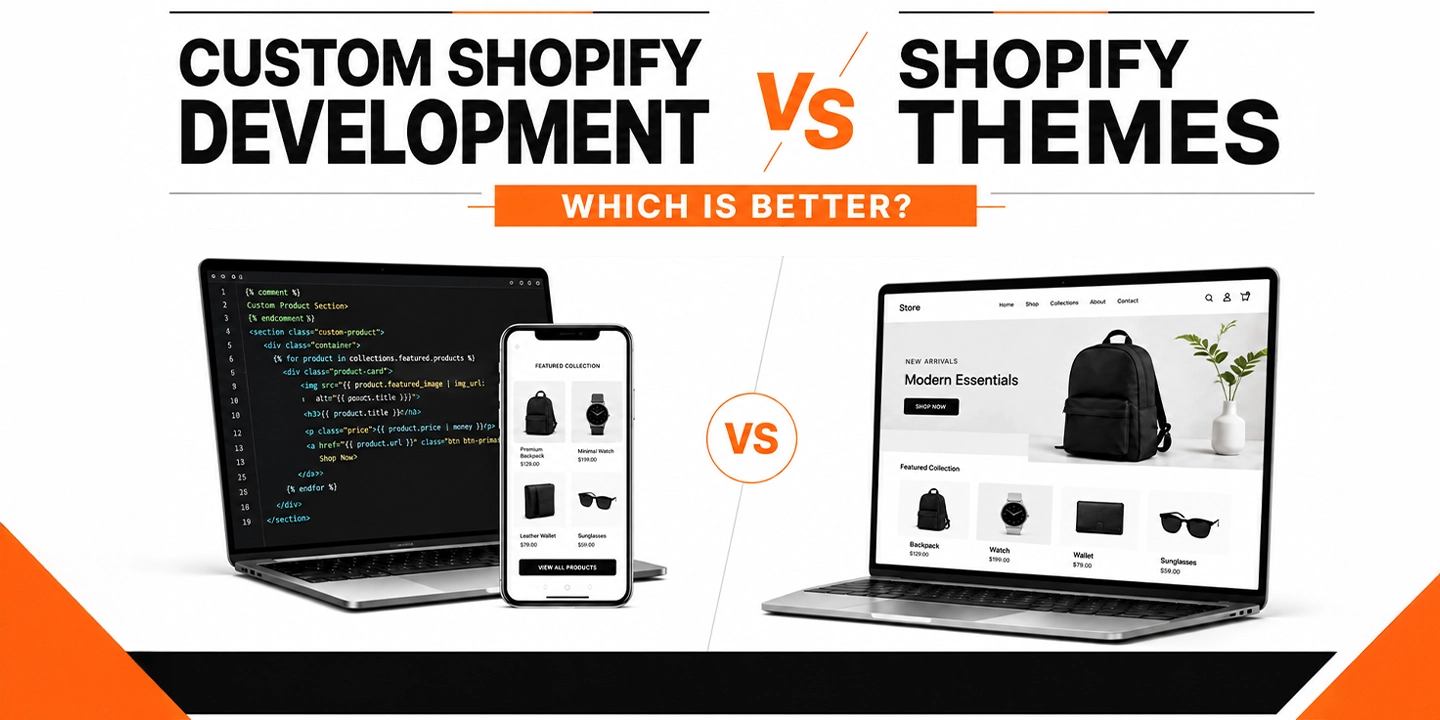
Custom Shopify Development vs Shopify Themes: Which Is Better?

If you’ve spent any time researching Shopify web design services, you’ve probably run into the same fork in the road that almost every merchant hits eventually. Do you buy a theme from the Shopify Theme Store and customize it, or do you bring in a Shopify web development agency and build something from scratch?

Honestly, there’s no single right answer here, and anyone who tells you otherwise is probably trying to sell you something. What I can tell you, from years of watching stores launch, scale, and sometimes stall out, is that the “which is better” question depends almost entirely on where your business is right now and where you’re trying to go in the next 12 to 24 months.

This article breaks down both paths in plain language, backed by real data, so you can make a decision that fits your business instead of someone else’s sales pitch.

Quick Answer: Themes vs Custom Development

A Shopify theme is a pre-built template you install and customize with settings, apps, and minor code tweaks. Custom Shopify development means building a storefront from the ground up (or heavily rebuilding a theme’s foundation) around your specific business logic. Themes suit new or small stores that need to launch fast and affordably. Custom development suits growing brands that need speed, unique functionality, or a shopping experience competitors can’t copy.

What Is a Shopify Theme, Exactly?

A Shopify theme is essentially a pre-coded storefront. You pick one from the Shopify Theme Store (free or paid, usually between $0 and $400), install it, and then adjust colors, fonts, sections, and layout through the theme editor. Popular options like Dawn, Impulse, and Turbo cover the basics well: product pages, collection grids, cart drawers, and blog layouts that already work out of the box.

The thing is, themes are built to be general-purpose. A theme developer has to design something that works reasonably well for a skincare brand, a furniture store, and a pet supply shop all at once. That’s the trade-off. You get speed and affordability, but you also get a store that looks and behaves a lot like thousands of others running the same theme.

From my experience, themes are genuinely the right call for a large share of new merchants. If you’re testing a product idea, running a side business, or bootstrapping your first year, there’s no reason to spend five figures on a build before you’ve proven people want what you’re selling.

What Is Custom Shopify Development?

Custom Shopify development means a developer (or a full Shopify website development company) builds your storefront’s theme code, apps, and sometimes backend integrations specifically for your business. This can mean starting from a blank Shopify theme framework, deeply modifying an existing base, or building on Shopify’s headless architecture using the Storefront API and Hydrogen.

Custom builds typically involve:

  • Custom Liquid, HTML, CSS, and JavaScript written for your exact product experience
  • Unique page layouts (product configurators, size finders, quizzes, subscription flows)
  • Integrations with your ERP, PIM, POS, or fulfillment systems
  • Performance work targeted at your specific catalog size and traffic patterns
  • App consolidation, meaning fewer third-party apps because functionality is built natively

One thing many businesses overlook is that “custom development” doesn’t always mean starting from zero. In most cases, a good agency will take a solid theme foundation like Dawn and rebuild the sections and templates around it, which keeps development time reasonable while still giving you a fully original front end.

Shopify Themes vs Custom Development: Side-by-Side Comparison

Factor Shopify Theme Custom Development
Upfront cost $0 to $400 $5,000 to $150,000+
Timeline to launch 1 to 3 weeks 6 to 20+ weeks
Design uniqueness Shared with other stores Fully original
Performance ceiling Limited by theme code Can be optimized for your catalog
Scalability Works until traffic or catalog outgrows it Built to scale with the business
App dependency High (apps patch missing features) Lower (features built natively)
Ongoing maintenance Minimal Requires a developer relationship
Best for New stores, MVPs, small catalogs Growing brands, high traffic, complex catalogs

The Real Cost Difference (And Why It’s Not as Simple as It Looks)

You’ll notice most articles stop at “themes are cheap, custom is expensive.” That’s technically true but misses the part that actually matters for your decision: total cost of ownership.

A $350 theme plus five or six apps to patch in the features you need can easily run $150 to $400 a month in app subscriptions alone. Over two years, that’s $3,600 to $9,600, on top of the theme’s own limitations and the labor cost every time an app conflict breaks your checkout flow. Custom development front-loads the cost but often reduces app dependency, which lowers your monthly overhead once the site is live.

That said, custom development isn’t the automatic winner on cost. If your store does $15,000 a month in revenue, spending $60,000 on a custom build doesn’t make financial sense yet, no matter how nice it would look. This is where an honest conversation with a Shopify partner matters more than a sales pitch. A good agency will tell you when you’re not ready for custom work, not just quote you a number.

Performance and Conversion: Where the Real Money Is

This is the part that tends to get glossed over, and it shouldn’t, because performance is where design decisions turn into actual revenue.

According to a joint study by Google and Deloitte, a mobile page speed improvement of just 0.1 seconds increased retail conversion rates by 8.4% and average order value by 9.2%. That’s not a typo. A tenth of a second moved the needle that much across 37 brands and roughly 30 million real user sessions. Google’s own research also found that 53% of mobile visitors abandon a page that takes longer than three seconds to load.

That’s where things change for stores that outgrow their theme. Off-the-shelf themes carry code for features you’re not using, sections you never enabled, and app scripts stacking on top of each other, and all of that weight slows the page down. Custom builds strip that out and load only what your specific store needs.

Mobile matters here more than people think. Mobile commerce now accounts for roughly 60% of global ecommerce sales, according to Statista, and mobile traffic makes up an even larger share of visits than that. If your theme (or the ten apps bolted onto it) is slow on a phone, you’re losing a majority-channel’s worth of buyers before they even see your products.

Cart abandonment is another place performance and design intersect. Baymard Institute, which has run large-scale checkout usability research for over a decade, puts the average cart abandonment rate at 70.22% across 50 studies. Nearly half of shoppers who abandon do so because of unexpected costs revealed late in checkout, and Baymard estimates that fixing checkout usability issues alone can lift conversion by an average of 35.26% on large ecommerce sites. A theme’s default checkout flow is fine for most stores, but if your business has a complicated cart (subscriptions, bundles, multi-currency, wholesale tiers), a custom checkout experience built around those specifics can recover a meaningful chunk of that lost revenue.

When a Shopify Theme Is Genuinely the Better Choice

I want to be fair here, because plenty of content in this space treats themes as a lesser option, and that’s not accurate. Themes are the right call when:

  • You’re launching your first store and need to validate demand before investing heavily
  • Your product catalog is small and straightforward (under a few hundred SKUs)
  • You need to be live in under a month
  • Your budget realistically caps out under $10,000 for the whole build
  • Your business model doesn’t require anything outside standard ecommerce flows

Shopify itself reports that the platform now processes over $115 billion in gross merchandise volume per quarter, and a huge share of that volume runs through stores that never touched custom code. A well-chosen theme, set up properly with the right apps, competent copy, and decent product photography, will outperform a poorly executed custom build every time. Execution matters more than the label “custom” or “template.”

When Custom Shopify Development Actually Pays Off

In most cases, the switch to custom development makes sense once one or more of these show up:

Your theme can’t do what your business needs. Configurators, complex bundling logic, B2B pricing tiers, or unique checkout requirements often can’t be solved with apps alone, or can only be solved by stacking five apps that slow the site down and conflict with each other.

You’re bumping into a performance ceiling. If your Core Web Vitals scores are poor despite removing unused apps and compressing images, the theme’s underlying code is likely the bottleneck.

Brand differentiation has become a competitive issue. If your top three competitors are running the same Theme Store templates as you (which happens more than people realize, since Dawn alone powers a huge share of Shopify stores), a custom front end becomes a real differentiator, not just an aesthetic upgrade.

You’re scaling toward Shopify Plus. Businesses moving toward $1M-plus in annual revenue often need custom checkout extensions, script customizations, and integrations that go beyond what a theme was built to handle. Shopify Plus itself now powers tens of thousands of higher-volume stores in the US, and most of them run custom or heavily modified themes rather than stock templates.

App costs are eating into margin. If you’re paying for eight or nine apps a month just to replicate features a custom build could handle natively, the math starts favoring a one-time development investment over recurring subscription costs.

A Real-World Example

I worked through this exact decision with a mid-sized home goods brand a while back. They launched on a $300 theme, which was the right call at the time, since they were testing whether their product line would sell at all. Eighteen months later, they were doing solid six-figure monthly revenue, running 11 apps to handle bundling, loyalty, reviews, and upsells, and their homepage was taking close to 5 seconds to load on mobile.

The apps alone were costing them close to $600 a month, their mobile bounce rate was well above industry benchmarks, and their checkout couldn’t support the subscription model they wanted to add. That’s a textbook signal that a custom rebuild, not another app, was the right next move. After a custom build that consolidated four of those apps into native functionality and rebuilt the product pages around their actual catalog structure, load time dropped under 2 seconds and mobile conversion improved noticeably within the first full quarter.

The point of that example isn’t “custom is always better.” It’s that the theme served its purpose for exactly as long as it should have, and the business outgrew it on schedule, not too early and not too late.

Hybrid Approach: The Middle Ground Most Agencies Won’t Mention

There’s a third option that gets skipped in most “theme vs custom” articles: starting with a strong theme and investing in targeted custom sections rather than a full rebuild. This is often the smartest move for stores in the $20,000 to $80,000 monthly revenue range.

A capable developer can take a theme like Dawn, keep its stable core (cart logic, checkout compatibility, update path), and build fully custom sections for the parts of your site that actually drive conversions, your homepage, your best-selling product templates, or a custom collection filtering system. You get meaningful differentiation and performance gains without paying for a from-scratch build.

How to Decide: A Practical Framework

Ask yourself these questions in order:

  1. Can I validate my product idea with a $300 theme right now? If you haven’t proven demand yet, start there.
  2. Is my current theme actually the bottleneck, or is it my marketing, pricing, or product-market fit? Custom development won’t fix a demand problem.
  3. Am I paying more in app subscriptions than a one-time development cost would return in 12 to 18 months? Run the actual numbers.
  4. Does my business model require something a theme genuinely can’t do? Not “would be nicer,” but genuinely can’t.
  5. Do I have consistent revenue to justify ongoing developer support? Custom sites need maintenance; budget for it before you commit.

If you answer these honestly, the right path usually becomes obvious. It’s rarely a close call once you actually run the numbers instead of guessing.

Why the Agency You Choose Matters More Than the Path You Pick

Whichever direction you go, the team building it matters enormously. A rushed theme customization from an inexperienced freelancer can perform worse than a well-executed template, and a poorly planned custom build can end up slower and buggier than the theme it replaced.

When you’re ready to hire Shopify developers, whether for a theme customization or a full custom build, look for a Shopify website development company that can show you real performance data from past projects, not just portfolio screenshots. Ask about their Core Web Vitals track record, how they handle app consolidation, and whether they’ve built for your specific business model (subscriptions, wholesale, high-SKU catalogs, and so on).

A genuine Shopify web development agency should be willing to tell you when a theme is the smarter, cheaper option for your stage of business. If every conversation ends with “you need a custom build,” that’s a sales conversation, not a consulting one.

Final Take

Neither option is universally better. Themes win on speed, cost, and simplicity. Custom development wins on performance ceiling, differentiation, and long-term scalability. The businesses that get burned are usually the ones that pick based on ego (wanting something “custom” before they need it) or based on fear (avoiding custom development even after outgrowing every workaround their theme allows).

Look at your revenue, your catalog complexity, your app spend, and your actual performance numbers. That data will tell you which path fits, far more reliably than any generic advice, including this article.

BigCommerce vs Shopify: Which Ecommerce Platform Should You Choose in 2026?

If you have spent even a weekend researching ecommerce platforms, you already know the BigCommerce vs Shopify debate is not going away anytime soon. Both platforms have been around for over a decade, both keep shipping new features every quarter, and both have loud fan bases who will tell you their pick is the only sane choice.

Honestly, the truth is less dramatic. Neither platform is universally better. What matters is your business model, your growth stage, and how much you plan to lean on AI-driven discovery in the next few years, because that part of the equation has changed a lot faster than most guides admit.

In this article, I am going to walk you through the real differences between BigCommerce and Shopify in 2026, backed by current data, and I will also talk about something most comparison posts skip entirely: how each platform is preparing for agentic commerce, where AI agents inside ChatGPT, Copilot, and Google AI Mode are starting to shop on behalf of customers. If you are evaluating agentic Shopify web development services or looking for a BigCommerce web design company to rebuild your store, this should give you a clear, honest starting point.

Quick Answer: Shopify vs BigCommerce in 2026

Shopify is the better choice for most direct-to-consumer brands, startups, and businesses that want a large app ecosystem, strong design flexibility, and the fastest path into AI-driven shopping channels. BigCommerce tends to win for B2B sellers, wholesalers, and multi-storefront businesses that need native functionality without stacking third-party apps. Neither is objectively superior; the right pick depends on your business model.

Market Share and Adoption: Who Actually Uses What

Before comparing features, it helps to see where each platform actually stands today, because market share tells you a lot about ecosystem maturity, third-party app support, and how easy it will be to hire developers with real experience.

Shopify commands roughly 27 to 28 percent of the US ecommerce platform market, and some trackers put the figure closer to 30 percent depending on methodology and site tier. The platform now powers over 5.6 million active stores globally and reports annual revenue north of 11 billion dollars, which is a huge jump from where it stood even five years ago. That scale is not just a vanity number. It is what lets Shopify fund proprietary tools like Shop Pay and its own AI shopping assistant, something smaller platforms simply cannot match dollar for dollar.

BigCommerce tells a different story. Active store counts have actually shrunk to roughly 37,000 live stores as of mid-2026, down about 8 percent year over year, yet the company posted its first ever GAAP profitable quarter in early 2026, with revenue around 87 million dollars for that quarter alone. That combination, fewer stores but more revenue, tells you exactly who is staying: bigger, more complex merchants. Enterprise accounts now generate somewhere between 75 and 80 percent of BigCommerce’s annual recurring revenue, and B2B merchant growth has been running at a compound annual rate above 12 percent.

One thing many business owners overlook here: BigCommerce is not trying to compete with Shopify on volume anymore. It is deliberately consolidating around wholesale, multi-brand, and B2B/B2C hybrid sellers who need native features Shopify normally handles through apps.

Pricing Comparison: What You Actually Pay

At a glance, Shopify starts around 39 dollars a month for its Basic plan and scales up through Grow, Advanced, and Plus tiers, with Plus pricing typically starting near 2,300 dollars a month for high-volume merchants. BigCommerce starts at a similar entry price but calculates plan tiers by annual online sales revenue rather than flat feature bundles, meaning your plan cost can climb as your store grows even if you never add a single new feature.

That’s where things change depending on your growth trajectory. If you expect steady, predictable growth, Shopify’s flat tiering is easier to budget around. If your revenue is seasonal or unpredictable, BigCommerce’s revenue-based thresholds can catch you off guard, and in 2026 the platform added a new wrinkle: a 2 percent penalty for merchants using non-approved payment processors, along with revised gross merchandise value thresholds for tier upgrades. That change triggered real merchant pushback, since one of BigCommerce’s original selling points was avoiding Shopify style transaction fees.

Factor Shopify BigCommerce
Entry pricing Flat monthly tiers Revenue-based tiers
Transaction fees Waived with Shopify Payments No forced transaction fee, but payment processor penalties apply
Enterprise pricing model Shopify Plus, custom quote Enterprise plan, custom quote
Ideal for DTC brands, subscription, dropshipping B2B, wholesale, multi-storefront

Design and Themes: Which Platform Builds a Better Storefront

Shopify wins on design flexibility for most B2C brands. The platform’s app store carries over 8,000 apps, and page builder tools like Shogun, PageFly, and GemPages give designers granular control without touching code. BigCommerce’s native design tools are solid but the platform simply has fewer design-focused apps than Shopify, which is why many agencies default to Shopify when a client’s top priority is a distinctive storefront that actually converts.

If you are searching for Bigcommerce design services or a Bigcommerce web design company, you’ll notice most agencies lean on the platform’s built-in Page Builder and Stencil theme framework rather than a marketplace of third-party design apps. That is not necessarily a downside. It means less plugin bloat and often faster page load times out of the box, since you are not stitching together five different apps to get one polished layout. In my experience, this matters more than people expect. A store built from six stacked apps tends to load slower and break more often during theme updates than one built on a smaller number of native tools.

B2B and Wholesale: Where BigCommerce Pulls Ahead

This is the one category where the data is not close. BigCommerce built native B2B functionality directly into its core plans, including customer-specific catalogs, tiered pricing, quote management, and support for SKU catalogs running into the hundreds of variants. Shopify handles B2B primarily through its Plus tier and a stack of apps, which works well but usually costs more to configure at the same depth.

If your business sells wholesale, operates a hybrid B2B and B2C model, or manages multiple storefronts under one back end, a Bigcommerce development agency will likely tell you the native tooling saves real implementation time. This is exactly the segment BigCommerce is now building its entire business around, given that enterprise B2B accounts already represent the bulk of its recurring revenue.

Ecommerce Growth Trends You Should Know Before Choosing

A few broader numbers help put this decision in context.

US ecommerce revenue reached roughly 1.2 trillion dollars in 2025, up from around 875 billion dollars just a couple of years earlier. That kind of growth is exactly why platform choice matters more than ever; the cost of picking the wrong foundation compounds as your traffic and order volume scale.

Checkout experience remains one of the biggest points of revenue leakage industry-wide. According to the Baymard Institute’s cart abandonment research, which aggregates data from 50 different studies, the average cart abandonment rate sits at just over 70 percent, and mobile abandonment runs even higher than desktop in nearly every dataset available. Close to half of shoppers abandon a cart because of unexpected extra costs revealed at checkout, which is a fixable problem on both Shopify and BigCommerce if your development team builds transparent shipping and tax calculations into the flow early. Baymard’s own research suggests large ecommerce sites can gain more than a 35 percent increase in conversion rate purely through better checkout design, which is a bigger lever than most business owners realize when they are busy debating platform logos.

This is exactly why the quality of your development partner matters as much as the platform itself. A skilled Shopify web development agency or Bigcommerce development services team will spend real time auditing your checkout flow, not just installing a theme and calling it done.

Agentic Commerce: The Shift Most Comparison Articles Miss

Here is the part of this decision that changed dramatically over the last year, and it is the reason I specifically called out agentic Shopify web development services earlier in this piece.

AI agents are no longer just answering product questions. They are starting to browse, compare, and check out on a shopper’s behalf inside ChatGPT, Microsoft Copilot, and Google’s AI Mode. In the first quarter of 2026, AI-driven traffic to Shopify stores grew roughly eight times year over year, while orders coming from AI-powered search increased nearly thirteen times, and new buyers placed orders through AI channels at nearly twice the rate of other channels. That is not a small experimental blip anymore.

Shopify has moved fast to capture this shift. According to Shopify’s own reporting on agentic commerce, agentic storefronts became available to millions of merchants as of March 2026, and eligible US stores are automatically discoverable inside ChatGPT once their products sit in the Shopify Catalog. ChatGPT Shopping is now live for all United States users, with more than a million Shopify merchants already connected alongside Etsy. On the payments side, Shopify Payments processed around 67 billion dollars of GMV in the first quarter of 2026 alone, up 41 percent year over year, while Shop Pay processed roughly 35 billion dollars, growing 59 percent.

The broader trend backs this up. Some analysts estimate agentic commerce could account for a meaningful share of US online sales within the next few years, with the largest early gains concentrated in recurring, low-risk categories like groceries and subscriptions. Adobe Analytics data from late 2025 already showed AI-referred shoppers converting at a notably higher completion rate during Black Friday, and by early 2026 AI-referred traffic was converting well above traditional search traffic.

BigCommerce has not published comparable public numbers on agentic traffic growth, largely because its merchant base skews B2B, where AI-agent checkout adoption is still early. That does not mean BigCommerce is behind on AI entirely, but for a brand that lives or dies on direct-to-consumer discovery, this is the single biggest reason Shopify currently has the edge going into 2027 planning. This is also exactly why more brands are searching specifically for agentic shopify web development services rather than generic Shopify developer help. Getting your product feed structured correctly for AI catalogs, keeping inventory data clean, and setting up proper checkout attribution takes a different kind of technical setup than a standard theme build.

Mobile Commerce and Conversion Benchmarks

Mobile continues to dominate ecommerce traffic, and the abandonment gap between devices is still wide. Mobile cart abandonment consistently runs well above desktop across nearly every meta-analysis, with some studies putting the gap at ten to fifteen percentage points depending on the industry vertical. That’s a big enough gap that mobile-first checkout design should be non-negotiable no matter which platform you pick.

Both Shopify and BigCommerce support one-click checkout tools. One-click checkout options like Shop Pay have been shown in Shopify’s own data to meaningfully reduce abandonment and lift conversion rates. If mobile conversion is your biggest pain point today, ask any agency you interview, whether it is a Shopify web design services provider or a Bigcommerce development agency, to show you real before-and-after mobile conversion data from past projects, not just a portfolio of pretty screenshots.

SEO and AI Search Visibility

Both platforms give you the basics: clean URL structures, editable meta tags, sitemap generation, and schema markup support. The real difference shows up in how flexible each platform is when you need structured data for AI Overviews, product feeds for AI shopping surfaces, or custom schema for rich results.

Shopify’s larger app ecosystem gives you more plug-and-play options for structured data and technical SEO. BigCommerce’s native flexibility means a skilled developer can hand-code exactly what you need without fighting app conflicts, which some technical teams actually prefer. In most cases, the deciding factor is not the platform itself but whether the agency you hire actually understands how Google AI Mode, Perplexity, and ChatGPT pull and cite ecommerce content, because that skill set is still rare even among experienced developers.

Support, Uptime, and Scalability

Shopify offers broader community support simply because of its size, with forums, a massive Partner network, and thousands of certified developers available to hire. BigCommerce support tends to be more hands-on for enterprise accounts, since the company’s business model now depends heavily on retaining large merchants.

Both platforms handle high traffic events like Black Friday reasonably well today, though Shopify’s infrastructure has been stress-tested at a much larger scale simply due to sheer merchant volume. If uptime during peak sales events is your top concern, Shopify’s track record gives slightly more peace of mind, though BigCommerce has closed most of the gap in recent years.

When to Choose Shopify

  • You are running or launching a direct-to-consumer brand
  • You want the largest possible app and theme ecosystem
  • You plan to sell through AI shopping channels like ChatGPT or Copilot
  • You want to hire Shopify developers easily, given the size of the talent pool
  • You need fast, flexible design changes without heavy custom development

When to Choose BigCommerce

  • You run a B2B, wholesale, or hybrid B2B/B2C operation
  • You need multi-storefront management from one back end
  • You want native functionality without stacking many paid apps
  • You are comfortable with revenue-based pricing tiers
  • Your catalog includes complex products with hundreds of variants

Why the Development Partner Matters More Than the Platform

I have watched businesses pick the “right” platform and still end up with a slow, confusing store because the build itself was rushed. The platform is maybe 40 percent of the outcome. The other 60 percent comes down to execution: information architecture, checkout UX, page speed, and now, increasingly, whether your product data is structured well enough for AI agents to find and recommend you at all.

If you are comparing quotes, ask specific questions. A real Bigcommerce development agency should be able to walk you through past B2B catalog migrations in detail, not just talk in generalities. A Shopify web development agency worth hiring in 2026 should already have a plan for structuring your Shopify Catalog feed for AI discovery, not just a plan for building a pretty homepage. One thing many businesses overlook until it’s too late: the cheapest quote almost always skips this part of the work entirely.

Final Verdict

If you are a growing DTC brand chasing both organic search rankings and visibility inside AI shopping assistants, Shopify is the stronger long-term bet in 2026, and pairing it with an agency that understands agentic Shopify web development services will matter more each year. If you run a complex B2B or wholesale operation and need native tools rather than a stack of apps, BigCommerce still holds real advantages, especially now that the platform has doubled down on enterprise B2B as its core identity.

Neither platform is going anywhere. The smarter question is not “which platform is better” in the abstract, but which one matches how your customers actually buy from you today, and how they are likely to buy from you two years from now.