
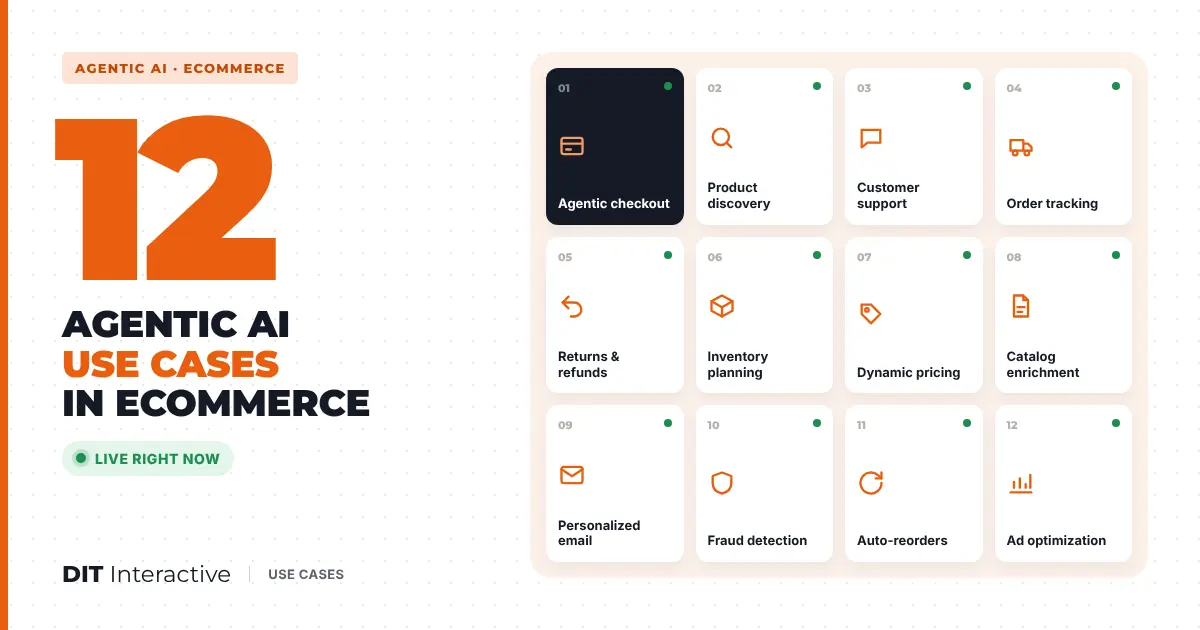
In short: The most useful agentic AI use cases in ecommerce in 2026 are guided shopping, autonomous customer service, post-purchase support, buying on a shopper’s behalf, checkout inside AI agents, catalog enrichment and back-office automation. Brands such as SharkNinja, Pandora, Amazon, Zalando and Shopify merchants already run them, and most start with one narrow task.
During the 2025 holiday season, retailers that ran their own AI agents, including Pandora, SharkNinja and Funko, grew sales 6.2% year on year, against 3.9% for those without, according to Salesforce. That gap is why “agentic AI” has moved from conference slides to product roadmaps.
But what does an AI agent actually do in an online store? This guide lists 12 agentic AI use cases in ecommerce that are live or rolling out in 2026. Each one has a plain definition, a real named example, the technology behind it and the effort it takes. Where a feature is still in pilot, we say so.
What is agentic AI in ecommerce?
Definition: Agentic AI in ecommerce means AI systems that can plan and carry out tasks, not just answer questions. An agent can search a catalog, compare options, update an order, write product content or complete a purchase, usually within limits set by the business or the shopper.
A chatbot answers “Where is my order?” An agent looks up the order, sees it is delayed, offers a discount code and updates the ticket.
Agentic AI use cases in ecommerce at a glance
| # | Use case | Live example | Typical stack | Effort | Status (Nov 2026) |
| 1 | Guided shopping agent | SharkNinja | Salesforce Agentforce + Data 360 | Medium | Live |
| 2 | Personal shopper agent | Pandora (“Gemma”) | Salesforce Agentforce | Medium | Live |
| 3 | Autonomous customer service | Pandora (“Clara”) | Salesforce Agentforce | Medium | Live |
| 4 | Post-purchase setup agent | SharkNinja unboxing agent | Agentforce + QR code | Low–Medium | Live |
| 5 | Buy for me on other stores | Amazon Buy for Me | Amazon’s own agent | Low (for merchants) | Live |
| 6 | Price-watch auto-buy | Amazon Auto-Buy | Amazon’s own agent | Low (for merchants) | Live |
| 7 | Cross-retailer agent checkout | Zalando Extended | Zalando’s own agent | Low (for partners) | Pilot; agent checkout from 2027 |
| 8 | Checkout inside personal AI agents | Shop Pay in Muse, Claude Duet, Instinct, Grok Bot | Shopify + Shop Pay | Low | Live |
| 9 | Agent payments with tokens | Mastercard Agent Pay | Card network tokens | Low (via your payment provider) | Live, expanding |
| 10 | AI catalog enrichment | BigCommerce Catalog Enrichment | BigCommerce control panel | Low | Early access |
| 11 | Bulk store changes by an admin agent | Shopify Sidekick staged plans | Shopify admin | Low | Early access |
| 12 | Back-office agents via MCP | WooCommerce MCP abilities | WordPress MCP Adapter | Medium | Developer preview |
Agentic AI use cases for product discovery and selling
1. Guided shopping agent
What it is: An agent that asks shoppers questions, compares products and recommends the right one, the way a good store assistant would.
Live example: SharkNinja added guided shopping to its existing FAQ agent in eight weeks using Salesforce Agentforce. Salesforce reports an 11% conversion rate with agentic shopping guidance, 14% larger baskets year on year and the agent live in 14 countries.
Stack: Salesforce Agentforce, grounded in customer and product data through Data 360.
Effort: Medium. The work is in connecting accurate product, stock and order data.
2. Personal shopper agent
What it is: An agent with a clear brand personality that helps shoppers choose products for a person or occasion.
Live example: Pandora built “Gemma”, a personal shopper agent that helps customers choose jewellery, as part of its plan to bring the in-store experience online.
Stack: Salesforce Agentforce.
Effort: Medium. Getting the tone of voice right takes as much work as the technology.
3. Autonomous customer service
What it is: An agent that resolves routine questions such as order status, returns and FAQs on its own, and hands complex cases to a person.
Live example: Pandora built “Clara”, a service agent that answers FAQs and gives instant order updates. According to Salesforce, Pandora’s Agentforce agents handle about 40,000 conversations a month and resolve 60% of cases without a human, and the agent-first service has lifted Pandora’s net promoter score by 10%.
Stack: Salesforce Agentforce, connected to order and loyalty data.
Effort: Medium. This is usually the best first use case, because results are easy to measure.
4. Post-purchase setup agent
What it is: An agent that helps customers set up and use a product after delivery, which reduces support calls and returns.
Live example: In April 2026, SharkNinja launched an unboxing agent for its Ninja Luxe Café Premier espresso machine. Customers scan a QR code on the box to get model-specific setup steps, ask questions and register their warranty. Safety issues are handed straight to a person. SharkNinja expects it to resolve around 30% of questions on its own and support about 1,000 customers a day.
Stack: Salesforce Agentforce with a QR-code entry point.
Effort: Low to medium. A good fit for products that are complex to set up.
Also read: For a deeper look at how agents are changing every stage of the customer journey, see our guide on how AI agents are changing ecommerce, from product discovery to autonomous checkout.
Agentic commerce examples: agents that buy for the shopper
These agentic commerce examples show agents completing the purchase itself. For most merchants, the job is to make products easy for these agents to find and buy.
5. Buy for me on other stores
What it is: A marketplace agent that buys a product from a brand’s own website when the marketplace does not stock it.
Live example: Amazon’s Buy for Me feature purchases selected products from brand websites on the shopper’s behalf. Amazon says the number of products available through it has grown from 65,000 at launch to more than half a million.
Stack: Amazon’s own agent, which enters the shopper’s details on the brand’s site.
Effort for merchants: Low. Keep product pages, prices and checkout reliable so agents can complete purchases.
6. Price-watch auto-buy
What it is: An agent that watches a product and buys it automatically when the price drops to a level the shopper sets.
Live example: Amazon’s auto-buy feature, now part of Alexa for Shopping, purchases an item once it hits the shopper’s target price. Amazon says shoppers save about 20% on average per purchase. Shoppers confirm the request first and can cancel before the item ships.
Stack: Amazon’s own agent.
Effort for merchants: Low. Accurate, consistent pricing matters, because agents act on it instantly.
7. Cross-retailer agent checkout
What it is: A retailer’s app lets shoppers buy products from other online stores, with an agent completing checkout on the other store’s site.
Live example: On 3 November 2026, Zalando announced Zalando Extended. Products from other shops appear in the Zalando app, and Zalando’s AI agent will buy them on the customer’s behalf. Home retailer Westwing is the first pilot partner, and agent checkout is planned from 2027. Zalando’s existing AI assistant was used by 22 million people in 2026.
Stack: Zalando’s own agent platform.
Effort for partner retailers: Low. Zalando says partners can reach its customers without complex integrations.
8. Checkout inside personal AI agents
What it is: Shoppers find and pay for products without leaving an AI assistant.
Live example: Since Shopify’s Fall ’26 Edition, shoppers can pay with Shop Pay inside personal AI agents including Meta’s Muse, Claude Duet, Instinct and Grok Bot. The shopper approves each purchase and the agent never sees the full card number.
Stack: Shopify, Shop Pay and Shopify Catalog.
Effort: Low for Shopify merchants: keep Shop Pay on and product data complete.
9. Agent payments with tokens
What it is: Payment technology that lets AI agents pay securely, with each purchase tied to an approved agent and a shopper’s consent.
Live example: Mastercard Agent Pay uses network tokens so that only registered agents can transact, and each payment is traceable to the agent that made it. Mastercard says agentic volumes are still early but growing week on week.
Stack: Card network tokens, usually enabled through your payment provider.
Effort: Low. Ask your payment provider when agent tokens will be supported on your account.
Agentic AI use cases for store operations
10. AI catalog enrichment
What it is: An agent that rewrites and fills in product data, such as titles, descriptions, feature bullets and FAQs, so products are easier for shoppers and AI tools to find.
Live example: On 29 September 2026, Commerce (BigCommerce’s parent company) launched BigCommerce Catalog Enrichment and Feedonomics Enrichment. They generate product titles, descriptions, feature bullets, FAQs and SEO metadata, with a person reviewing changes before they go live. BigCommerce Catalog Enrichment is in early access.
Stack: BigCommerce control panel or Feedonomics.
Effort: Low. The main work is reviewing the drafts.
11. Bulk store changes by an admin agent
What it is: An agent inside the store admin that plans and applies many changes at once, for approval by the merchant.
Live example: Shopify Sidekick can now draft up to 50 store changes as one plan, such as rewriting every description in a collection, which the merchant approves together. The feature is in early access for some stores.
Stack: Shopify admin.
Effort: Low. Agree who reviews the plans before using it on live products.
12. Back-office agents via MCP
What it is: Store staff use an AI assistant to query and update products and orders through the Model Context Protocol (MCP), the open standard that connects AI tools to software.
Live example: WooCommerce ships product and order abilities that AI clients can use through the WordPress MCP Adapter, such as querying orders, updating order status and adding order notes. It is still a developer preview.
Stack: WooCommerce, WordPress MCP Adapter and an MCP client such as Claude Code or Cursor.
Effort: Medium. It needs a developer to set up permissions safely.
Which agentic AI use case should you start with?
Start where you have high volume, clear rules and easy measurement. For most stores, that means one of three options:
- Customer service (use case 3), if support tickets are your biggest cost.
- Catalog enrichment (use case 10), if your product data is thin or inconsistent. It also improves your visibility to AI shopping tools.
- Checkout in AI agents (use case 8), if you are on Shopify and want to be ready for agent-led shopping.
Then follow four rules:
- Keep a human in the loop at first. Let the agent draft or suggest, then remove approval for tasks it handles reliably.
- Measure one number, such as resolution rate, conversion rate or hours saved.
- Connect as few systems as possible for the first version.
- Set spending and permission limits before the agent goes live.
If you need help planning a roadmap, a partner offering agentic AI services USA and UK brands trust can help you scope a pilot and connect it to your store safely. For cross-tool automations that do not need a full agent, such as syncing orders to a spreadsheet or tagging support tickets, an AI automation agency USA or UK partner can often deliver results faster and for less.
When you compare providers of agentic AI services USA or UK, ask to see a live agent they have built, how they set permission limits and what it costs to run each month. A good AI automation agency USA retailers use should also tell you when a simple workflow beats an agent.
Related reading: Ready to build your own? Our step-by-step guide explains how to build an AI shopping agent for your ecommerce business. Shopify merchants should also read our explainer on Shopify agentic commerce.
What are the risks of agentic AI in ecommerce?
Agentic AI can make costly mistakes if it is not controlled. The main risks are:
- Wrong answers at scale, such as incorrect return policies or prices repeated to thousands of shoppers.
- Unauthorised actions, such as refunds or order changes the business did not intend.
- Data privacy, because agents often handle names, addresses and order history.
- Rising running costs, as agents make more model calls per task.
Most can be managed with limited permissions, human approval for high-value actions, clear published policies and regular testing against real examples.