
Your online store used to be one big system: the same platform ran the design, the product catalogue, the content and the checkout. Change one part and you risked breaking the rest. Headless commerce splits those parts apart and connects them with APIs, so each one can be the best tool for its job.
The shift is well under way. Mordor Intelligence estimates the headless commerce platform market will grow from $2.41 billion in 2026 to $6.17 billion by 2031, about 21% a year, and North America is the largest region.
This guide explains headless commerce architecture in plain English, layer by layer: frontend, APIs, commerce engine, CMS, PIM, checkout and integrations. It is written by the headless commerce services team at DIT Interactive, a headless commerce development company in the USA and UK with 435+ projects delivered.
Quick answer: what is headless commerce architecture?
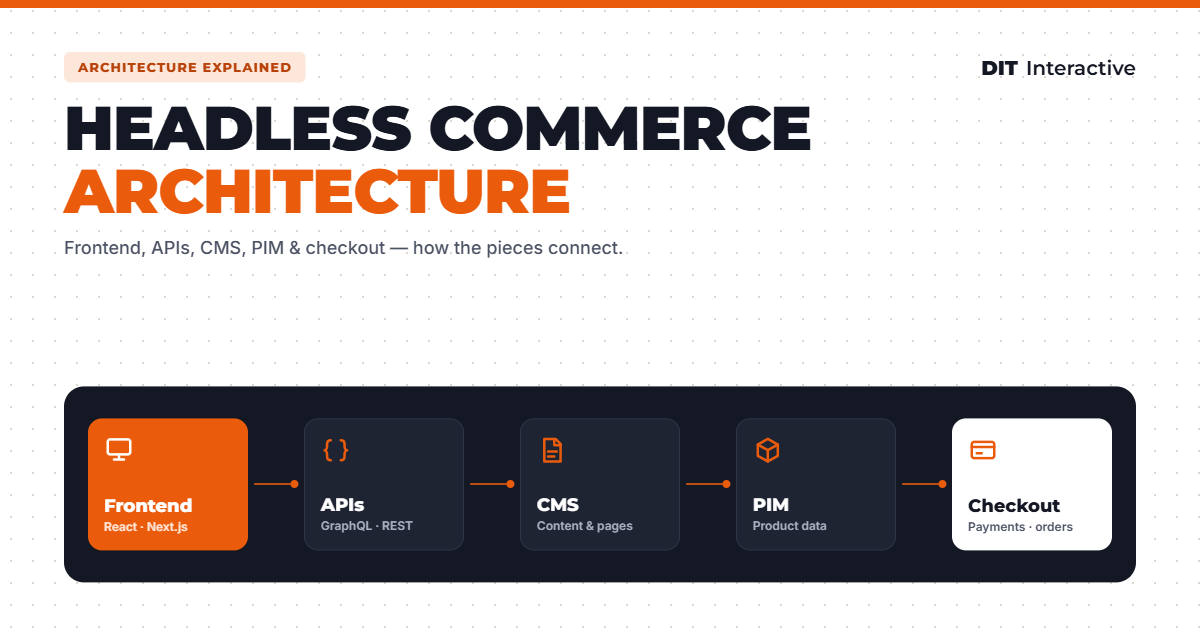
Headless commerce architecture separates the customer-facing frontend from the backend commerce systems and connects them through APIs. A typical stack has six layers:
- Frontend (the “head”): the website, app or other touchpoint shoppers use, often built with React or Next.js
- API layer: REST or GraphQL APIs, plus middleware, that move data between every part
- Commerce engine: products, pricing, carts, orders and customers (for example BigCommerce, Shopify or Adobe Commerce)
- CMS: pages, blogs, banners and campaign content
- PIM: the single source of truth for product data
- Checkout and payments: the secure purchase flow, payment gateways, tax and fraud tools
Around them sit integrations such as ERP, OMS, CRM, search, analytics and, increasingly, AI agents.
What is headless commerce, and how is it different from traditional ecommerce?
Headless commerce is an ecommerce setup where the frontend (what shoppers see) is decoupled from the backend (how the store runs), and the two talk only through APIs. You can redesign the storefront, launch a new app or add a new channel without rebuilding the commerce engine underneath.
In a traditional (monolithic) platform, the theme, catalogue, content and checkout are tightly bound together. That is fast to launch, but every change runs through the platform’s templates and release cycle.
| Traditional (monolithic) | Headless | |
| Frontend | Platform theme | Any framework (React, Next.js, Vue) |
| Channels | Mainly one website | Web, app, kiosk, marketplace, AI assistants |
| Content | Built-in page editor | Dedicated headless CMS |
| Product data | Inside the platform | Often a PIM feeding every channel |
| Speed of change | Tied to theme and platform updates | Frontend and backend release independently |
| Performance | Good, limited by theme | Excellent with static or edge rendering |
| Upfront cost and effort | Lower | Higher |
| Best for | Small catalogues, simple needs | Growing brands, B2B, multi-brand, multi-region |
Headless vs composable vs MACH
These terms overlap. Headless means the frontend is separated. Composable goes further: every backend capability (search, CMS, PIM, checkout) is a swappable component. MACH (Microservices, API-first, Cloud-native, Headless) is the set of principles behind composable stacks.
Adoption is now mainstream. A 2026 MACH Alliance report found that 92% of organisations have implemented or are adopting composable technology, with 71% at wide or full implementation.
For a deeper comparison, read our guide to headless vs composable commerce.
Headless commerce architecture, layer by layer
Every headless commerce solution in the USA and beyond is built from the same building blocks; what differs is which tools you choose for each layer and how well they are connected. Here is what each layer does, the common tool choices and what to watch for.
1. Frontend layer (the presentation layer)
The frontend is everything the shopper sees and touches: pages, product listings, search, cart and account screens. In headless, it is a separate application that pulls data from the backend through APIs.
- Common frameworks: Next.js (React), Remix, Nuxt (Vue), Shopify Hydrogen, BigCommerce Catalyst
- Rendering: static generation and edge rendering for fast product and category pages; server rendering for personalised pages
- Hosting: Vercel, Netlify, Cloudflare, AWS
- Other heads: native mobile apps, in-store kiosks, smart TVs and voice or AI assistants can use the same APIs
Watch for: SEO basics (server-rendered HTML, metadata, sitemaps, structured data) must be built in, because a theme no longer does it for you. DIT’s front-end development, React.js development and UI/UX design teams handle this as standard.
2. API layer and middleware (the connective tissue)
The API layer moves data between the frontend and every backend system, and middleware shapes that data so each frontend gets exactly what it needs.
- API styles: REST for simple calls, GraphQL to fetch exactly the fields a page needs in one request
- Backend for frontend (BFF): a small service per frontend that combines calls to several systems
- Webhooks and events: push updates (price changes, stock, order status) the moment they happen
- API gateway: one secure entry point with authentication, rate limits and caching
Watch for: too many direct calls from the browser slow pages down. A well-designed middleware layer, often built in Node.js, keeps pages fast and backends replaceable.
3. Commerce engine (the transactional core)
The commerce engine runs the business logic of selling: catalogue structure, pricing, promotions, carts, orders, customers and tax rules.
| Engine | Strengths in a headless setup |
| BigCommerce | Open APIs, Catalyst storefront, multi-storefront from one admin, strong B2B Edition |
| Shopify / Shopify Plus | Hydrogen framework, Storefront API, huge app ecosystem |
| Adobe Commerce (Magento) | Deep customisation, complex B2B and multi-site catalogues |
| commercetools and other API-first engines | Fully composable, built for large enterprises |
DIT builds headless on BigCommerce, Shopify and Magento, and helps you choose the right engine for your catalogue size, B2B needs and budget.
4. Headless CMS (the content layer)
A headless CMS stores and manages content (home pages, landing pages, blogs, banners, lookbooks) and delivers it through APIs to any frontend. Marketers edit content without touching code.
- Common choices: Contentful, Sanity, Storyblok, Strapi, Builder.io, Makeswift, or WordPress used headlessly
- Key features: visual editing and preview, reusable content blocks, scheduling, localisation, roles and approvals
- How it links to commerce: content blocks reference products by ID, so prices and stock always come live from the commerce engine
Watch for: choose a CMS your marketing team enjoys using. A powerful CMS nobody can operate is the most common headless regret.
5. PIM (the product data layer)
A PIM (product information management) system is the single source of truth for product data: attributes, descriptions, specs, images, translations and channel-specific versions.
- Common choices: Akeneo, Salsify, Pimcore, inRiver, Plytix
- What it does: imports supplier data, enriches it, checks completeness, then syndicates it to the store, marketplaces, Google Shopping and AI shopping channels
- When you need one: thousands of SKUs, many attributes, several languages or channels, or several teams editing product data
Watch for: if your catalogue is small, the commerce engine’s own catalogue may be enough. Add a PIM when spreadsheets start to break.
6. Checkout and payments (the conversion layer)
Checkout is where revenue is won or lost, so most headless stores use the commerce engine’s hosted or embedded checkout and customise around it, rather than building one from scratch.
- Options: platform-hosted checkout (most secure and PCI-friendly), embedded checkout SDKs, or a fully custom checkout through checkout APIs
- Payments: Stripe, PayPal, Adyen, Braintree, Apple Pay, Google Pay, buy now pay later
- Supporting tools: tax (Avalara, Vertex), fraud screening, address validation, shipping rates
- Agentic checkout: AI assistants are starting to hand shoppers to merchant checkouts through protocols such as ACP and UCP
Watch for: a fully custom checkout adds PCI and maintenance burden. Customise only where it lifts conversion.
7. Integrations: ERP, OMS, search, CRM and analytics
Integrations connect the store to the systems that run the rest of the business.
- ERP and OMS: NetSuite, SAP, Microsoft Dynamics for inventory, fulfilment and finance
- Search and merchandising: Algolia, Klevu, Bloomreach, Constructor
- CRM and marketing: HubSpot, Salesforce, Klaviyo
- Analytics: GA4, server-side tagging, a customer data platform
8. The new layer: AI agents
Headless stacks are naturally AI-ready, because AI agents use the same APIs as your frontends. A shopping assistant, a Storefront MCP connection or a back-office catalogue agent can plug into the API layer without a redesign. The MACH Alliance found that 78% of companies with mature composable technology report clear AI ROI, against 13% of those yet to adopt it.
Learn more in BigCommerce Storefront MCP: what it means for AI-powered ecommerce and how AI agents are changing ecommerce.
How a single order flows through a headless stack
- A shopper opens a product page; the frontend fetches content from the CMS and live price and stock from the commerce engine through the API layer.
- Product details and images come from data the PIM has synced to the commerce engine.
- The shopper adds to cart; the commerce engine calculates price, promotions and tax.
- Checkout takes payment through the gateway and runs fraud checks.
- The order is created and pushed to the ERP or OMS by webhook for fulfilment.
- The CRM and analytics tools record the order and trigger the post-purchase email.
Benefits of headless commerce architecture
The main benefits are speed, design freedom, faster launches across channels and a stack you can upgrade piece by piece.
- Faster pages: static and edge-rendered pages load quickly, which helps Core Web Vitals, SEO and conversion
- Full design freedom: no theme limits, so the brand experience can be truly custom
- Omnichannel from one backend: web, app, marketplaces, in-store and AI assistants share the same data
- Independent releases: marketing can ship content and developers can ship features without waiting on each other
- Best-of-breed tools: pick the best CMS, search or PIM, and swap one without replatforming
- AI-ready by design: agents and assistants use the same APIs as your storefront
When should you choose headless ecommerce solutions in the USA?
Go headless when your store has outgrown its theme, not just because it is fashionable. It is usually the right move if two or more of these apply:
- Annual online revenue above roughly $2 million, or fast growth expected
- You sell across several channels, brands, regions or languages
- You run complex B2B pricing, quotes or account structures
- Your theme cannot deliver the design or speed you need
- Marketing needs rich content and campaigns without developer help
- You plan mobile apps, kiosks or AI shopping experiences
If none apply, a well-optimised theme on BigCommerce or Shopify may give you better return for now. A good headless partner will tell you so.
How much does headless commerce development cost in the USA?
A headless build typically costs from about $30,000 for a focused storefront on an existing platform to $250,000 or more for an enterprise composable stack. The biggest cost drivers are the number of integrations, custom checkout work, PIM and CMS setup, and data migration.
| Project scope | What is included | Indicative budget (USD) | Timeline |
| Headless storefront | New Next.js or Catalyst / Hydrogen frontend on your current platform, CMS for key pages | $30,000 to $80,000 | 8 to 14 weeks |
| Headless replatform | New engine, frontend, CMS, data migration, core integrations | $80,000 to $200,000 | 4 to 7 months |
| Enterprise composable | Commerce engine, CMS, PIM, search, ERP/OMS, multi-region | $200,000+ | 6 to 12 months |
| Ongoing support | Hosting, monitoring, updates, new features | $3,000 to $15,000 per month | Ongoing |
These are indicative ranges, not quotes. Because DIT pairs US and UK project leads with engineering teams in India, our headless commerce solutions in the USA usually cost noticeably less than onshore-only agencies for the same scope. You can also hire dedicated developers to extend your own team.
7 common headless commerce mistakes
Most failed headless projects fail on planning and integration, not on technology. Avoid these:
- Going headless without a clear business case (speed, channels, content, or B2B needs)
- Forgetting SEO in the new frontend: missing server rendering, redirects, metadata and schema
- Choosing a CMS marketers find hard to use
- Building a custom checkout you did not need
- Calling every backend from the browser instead of through middleware
- Skipping a PIM when product data is already messy
- No plan for ongoing ownership: headless stacks need monitoring, updates and a team that knows them
How to choose a headless commerce agency in the USA
Pick the partner that has shipped headless stores on your chosen platform, can show live sites, and will own SEO, integrations and support after launch. Ask these questions:
- Which headless stores on our platform can we visit today?
- How do you protect organic traffic during the migration?
- Which CMS and PIM do you recommend for us, and why?
- How do you structure middleware and API calls for speed?
- Who handles checkout, payments and PCI responsibilities?
- What does support cost after launch, and what is included?
- Can your team overlap with our US working hours?
Why DIT Interactive is the headless commerce development company in the USA to trust
DIT Interactive designs, builds and supports headless stores end to end, from architecture and frontend to CMS, PIM, checkout, integrations and SEO, with teams in the USA, UK and India. You work with one partner instead of stitching together several vendors.
| What you get | DIT Interactive |
| Experience | 13+ years, 110+ experts, 435+ projects delivered, 376+ happy clients |
| Headless commerce services in the USA | Architecture, Next.js and React frontends, Catalyst and Hydrogen builds, custom APIs and middleware |
| Platforms | BigCommerce (Certified, 4.9 rating), Shopify (Partner, 4.8 rating), Magento, WooCommerce |
| CMS, PIM and integrations | Headless CMS setup, PIM selection and syncing, ERP, OMS, CRM, search and payments |
| Growth | SEO-safe migrations, CRO, PPC and AI search readiness |
| AI | Storefront MCP, AI shopping assistants, agentic workflow automation |
| Offices | Iselin, New Jersey (USA) · Hillingdon, London (UK) · Ahmedabad (India) |
| Getting started | Free consultation, zero upfront investment, first 7 days on us |
DIT also features in our research on the top headless commerce development companies in the USA.
Conclusion: build a headless stack that grows with you
Headless commerce architecture gives you a fast, flexible storefront on top of best-of-breed systems for commerce, content, product data and checkout, all joined by APIs. The technology is proven; success comes from choosing the right tools for each layer and connecting them well.
If you are planning a headless build or replatform, start with a clear business case, protect your SEO, and choose a partner who can own every layer. As a headless commerce development company in the USA, UK and India, DIT Interactive can take you from architecture workshop to launch and beyond.