
A few years ago, when a client asked me about “going headless,” it was usually a curiosity question from a technical co-founder who’d read something on Hacker News. These days, it’s one of the first things comes up in nearly every discovery call I have with a growing ecommerce brand. The thing is, most business owners still aren’t entirely sure what headless actually means, whether their business is even ready for it, or whether it’s worth the investment compared to just staying on a standard theme-based storefront.
I’ve spent the last decade building and scaling ecommerce platforms, and BigCommerce specifically has become one of the more interesting cases in this conversation, because unlike some platforms that bolted headless capability on as an afterthought, BigCommerce built its architecture to support it from early on. This guide walks through what headless BigCommerce actually is, when it makes sense, what it costs, and how to approach development the right way, without the fluff you’ll find in most vendor blog posts.
What Is Headless BigCommerce?
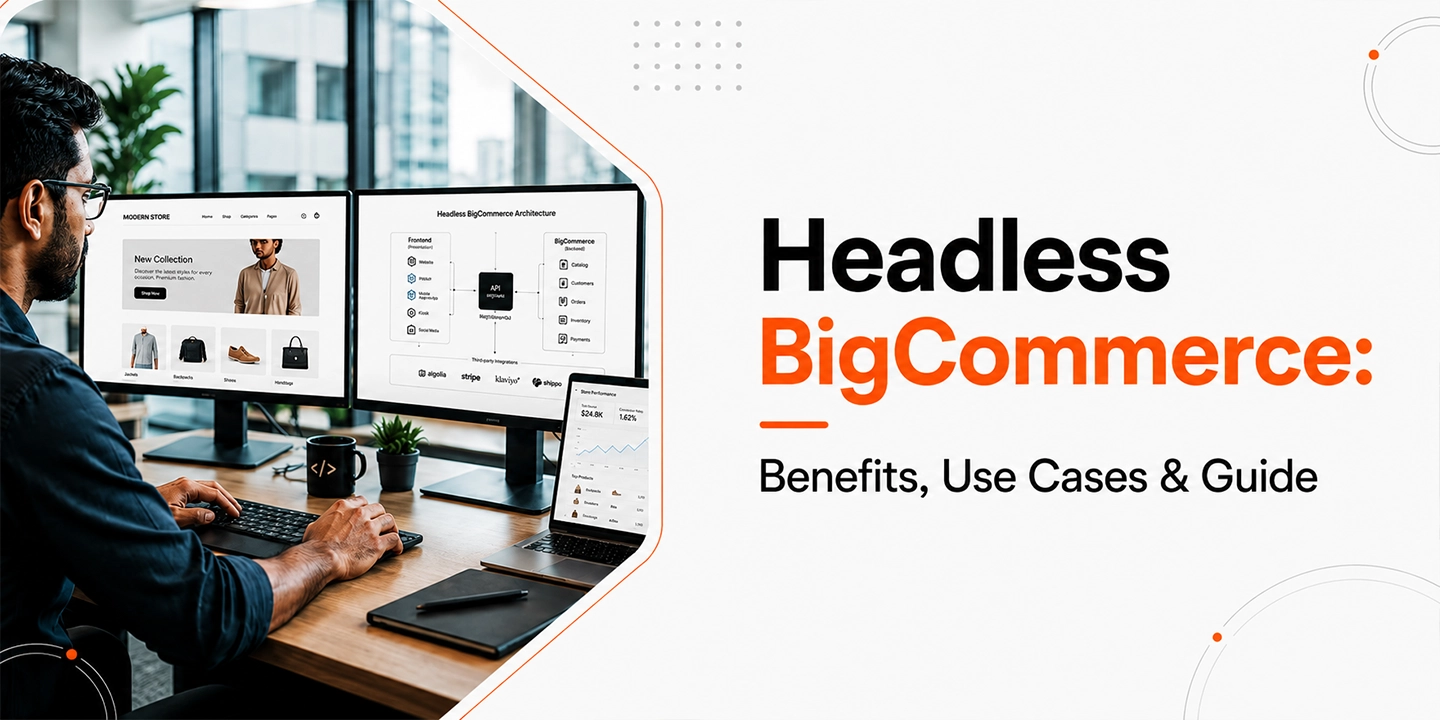
Headless BigCommerce separates the frontend, the part customers see and interact with, from the backend, where product data, inventory, pricing, and orders live. Instead of using BigCommerce’s built-in Stencil theme engine to render pages, developers build a custom frontend using frameworks like Next.js and connect it to BigCommerce through APIs. The backend still handles commerce operations. The frontend can be built and updated independently.
In a traditional BigCommerce setup, the platform controls both ends. It stores your product catalog and processes orders, and it also renders the actual pages your customers browse, using Stencil templates and Handlebars. That’s simple to manage, but it limits how far you can customize the actual shopping experience.
In a headless setup, you keep BigCommerce as what’s often called the “backend of record,” handling catalog, cart, checkout, and orders, but you build a separate frontend application that talks to BigCommerce through REST and GraphQL APIs. That frontend can live anywhere, on a completely custom framework, and can be redesigned or rebuilt without touching your commerce data at all.
Headless vs Traditional BigCommerce: A Quick Comparison
| Factor | Traditional BigCommerce (Stencil) | Headless BigCommerce |
| Frontend rendering | Server-rendered Handlebars templates | Custom frontend, typically Next.js via Catalyst |
| Customization ceiling | Limited to theme and app capabilities | Practically unlimited, built to spec |
| Development speed | Faster initial setup | Slower initial build, faster long-term iteration |
| Performance ceiling | Good, but capped by theme structure | Higher, with edge rendering and static generation |
| Team requirement | Store manager or basic developer | Dedicated frontend development team |
| Best for | Small to mid-size stores, standard needs | Growing brands with complex or unique requirements |
| Upfront cost | Lower | Higher |
| Long-term flexibility | Constrained | High |
If your business fits comfortably in the traditional column, that’s not a failure, it’s the right call for a lot of stores. Headless earns its cost when the constraints in that left column start actually costing you sales or slowing your team down.
Why BigCommerce Specifically for Headless Projects
BigCommerce markets itself as an “open SaaS” platform, and honestly, that description holds up better than most platform marketing lines. The company built out native multi-storefront capability, robust REST and GraphQL APIs, and an official headless framework called Catalyst, built on Next.js, specifically to support composable and headless builds without forcing merchants to manage their own infrastructure.
That matters because a lot of headless commerce projects on other platforms require stitching together separate backend services, a headless CMS, a search provider, and payment processing yourself. With BigCommerce, you keep enterprise-level performance, security, and uptime from the platform itself, while still having the freedom to build a completely custom frontend on top of it.
You’ll notice this shows up in how BigCommerce is positioned against competitors. Where some platforms treat headless as a workaround, BigCommerce treats it as a core deployment option, which is one of the reasons agencies specializing in Bigcommerce development services in USA increasingly default to headless architecture for any client with real growth ambitions.
The Data: Why Headless Adoption Is Accelerating
Here’s the quick answer for anyone who wants the numbers first: the global headless commerce market is valued between roughly 2 billion and 2.2 billion dollars in 2026, with most analyst projections showing it growing to somewhere between 5.5 billion and 7.2 billion dollars by the early 2030s, at compound annual growth rates ranging from about 19 to 23 percent depending on the research firm.
That growth isn’t happening in a vacuum. It’s being driven by real, measurable performance and revenue outcomes that businesses are reporting after making the switch. Let me walk through the numbers that actually matter for a decision like this.
Adoption is no longer a niche move. Industry research compiled by Swell found that 73 percent of businesses now report using some form of headless website architecture, and nearly all of the remaining businesses said they planned to evaluate a headless approach within the next 12 months. That’s a meaningful shift from just a few years ago, when headless was still considered an enterprise-only strategy.
Revenue impact is documented, not theoretical. According to that same research, 80 percent of businesses that implemented headless architecture reported measurable revenue increases, with an average sales growth of around 24 percent across adopters. That’s a substantial number, and it’s exactly the kind of statistic that should make a business owner pause and ask whether their current platform setup is quietly leaving money on the table.
Speed differences are significant and well documented. Multiple independent benchmarks point in the same direction here. One analysis of over 2,400 stores across major platforms found headless architectures deliver 20 to 50 percent faster page loads than traditional counterparts, with median improvements in Largest Contentful Paint of 0.6 to 1.2 seconds. Time to First Byte specifically showed the most dramatic gains, improving 65 to 85 percent faster in headless deployments compared to traditional server rendering.
Speed is directly tied to revenue, not just a technical vanity metric. Research from Google and Deloitte, often referenced as the “Milliseconds Make Millions” study, found that a one-second delay in page load can reduce conversions by up to 7 percent. For a store doing $10,000 a day in revenue, that’s over $250,000 a year lost to slow load times alone. That same research found every 100 milliseconds of improvement in Largest Contentful Paint correlates with a 0.7 to 1.2 percent increase in conversion rate.
Real BigCommerce brands are seeing this play out. When Italian streetwear brand Boxeur des Rues moved to a headless BigCommerce build using Next.js, the company saw page load times drop from around five seconds to under one second within days of launch, alongside a nearly 8 percent decrease in bounce rate and a 14 percent increase in site sessions. British apparel brand White Stuff had a similar experience after replatforming to headless BigCommerce, seeing its site load 85 percent faster overall and doubling its mobile speed.
Composable architecture satisfaction rates are unusually high. Industry data compiled from recent composable commerce surveys found that 9 out of 10 organizations report that composable commerce meets or exceeds their return-on-investment expectations. That’s a notably strong satisfaction rate for any major infrastructure investment, and it’s worth taking seriously when you’re weighing whether the upfront cost is justified.
Mobile performance matters more than ever. Research shows that pages taking five seconds to load see a 53 percent bounce rate specifically on mobile devices, and given how much ecommerce traffic now comes from mobile, that single statistic explains a lot of why headless projects prioritize mobile-first rendering from day one.
Real Benefits of Headless BigCommerce
Let’s get specific about what you actually gain, beyond the marketing language.
1. Genuine Design Freedom
With Stencil themes, you’re working inside a structure that BigCommerce built. It’s flexible, but it’s still a structure. Headless removes that ceiling. Your development team can build exactly the shopping experience you want, down to how product pages animate, how filtering behaves, and how checkout flows visually, without fighting theme limitations.
2. Better Performance, Which Means Better Conversion
As covered above, headless architecture using frameworks like Next.js allows for static page generation, edge rendering, and much leaner JavaScript payloads. BigCommerce’s official Catalyst framework in particular is built to hit strong Lighthouse performance scores as a default outcome rather than something you have to fight for through extensive optimization work.
3. True Omnichannel Flexibility
Because the frontend is decoupled from the backend, the same BigCommerce catalog and order system can power a website, a mobile app, an in-store kiosk, or even a voice commerce integration, all pulling from one source of truth. That’s genuinely hard to do on a traditional theme-based setup.
4. Faster Long-Term Iteration
This one surprises people. Headless has a slower initial build, but once it’s live, your development team can ship frontend changes, run experiments, and roll out new features without waiting on platform-level release cycles or fighting app conflicts. In most cases, teams that go headless end up shipping frontend updates faster within the first year than they were on their old theme-based setup.
5. Reduced App Bloat
Traditional BigCommerce stores often accumulate a long list of third-party apps for search, reviews, personalization, and upsells, each injecting its own JavaScript and slowing the page down. A custom headless build lets your team choose exactly which integrations to build in, with far more control over the performance cost of each one.
Common Use Cases for Headless BigCommerce
Headless isn’t the right call for every business, but it’s clearly the right call for specific situations. From my experience, these are the patterns that consistently justify the investment:
- Brands scaling across multiple regions or storefronts. BigCommerce’s native multi-storefront capability pairs naturally with a headless frontend, letting you manage several branded experiences from one backend.
- Businesses with a strong in-house or agency development team. Headless requires ongoing frontend engineering support. If you don’t have that, or a reliable partner providing it, the maintenance burden can outweigh the benefit.
- Brands with heavy content and commerce overlap. If your marketing team wants a highly editorial, content-driven shopping experience, headless paired with a headless CMS gives content teams and commerce teams independent control.
- Companies expanding into new channels. If you’re planning a mobile app, an in-store digital experience, or IoT integration alongside your website, one BigCommerce backend serving multiple frontends is far more efficient than managing separate systems.
- High-traffic stores where speed directly affects revenue. If you’re already seeing meaningful traffic and every second of load time has a measurable dollar impact, the performance gains from headless tend to pay for themselves faster.
- B2B businesses with complex catalog and pricing logic. BigCommerce’s strong API layer and native B2B functionality make it a common choice for headless builds that need custom pricing tiers, account hierarchies, and quote workflows that a standard theme can’t easily support.
When Headless Is Probably Not Worth It Yet
I’d be doing you a disservice if I only told you the upside. Headless isn’t the right move for every business, and a good Bigcommerce development company should tell you that honestly rather than pushing the more expensive build regardless of fit.
Skip headless, at least for now, if:
- Your current Stencil-based store already loads reasonably fast and converts well
- You don’t have budget for ongoing frontend development and maintenance
- Your team needs to make frequent content or layout changes without developer involvement
- Your product catalog and business logic are relatively simple
- You’re still validating product-market fit and need to move fast with lower overhead
One thing many businesses overlook here: performance optimization on a traditional BigCommerce store can often recover 60 to 80 percent of headless-level speed gains at a fraction of the cost. If your primary motivation for going headless is purely speed, it’s worth getting a proper performance audit done first. Sometimes the honest answer is that your existing platform just needs better image optimization, a leaner app stack, and CDN tuning, not a full architectural rebuild.
How Headless BigCommerce Development Actually Works
If you decide headless is the right path, here’s a realistic breakdown of what the development process looks like.
- Discovery and technical scoping. A capable agency starts by mapping your current catalog structure, integrations, and customer journey before writing a single line of frontend code. This step determines the real cost and timeline, and skipping it is the most common reason headless projects go over budget.
- Backend configuration in BigCommerce. Your product catalog, categories, pricing rules, and checkout settings get configured through BigCommerce’s admin and APIs, even though customers won’t interact with BigCommerce’s native theme directly.
- Frontend architecture and framework selection. Most modern BigCommerce headless builds use Catalyst, BigCommerce’s official Next.js-based storefront framework, though some agencies build fully custom React or Vue frontends depending on project requirements.
- API integration. The frontend connects to BigCommerce through REST and GraphQL APIs for product data, cart management, and checkout, along with any additional systems like a headless CMS, search provider, or personalization engine.
- Performance and SEO configuration. This step gets skipped more often than it should. Headless storefronts don’t automatically inherit the SEO handling that traditional platforms build in. Server-side rendering, structured data, canonical tags, and sitemap generation all need to be explicitly implemented, which is exactly where an experienced development partner earns their fee.
- Testing across devices and edge cases. Cart behavior, checkout flow, and mobile responsiveness need thorough testing before launch, since a custom frontend doesn’t come with the built-in reliability of a theme BigCommerce has already tested at scale.
- Launch and post-launch monitoring. Once live, ongoing monitoring of Core Web Vitals, conversion rates, and error tracking helps confirm the build is actually delivering the performance gains it was built for.
What It Costs to Build a Headless BigCommerce Store
Pricing varies significantly based on scope, but here’s a realistic range based on what I’ve seen across recent projects. A straightforward headless build using Catalyst with standard integrations typically falls in the mid five-figure range. More complex builds involving custom personalization, multiple storefronts, B2B pricing logic, or heavy third-party integrations can move into six figures.
Ongoing costs matter too, and they’re often underestimated. Budget for continued frontend development, hosting for your custom application, and regular performance monitoring. This is a genuinely different cost structure than a traditional BigCommerce store, where most of your ongoing spend goes toward apps and platform fees rather than developer time.
How to Choose a BigCommerce Development Partner
If you’ve decided headless is the right move, the partner you choose matters more than the framework you pick. Here’s what I’d actually look for.
Ask for real headless project examples, not just BigCommerce experience generally. A lot of agencies list BigCommerce as a platform they support without having actually shipped a headless build. Ask specifically to see Catalyst or custom headless projects they’ve completed, and ask what results the client saw.
Confirm they understand SEO implications of headless architecture. This is where a lot of headless BigCommerce projects quietly fail. If server-side rendering and structured data aren’t handled correctly, you can lose organic visibility even while gaining speed. Any agentic AI development services in USA in the marketing space, and by that I mean the SEO and AI search side, will tell you the same thing, technical SEO has to be built into a headless frontend from the start, not patched on afterward.
Ask how they handle post-launch support. Headless stores need ongoing frontend maintenance in a way traditional theme-based stores don’t. Make sure your partner has a clear plan for updates, monitoring, and bug fixes after launch, not just a handoff.
Look for transparency on cost and timeline. A trustworthy Bigcommerce development agency will give you a realistic range upfront based on discovery findings, not a suspiciously low flat quote before they’ve mapped your actual requirements.
Check whether they can scale with you. If you’re planning to hire Bigcommerce developers in-house eventually, ask whether the agency’s code and documentation are built in a way your future internal team can actually maintain, rather than a proprietary black box only they can touch.
Real-World Example
A mid-market outdoor gear retailer I worked with had outgrown their Stencil theme. Their catalog had grown past 8,000 SKUs, they were running over a dozen apps for search, reviews, and personalization, and their mobile load time had crept up past six seconds. Cart abandonment on mobile was noticeably higher than desktop, which tracked with what you’d expect given the bounce rate research on slow mobile pages.
We moved them to a headless BigCommerce build on Catalyst, consolidated several of their app-based features into custom-built frontend functionality, and implemented edge caching for their most-visited category pages. Mobile load time dropped to under two seconds, and mobile conversion rate improved by double digits within the first full quarter post-launch. That’s not an unusual outcome. It’s fairly consistent with the broader performance and conversion data across the industry, which is exactly why this trend isn’t slowing down.
The Bottom Line
Headless BigCommerce isn’t a trend you need to chase just because it’s popular right now. It’s a genuine architectural upgrade that makes sense once your business hits certain complexity, traffic, or performance thresholds, and it’s the wrong investment if you’re still below them. The data is fairly clear that businesses making the switch at the right time see real gains in speed, conversion, and long-term flexibility, but the businesses that get burned are usually the ones who went headless before they actually needed it, or who hired a partner that treated it as a template rather than a custom build.
If you’re evaluating Bigcommerce development services in USA and trying to figure out whether headless is right for your business, the honest starting point is a proper technical audit of where you are now, not a sales pitch for where a vendor wants you to be. Get that assessment first. The right architecture decision follows from there.