
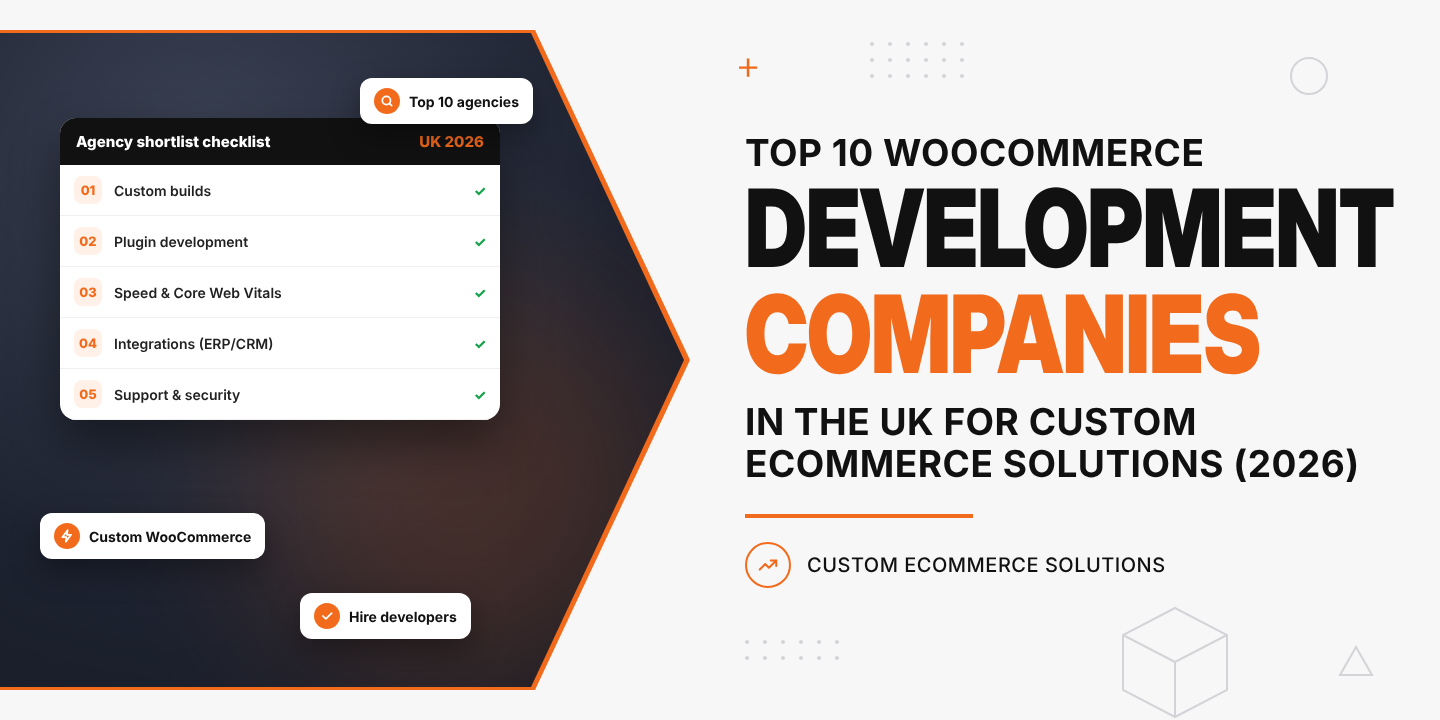
Top 10 WooCommerce Development Companies in the UK for Custom Ecommerce Solutions (2026)

Quick answer

The top WooCommerce development companies in the UK for custom ecommerce in 2026 are DIT Interactive, Atomic Smash, Creative Brand Design, Trafiki Ecommerce, SeedCMS, Unified, Page Creative, Plug & Play, blubolt and YourDigiLab. Choose based on the depth of custom WooCommerce development you need, your budget and whether you want design, development and growth marketing from one team.

Why WooCommerce still wins for custom ecommerce

WooCommerce is the free, open-source ecommerce plugin for WordPress. Because you own the code and the hosting, it suits businesses that need custom checkout logic, unusual product types, deep content marketing or integrations that hosted platforms restrict.

That flexibility cuts both ways. A plugin-heavy WooCommerce store can turn slow and fragile. Core Web Vitals are a confirmed Google ranking factor, and WooCommerce stores are especially exposed because of their plugin load. The right WooCommerce development agency keeps the custom parts clean, fast and maintainable.

In 2026 there is a new reason to care about code quality: AI shopping agents. WooCommerce has an MCP integration in developer preview (Your Next Store comparison, Oct 2026), and stores with clean product data and APIs will be easier to connect to AI channels.

How we selected these companies

  1. UK presence with an office in England, Scotland, Wales or Northern Ireland.
  2. Visible WooCommerce work in public portfolios or directory listings.
  3. Range of WooCommerce development services, from design and builds to custom plugins, integrations, migration and support.
  4. Client fit and reviews across directories such as DesignRush, GoodFirms and Clutch.
  5. Readiness for 2026 needs: performance, SEO, AI search visibility and AI agent integration.

Top 10 WooCommerce development companies in the UK at a glance

# Company UK location Known for Best for
1 DIT Interactive Hillingdon, London Custom WooCommerce development, white-label delivery, agentic AI Custom builds, agency partners, AI-ready stores
2 Atomic Smash Bristol WooCommerce and WordPress builds; Certified Platinum WooExpert Complex WooCommerce projects
3 Creative Brand Design London Bespoke, design-led WooCommerce stores Luxury and lifestyle brands
4 Trafiki Ecommerce London Multi-platform ecommerce and growth Brands wanting builds plus marketing
5 SeedCMS London Ecommerce development across WooCommerce and Shopify Established retail and lifestyle brands
6 Unified London Multi-platform ecommerce development Brands comparing platforms
7 Page Creative Essex and London Ecommerce design and development Beauty and lifestyle brands
8 Plug & Play London WooCommerce and web development SMEs needing practical builds
9 blubolt Bristol Ecommerce for fashion, beauty and home Retailers in fashion and beauty
10 YourDigiLab Ilford Web and WooCommerce development Budget-conscious SMEs

1. DIT Interactive

UK office: Hillingdon, London, with teams in Iselin, New Jersey and Ahmedabad WooCommerce development services: Custom WooCommerce development, theme design, custom plugins, ERP and CRM integrations, migrations, performance tuning, headless WooCommerce, AI shopping agents

DIT Interactive is a WooCommerce website development company and white-label digital partner for brands and agencies in the UK and the US. The team pairs WordPress development with UI/UX design and SEO, and holds a 5.0 GoodFirms rating and 100% job success on Upwork.

The difference is AI readiness. DIT also runs an agentic AI development practice, so WooCommerce stores can gain shopping assistants, AI customer service and automated catalog enrichment built by the same team.

Best for: Brands and agencies that want custom WooCommerce development, dedicated WooCommerce website developers and AI features from one partner. Explore: WooCommerce development services ยท Client reviews

2. Atomic Smash

Location: Bristol Focus: WordPress and WooCommerce development

Atomic Smash is a Bristol WooCommerce agency that holds Certified Platinum WooExpert status, a distinction WooCommerce grants to a small group of agencies worldwide.

Best for: Complex WooCommerce builds that need deep platform expertise.

3. Creative Brand Design

Location: London Focus: Web design, WooCommerce development, SEO and branding

Creative Brand Design builds bespoke, visually rich WooCommerce stores, with a portfolio weighted toward retail and luxury goods.

Best for: Luxury and lifestyle brands that lead with visual identity.

4. Trafiki Ecommerce

Location: London, also Dubai Focus: Ecommerce builds across WooCommerce, Shopify, Adobe Commerce and BigCommerce, plus marketplace growth

Trafiki combines development with ecommerce growth services for brands in food and drink, home and specialist retail.

Best for: Brands that want a build and a growth plan together.

5. SeedCMS

Location: London Focus: Ecommerce development on WooCommerce, Shopify, Shopify Plus, Adobe Commerce and BigCommerce

SeedCMS lists a long roster of named retail and consumer clients and works across several platforms.

Best for: Established brands that want a multi-platform agency.

6. Unified

Location: London Focus: Ecommerce development on WooCommerce, Shopify, Adobe Commerce and BigCommerce

Unified suits businesses still choosing a platform, since it works across the main options.

Best for: Brands weighing WooCommerce against hosted platforms.

7. Page Creative

Location: Essex, also London Focus: Ecommerce design and development on WooCommerce, Shopify and Adobe Commerce

Page Creative works with beauty and skincare brands among others.

Best for: Beauty and lifestyle brands.

8. Plug & Play

Location: London Focus: WooCommerce and web development

Plug & Play is a London agency listed for WooCommerce development work.

Best for: SMEs needing a practical, well-scoped WooCommerce build.

9. blubolt

Location: Bristol Focus: Ecommerce for fashion, apparel, beauty and home brands

blubolt focuses on retail verticals with design-sensitive catalogs.

Best for: Fashion, beauty and home retailers.

10. YourDigiLab

Location: Ilford Focus: Web and WooCommerce development for UK SMEs

YourDigiLab offers WooCommerce builds and performance work at accessible budgets.

Best for: Small businesses with tight budgets.

How to choose a WooCommerce development agency

Use this checklist before you sign:

  1. Ask for custom work, not theme installs. Look for custom plugins, checkout changes and integrations in their portfolio. You can review DIT’s recent work as an example.
  2. Check performance. Ask for Core Web Vitals results on live stores they built.
  3. Review their plugin policy. Good WooCommerce website developers keep plugins to a minimum and write custom code where it counts.
  4. Confirm security and maintenance. WordPress and WooCommerce need regular updates. Get a support plan in writing.
  5. Ask about SEO and AI search. Your WooCommerce web design agency should handle schema, site speed and content structure so you appear in Google and in AI answers. See our SEO services.
  6. Plan for AI agents. Ask how they would connect your store to AI shopping channels and on-site assistants through AI workflow automation and agent development.
  7. Choose the engagement model. Fixed-price builds suit defined projects. If you need ongoing capacity, hire WooCommerce developers on a dedicated basis.

WooCommerce vs. Shopify for custom ecommerce

Factor WooCommerce Shopify
Code ownership Full, open source Platform-controlled
Hosting You choose Included
Custom checkout logic Highly flexible Limited outside Shopify Plus
Content and blogging Excellent (WordPress) Good
Maintenance load Higher Lower
Best for Custom requirements, content-led brands Fast launch, lower maintenance

If your requirements are standard and you want low upkeep, a hosted platform may suit you. If you need control over code, data and checkout, custom WooCommerce development is the stronger choice. DIT builds on both, so we can advise either way. See our Shopify development services.

Planning a WooCommerce build or rebuild? Request a WooCommerce project estimate or hire WooCommerce developers from DIT Interactive’s London and US teams.
Custom WooCommerce Plugin Development Services for USA Businesses

If you’ve been running a WooCommerce store for a while, you’ve probably hit that wall. You know the one. The moment when no plugin in the WordPress repository does exactly what you need, or you’re stitching together four different tools that half-work together and hope nothing breaks during checkout.

That’s a real problem, and it’s one of the biggest reasons businesses start looking into WooCommerce development services in the USA to get something built specifically for them.

This article is going to walk you through what custom WooCommerce plugin development actually means, when it makes sense, what to look for in a development partner, and how the whole process typically works. No fluff, just honest information.

What Is Custom WooCommerce Plugin Development, Really?

Short answer: It’s building a plugin from scratch (or heavily modifying an existing one) to do something specific that your store needs, which off-the-shelf solutions can’t quite handle.

But let’s go a bit deeper. WooCommerce is incredibly flexible out of the box. It runs on WordPress and has thousands of plugins that extend its functionality. But businesses that grow beyond a certain point often find that generic plugins create friction. Things like:

  • A custom pricing model that doesn’t fit standard quantity discounts
  • Integration with an internal CRM or ERP that has no existing connector
  • A product configurator with logic only your business understands
  • Booking or rental workflows that don’t match standard e-commerce patterns

When you’re dealing with stuff like that, you’re not going to find a $49/year plugin that handles it cleanly. That’s where custom development comes in.

When Does It Make Sense to Go Custom?

Honestly, not every business needs a custom plugin. If you’re just starting out or your store has basic needs, a combination of trusted premium plugins works fine. But there are clear signs that custom development is the right move.

You’ve outgrown what’s available. You’ve tried three or four plugins for the same functionality, and none of them quite do the job. You’re using workarounds, and those workarounds are becoming a headache to maintain.

You have unique business logic. Your pricing, your shipping rules, your membership tiers, your checkout flow, and your product options don’t match what standard tools expect. Forcing your business into a plugin’s limitations instead of the other way around is always going to cost you in the long run.

Performance is suffering. Loading fifteen different plugins, each with its own scripts and database queries, adds up. A single well-built custom plugin that does exactly what you need is almost always lighter and faster.

You’re building something scalable. If you’re planning to grow, you want infrastructure that grows with you. Custom plugins can be written to your specifications and updated on your schedule, not a third-party developer’s.

How to Hire WooCommerce Developers Who Actually Know What They’re Doing

This is where a lot of businesses make mistakes. The WooCommerce ecosystem is huge, which means there’s a wide range of developer quality out there. Knowing how to hire WooCommerce developers who are genuinely skilled takes a little bit of work upfront.

Look at Their WooCommerce-Specific Experience

General WordPress developers are not the same as WooCommerce specialists. WooCommerce has its own hooks, filters, data structures, and conventions. Someone who’s built ten marketing sites might struggle with a complex e-commerce build. Ask specifically about WooCommerce projects they’ve handled.

Ask About Their Development Process

A serious WooCommerce development agency in the USA will have a clear process: discovery, planning, staging builds, QA testing, and a rollout plan. If someone just says “Send me your requirements, and I’ll start coding,” that’s a yellow flag. Good developers ask a lot of questions before writing a line of code.

Check How They Handle Testing and Code Quality

Custom plugins need to be thoroughly tested, especially if they’re touching checkout, payments, or inventory. Ask about their testing process. Do they use staging environments? Do they do code reviews? Do they write documentation so your team can understand what was built?

Get Clarity on Post-Launch Support

Plugins need maintenance. WordPress updates, WooCommerce updates, PHP version changes can break things. A reliable WooCommerce website development company will offer some form of ongoing support and communicate clearly about what’s included.

What the Custom WooCommerce Development Process Looks Like

Every agency does things a bit differently, but in most cases, the process follows a similar arc. Here’s a realistic picture of what to expect.

Discovery and Requirements

This is where good agencies spend serious time. They’ll want to understand your business, your current tech stack, what’s working, what isn’t, and what the end goal looks like. Don’t rush this phase. The clearer the requirements going in, the fewer surprises during development.

Technical Planning

Before any code is written, your WooCommerce website developers should map out the architecture. Which WooCommerce hooks will be used? How will data be stored? What happens when the plugin interacts with other plugins or themes? These questions need answers before development starts.

Development in a Staging Environment

Never let anyone build directly on your live store. All custom WooCommerce development should happen in a staging environment that mirrors your production setup. This is non-negotiable.

Testing

Good testing covers functional testing (does it do what it’s supposed to do?), edge case testing (what happens if someone does something unexpected?), compatibility testing (does it work with your other plugins and theme?), and performance testing (does it slow anything down?).

Launch and Handoff

A proper handoff includes documentation, a walkthrough of how to use or configure the plugin, and a clear plan for what happens if something breaks after launch.

What Makes a Good WooCommerce Web Design Agency Different

You’ll notice a real difference between agencies that treat WooCommerce as just another project and those that specialize in it. A strong Woocommerce web design agency understands that design and development in e-commerce are tightly connected.

The thing is, a plugin might work perfectly under the hood but create a terrible user experience in the frontend. Or a design decision might look beautiful but create checkout friction that kills conversions. The best teams think about both sides at once.

They’ll also understand WooCommerce’s template system, its cart and checkout hooks, and how custom functionality integrates with the storefront without creating visual or functional conflicts.

Red Flags to Watch Out For

Let’s be real for a second. Not every developer or agency that claims WooCommerce expertise actually has it. Here are some things to watch out for when evaluating options.

Vague or non-existent proposals. If you describe a complex requirement and get back a one-paragraph response with a price, that’s not a real proposal. Good developers ask follow-up questions.

No portfolio or case studies. Anyone serious about WooCommerce development should be able to show you past work. If they can’t (or won’t), that’s worth questioning.

Lowest bid wins mentality. Custom development done right isn’t cheap. If a quote is dramatically lower than others, it usually means corners are being cut somewhere, whether in testing, architecture, or support.

No mention of WooCommerce-specific considerations. A generic web developer might not even know what WooCommerce hooks are. If they don’t naturally bring up WooCommerce-specific technical details during the conversation, be cautious.

Questions to Ask Before Signing a Contract

Before you commit to any WooCommerce development services in USA, here are some direct questions worth asking:

  • How many WooCommerce-specific plugins have you built from scratch?
  • Can I see examples of custom WooCommerce work similar to what I need?
  • What’s your process for handling conflicts with other plugins?
  • Who will own the code after the project is complete?
  • What does post-launch support look like, and what does it cost?
  • How do you handle changes in scope during the project?

The answers to these questions will tell you a lot about whether you’re dealing with a real specialist or someone who’s generalized their way into WooCommerce work.

Cost Expectations for Custom WooCommerce Plugin Development

This is a question everyone asks and nobody likes giving vague answers to, so let’s talk about it plainly.

Simple custom plugins, something with limited scope and clear requirements, might run anywhere from $1,500 to $5,000. More complex builds, think full CRM integrations, complex product configurators, or multi-vendor functionality, can run $10,000 to $50,000 or more. Ongoing maintenance is typically billed separately, either hourly or as a monthly retainer.

What drives cost up? Complexity of the business logic, number of integrations required, size of the development team, timeline pressure, and the level of testing and documentation expected. A good agency will break down where the time and cost is going, not just give you a flat number.

Wrapping Up

If you’re at the point where your WooCommerce store needs something that simply doesn’t exist yet, custom plugin development is a legitimate path forward. It’s not always the first choice and it’s not always the cheapest, but for businesses with specific needs and plans to scale, it’s often the right one.

The key is finding the right partner. Whether you’re looking at a woocommerce development agency in USA or evaluating individual developers, take the time to vet them properly. Ask the hard questions, look at their past work, and make sure they understand WooCommerce at a technical level, not just a surface level.

Good custom development built on a solid foundation saves you from rebuilding things later. And in ecommerce, where your store is literally your business, that matters a lot.