Quick answer
The top headless commerce development companies in the USA for enterprise ecommerce in 2026 are DIT Interactive, Corra, Codal, Bounteous, Valtech, Digital Silk, Rightpoint, Absolute Web, Blue Acorn iCi and Netalico Commerce. The right pick depends on your platform (Shopify, BigCommerce, Adobe Commerce or commercetools), your front-end stack and whether you need AI agent readiness built in.
What is headless commerce?
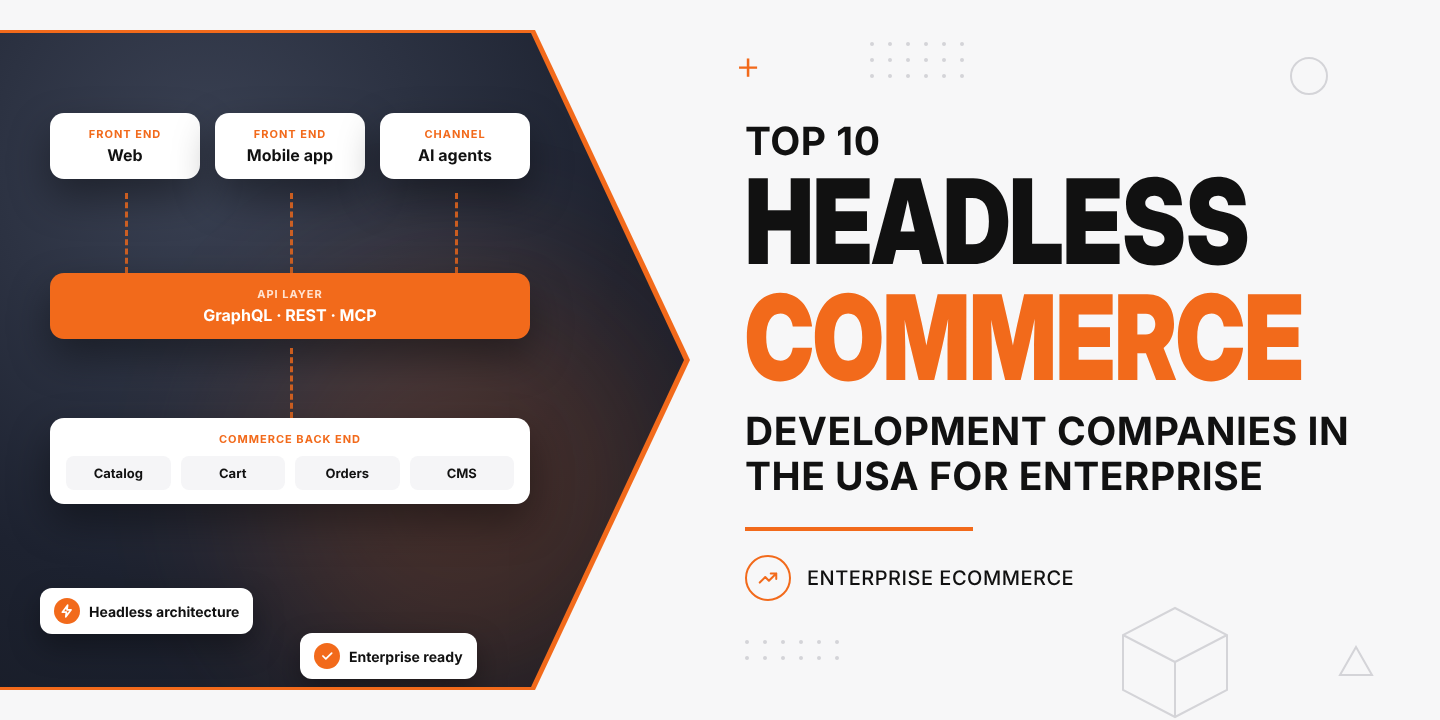
Headless commerce is an architecture that separates the customer-facing front end (the “head”) from the commerce back end that runs products, pricing, carts and orders. The two connect through APIs, so a brand can build the storefront in React, Next.js or another framework while the platform handles transactions.
Enterprises choose headless to ship faster page experiences, run several storefronts or regions from one back end, and push content to apps, kiosks and now AI agents. That last reason has grown in 2026. Platforms such as BigCommerce and Shopify now expose agent interfaces, and an API-first stack is the easiest place to plug them in.
In practice, headless ecommerce solutions range from a decoupled storefront on Shopify Hydrogen or BigCommerce Catalyst to a fully composable stack with a separate CMS, search, PIM and checkout. The right mix depends on how many channels you sell through and how much your team wants to own.
How we selected these companies
We scored each headless commerce company on five criteria:
- US presence with an office or delivery team serving US enterprises.
- Headless portfolio with public builds on Shopify Hydrogen, BigCommerce Catalyst, Adobe Commerce PWA, commercetools or custom Next.js and React stacks.
- Platform partnerships with Shopify, BigCommerce, Adobe or composable vendors.
- Breadth of headless commerce services, from architecture and CMS integration to performance, SEO and support.
- AI and agentic readiness, meaning the ability to connect storefronts to AI search, MCP servers and agent checkout protocols.
Top 10 headless commerce development companies at a glance
| # | Company | US base | Platform strengths | Best for |
| 1 | DIT Interactive | Iselin, NJ | Shopify, BigCommerce, Magento, WooCommerce, React, Node.js | Headless builds with agentic AI built in; white-label delivery |
| 2 | Corra | New York, NY | Adobe Commerce, Shopify Plus, BigCommerce | Large enterprise replatforming |
| 3 | Codal | Chicago, IL | Shopify, Adobe Commerce, headless | UX-led enterprise builds |
| 4 | Bounteous | Chicago, IL | Adobe, Salesforce, composable | Digital transformation programs |
| 5 | Valtech | US offices (global firm) | Composable, Adobe, Salesforce, commercetools | Fortune 500 global rollouts |
| 6 | Digital Silk | New York, NY | Shopify, BigCommerce, custom | Brand-led enterprise sites |
| 7 | Rightpoint | Chicago, IL | Adobe, Salesforce, Sitecore | Experience-led enterprises |
| 8 | Absolute Web | Miami, FL | Shopify, BigCommerce, Adobe Commerce | Mid-market to enterprise retail |
| 9 | Blue Acorn iCi | Charleston, SC | Adobe Commerce, Shopify | Data-driven commerce teams |
| 10 | Netalico Commerce | Miami, FL | Shopify, Magento | Growth-stage brands going headless |
1. DIT Interactive
Headquarters (US): Iselin, New Jersey, with teams in London and Ahmedabad Core headless commerce solutions: Headless Shopify, BigCommerce and Magento builds; React and Next.js storefronts; Node.js middleware; CMS integration; agentic AI integration
DIT Interactive is a full-service, AI-enabled headless commerce development company and white-label partner for US brands and agencies. The team holds BigCommerce Certified status (4.9 rating from 39 reviews) and Shopify Partner status (4.8 from 88 reviews), and builds front ends in React with Node.js back-end services.
What sets DIT apart is agent readiness. The same team that builds the headless storefront also builds agentic AI features, such as shopping assistants connected to BigCommerce Storefront MCP or Shopify’s Universal Commerce Protocol.
Best for: Enterprises and agencies that want a headless build, AI shopping features and dedicated developers from one partner. Explore: Headless commerce services · Our work
2. Corra
Headquarters: New York, NY Focus: Enterprise commerce on Adobe Commerce, Shopify Plus and BigCommerce, with headless and omnichannel builds
Corra is a long-standing enterprise commerce agency known for complex replatforming programs. It suits retailers with large catalogs and several integrated systems (ERP, OMS, PIM) that need a structured delivery process.
Best for: Large retailers moving off legacy platforms.
3. Codal
Headquarters: Chicago, IL Focus: UX-first design and engineering on Shopify, Adobe Commerce and headless stacks
Codal pairs research-driven design with engineering. Its headless work fits brands where the front-end experience is the main reason to decouple.
Best for: Brands that prioritize design and conversion.
4. Bounteous
Headquarters: Chicago, IL Focus: Digital transformation across Adobe, Salesforce and composable commerce
Bounteous runs large programs that combine commerce, content, analytics and personalization. It is a fit for enterprises standardizing on an enterprise software suite.
Best for: Multi-year transformation programs.
5. Valtech
US presence: Several US offices as part of a global network Focus: Composable and headless architecture for global enterprises
Valtech works with Fortune 500 brands on composable commerce, often across many countries and languages. Expect enterprise pricing and governance.
Best for: Global brands rolling out one architecture across regions.
6. Digital Silk
Headquarters: New York, NY Focus: Brand-led web design and ecommerce development, including headless builds
Digital Silk combines branding and development. It works well for companies where the storefront is also the flagship brand experience.
Best for: Brand repositioning alongside a replatform.
7. Rightpoint
Headquarters: Chicago, IL Focus: Customer experience strategy and digital platforms on Adobe, Salesforce and Sitecore
Rightpoint fits enterprises that treat commerce as one part of a wider experience program covering content, service and mobile.
Best for: Experience-led enterprises with content-heavy sites.
8. Absolute Web
Headquarters: Miami, FL Focus: Ecommerce design and development on Shopify, BigCommerce and Adobe Commerce
Absolute Web serves mid-market and enterprise retailers with design, development and marketing under one roof.
Best for: Retailers that want development and growth marketing together.
9. Blue Acorn iCi
Headquarters: Charleston, SC Focus: Adobe Commerce and Shopify builds with analytics and optimization
Blue Acorn iCi brings an analytics lens to commerce builds. It suits teams that want measurement designed in from the start.
Best for: Data-driven commerce teams on Adobe.
10. Netalico Commerce
Headquarters: Miami, FL Focus: Shopify and Magento development, UX and system integration
Netalico serves growth-stage and mid-market brands moving to more flexible architectures.
Best for: Growth-stage brands taking their first step into headless.
How to choose the right headless commerce agency
Use this checklist when you shortlist a headless commerce agency:
- Match the platform. Ask for live headless builds on your exact platform: Hydrogen for Shopify, Catalyst for BigCommerce, PWA Studio or a custom front end for Adobe Commerce.
- Check front-end depth. A strong headless commerce developer team should show React or Next.js work with good Core Web Vitals.
- Ask about SEO. Headless sites can lose rankings if rendering, redirects and structured data are mishandled. Ask how they handle server-side rendering and schema. See our SEO services.
- Plan for AI agents. Ask how the architecture will expose products to AI search and agent protocols such as MCP and UCP.
- Review total cost of ownership. Headless adds hosting, CMS and maintenance costs. Ask for a three-year view.
- Agree on support. Get post-launch SLAs in writing.
Headless vs. traditional ecommerce: when headless pays off
| Factor | Traditional (monolithic) | Headless |
| Front-end flexibility | Limited to platform themes | Any framework |
| Page speed potential | Good | Very high with modern frameworks |
| Multi-storefront and omnichannel | Harder | Built for it |
| AI agent and API integrations | Possible | Easier, API-first |
| Launch time | Faster | Longer |
| Ongoing cost | Lower | Higher |
Headless pays off when you run several brands or regions, need custom experiences your theme cannot deliver, or want to feed many channels from one back end. If you run one store with standard needs, a well-built theme on Shopify, BigCommerce or WooCommerce may serve you better.
Considering a headless build? Get a free headless commerce architecture review from DIT Interactive, or hire a dedicated headless commerce developer to extend your team.