
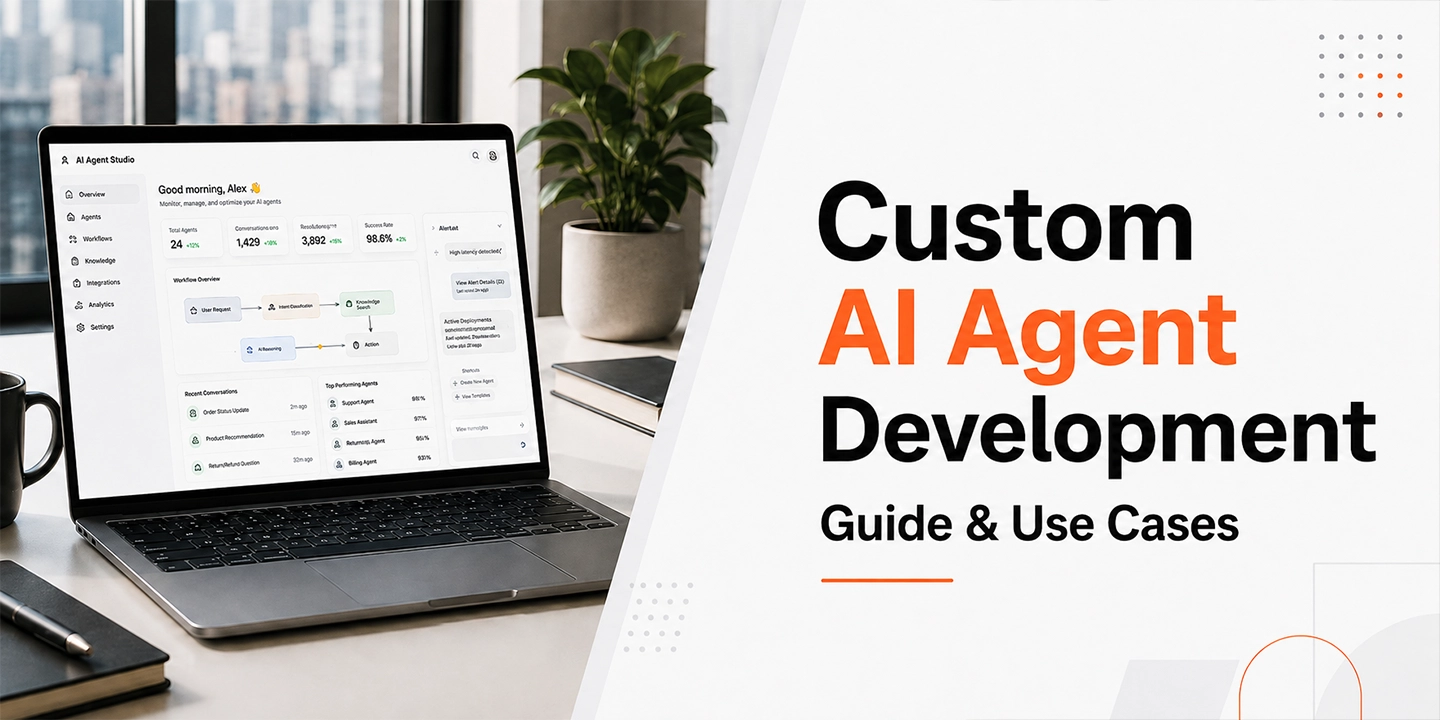
Businesses are increasingly moving beyond AI tools that simply answer questions. The next step is software that can understand a goal, gather information, interact with systems, make workflow decisions within defined rules, and complete tasks across multiple applications.
This is where custom AI agents come into the picture.
Unlike a standalone AI chatbot that responds to prompts, an AI agent can interact with business systems, retrieve information, execute actions, and manage multi-step workflows. A customer support agent might check order status, update tickets, and escalate complex issues. A sales agent might research prospects, qualify leads, update a CRM, and schedule meetings.
For organizations exploring AI adoption, understanding custom AI agent development is becoming increasingly important. Whether you’re evaluating an AI automation initiative or considering working with an experienced agentic AI development company, the goal should be the same: solving a real business problem through intelligent workflow automation.
What Is Custom AI Agent Development?
Short answer: Custom AI agent development is the process of designing, building, testing, and deploying AI-powered systems that can perform specific business tasks by combining AI models, business logic, company knowledge, software integrations, and controlled actions.
A custom AI agent is built around a business workflow rather than a generic conversation interface.
These systems can:
- Understand goals
- Break tasks into smaller steps
- Retrieve relevant information
- Use tools and APIs
- Interact with software systems
- Maintain context
- Make workflow decisions within defined rules
- Take approved actions
- Escalate situations to humans when needed
For example, a customer support AI agent may:
- Receive a customer request
- Access order information
- Verify eligibility for a return
- Create a support ticket
- Send a confirmation email
- Escalate unusual cases to a support representative
That workflow goes far beyond generating text. It combines AI reasoning, business rules, integrations, and operational processes.
What Is Agentic AI?
Short answer: Agentic AI refers to AI systems designed to pursue goals through planning, tool usage, information retrieval, workflow execution, and feedback-driven decision-making within defined constraints.
In practical business terms, Agentic AI combines several components:
- AI models
- Planning mechanisms
- Context and memory
- Tool access
- APIs
- Business rules
- Human oversight
- Feedback loops
An agentic system does not simply answer a question.
Instead, it may:
- Understand an objective
- Determine required steps
- Access business data
- Use external tools
- Evaluate results
- Decide what to do next
For example, a sales operations agent might receive a request to identify qualified leads in a specific industry. It can gather CRM information, review lead data, apply qualification rules, generate recommendations, and create tasks for sales representatives.
Importantly, agentic systems are not conscious and do not possess human judgment. Their effectiveness depends on workflow design, data quality, permissions, testing, and monitoring.
AI Agent vs Chatbot vs Generative AI
Short answer: Generative AI primarily creates content, chatbots primarily handle conversations, and AI agents can execute multi-step workflows using tools, systems, and business logic.
| Capability | Generative AI | Traditional Chatbot | AI Agent |
| Generates content | Yes | Limited | Yes |
| Understands context | Limited | Moderate | Stronger |
| Uses tools | Sometimes | Limited | Yes |
| Connects to APIs | Limited | Sometimes | Yes |
| Makes workflow decisions | No | Limited | Yes |
| Performs multi-step tasks | Limited | Limited | Yes |
| Takes actions | Rarely | Sometimes | Yes |
| Works autonomously within rules | No | Limited | Yes |
| Human escalation | Not typical | Yes | Yes |
| Best use cases | Content generation | Customer interactions | Workflow execution |
These categories often overlap.
A chatbot can use generative AI. An AI agent may include a conversational interface. A generative AI application can become agentic when connected to tools, workflows, and decision-making processes.
The difference is usually the ability to take action and manage tasks rather than simply generate responses.
How Do AI Agents Work?
Short answer: AI agents combine AI models, instructions, tools, business data, and workflow logic to complete tasks through a sequence of planned actions.
Simplified AI Agent Flow
Business Goal → AI Model → Planning → Tool Selection → Action → Result Evaluation → Next Action → Completion
Key components include:
- Large Language Models (LLMs)
- System instructions
- APIs
- Retrieval systems
- Databases
- Memory
- Business rules
- Guardrails
- Monitoring systems
- Human approvals
For example:
A customer asks about a delayed shipment.
The agent:
- Understands the request
- Retrieves order data
- Checks shipping status
- Applies company policies
- Generates a response
- Creates a support case if necessary
- Escalates complex situations
The practical answer is that successful AI agents rely just as much on integrations, workflow design, and controls as they do on the underlying AI model.
Key Components of a Custom AI Agent
AI Model
The AI model interprets instructions, understands context, generates responses, and supports decision-making.
Popular choices include models from OpenAI, Anthropic, Google, Microsoft, and open-source providers.
Agent Instructions
Instructions define:
- Goals
- Business rules
- Allowed actions
- Escalation requirements
- Communication style
These instructions act as operating guidelines.
Tools and APIs
Tools allow agents to interact with external systems.
Examples include:
- CRM platforms
- ERP systems
- Ecommerce platforms
- Helpdesk software
- Email platforms
- Databases
Knowledge and Retrieval
Agents often need access to company-specific information.
Retrieval systems can provide:
- Product documentation
- Policies
- Internal procedures
- Knowledge bases
Memory and Context
Memory helps agents maintain continuity.
This may include:
- Current conversation context
- Workflow state
- Historical interactions
- Business-specific preferences
Planning and Decision Logic
Planning systems break objectives into manageable tasks.
The agent determines:
- What information is needed
- Which tools to use
- Which actions are appropriate
Guardrails
Guardrails help control behavior.
Examples include:
- Permission controls
- Data validation
- Action approval requirements
- Compliance checks
Monitoring
Monitoring provides visibility into:
- Performance
- Errors
- Costs
- User satisfaction
- Escalation rates
Benefits of Custom AI Agent Development
Short answer: Custom AI agents can help businesses automate repetitive workflows, improve response times, support employees, and connect activities across multiple systems.
Automate Multi-Step Workflows
Many business processes involve multiple systems and decisions.
Examples include:
- Lead qualification
- Customer onboarding
- Ticket management
- Order processing
Reduce Manual Work
Employees often spend time on repetitive administrative tasks.
AI agents can assist with:
- Data entry
- Status updates
- Information retrieval
- Report generation
Improve Response Times
Faster access to information often improves customer and employee experiences.
Work Across Business Systems
AI agents can connect:
- CRM systems
- ERP platforms
- Ecommerce tools
- Databases
- Support software
- Communication platforms
Personalize Customer Experiences
Agents can use customer context to provide more relevant interactions.
Support Employees
Internal agents can help staff locate information, complete workflows, and answer operational questions.
Scale Operations
As task volume grows, agents can help manage larger workloads within defined boundaries.
Improve Decision Support
Agents can gather information, analyze data, and present recommendations for human review.
Custom AI Agent Development Process
Short answer: Successful AI agent projects begin with workflow discovery and progress through architecture, integration, testing, deployment, and ongoing monitoring.
Step 1: Identify the Business Problem
Start with the workflow.
Common questions include:
- What process causes delays?
- Where do employees spend excessive time?
- Which workflows involve repetitive decisions?
Step 2: Define Goals and KPIs
Potential metrics include:
- Time saved
- Resolution rate
- Response time
- Conversion rate
- Accuracy
- Task completion rate
Step 3: Map the Workflow
Document:
- Inputs
- Decisions
- Actions
- Exceptions
- Human approvals
- Outputs
Step 4: Select the AI Model and Architecture
Selection depends on:
- Complexity
- Cost
- Latency
- Context requirements
- Reliability
- Multimodal needs
Step 5: Connect Business Data and Tools
Common integrations include:
- Salesforce
- HubSpot
- Microsoft Dynamics
- SAP
- Shopify
- Zendesk
- Internal databases
Step 6: Build Agent Logic
This includes:
- Planning systems
- Retrieval mechanisms
- Memory
- Workflow logic
- Permissions
- Validation rules
Step 7: Develop the Agent
Development typically includes:
- Backend services
- Integrations
- User interfaces
- Knowledge systems
- Monitoring tools
Step 8: Test and Evaluate
Testing should cover:
- Accuracy
- Reliability
- Tool usage
- Failure handling
- Edge cases
- Security risks
Step 9: Human Approval and Escalation
Some workflows should always include human review.
Examples include:
- Financial approvals
- Legal decisions
- Healthcare recommendations
- Sensitive customer actions
Step 10: Deploy and Monitor
Deployment is not the end.
Ongoing activities include:
- Performance tracking
- Cost monitoring
- User feedback analysis
- Workflow refinement
Custom AI Agent Development Use Cases
Customer Support Agent
Can assist with:
- FAQ responses
- Order tracking
- Ticket creation
- Routing requests
- Escalation workflows
Sales Agent
Can support:
- Lead qualification
- Prospect research
- CRM updates
- Follow-up sequences
- Meeting scheduling
Marketing Agent
Useful for:
- Research
- Content planning
- Campaign analysis
- Performance reporting
Ecommerce Agent
Can assist with:
- Product discovery
- Order support
- Recommendations
- Inventory workflows
Finance Agent
May support:
- Invoice processing
- Data collection
- Reporting
- Reconciliation assistance
Human review remains important for financial decisions.
HR Agent
Useful for:
- Employee onboarding
- Policy lookup
- Document support
- Internal assistance
IT Support Agent
Can help with:
- Ticket classification
- Troubleshooting guidance
- Knowledge retrieval
- Approved system actions
Operations Agent
Can coordinate:
- Workflow tracking
- Data collection
- Exception handling
- Task management
Research Agent
Useful for:
- Document review
- Information gathering
- Competitive research
- Report preparation
[Internal Link: Custom AI Agent Development]
Industry-Specific AI Agent Use Cases in the USA
| Industry | Business Problem | AI Agent Use Case | Potential Benefit |
| Ecommerce | High support volume | Order support agent | Faster customer service |
| Healthcare | Administrative workload | Patient information workflows | Reduced manual processing |
| Finance | Reporting complexity | Data gathering agent | Improved operational efficiency |
| SaaS | Lead management | Sales qualification agent | Better lead prioritization |
| Retail | Inventory visibility | Inventory monitoring agent | Faster issue detection |
| Manufacturing | Operational coordination | Workflow monitoring agent | Improved visibility |
| Logistics | Shipment tracking | Logistics support agent | Faster updates |
| Real Estate | Lead follow-up | Property inquiry agent | Better responsiveness |
| Professional Services | Research workload | Knowledge assistant | Faster information access |
| Education | Student support | Student information agent | Improved support workflows |
For regulated industries, privacy, compliance, auditability, and human oversight are particularly important.
Custom AI Agent Development vs Off-the-Shelf AI Tools
| Factor | Off-the-Shelf AI | Custom AI Agent |
| Customization | Limited | High |
| Integrations | Basic | Extensive |
| Data Control | Limited | Greater control |
| Workflow Complexity | Simple | Advanced |
| Initial Cost | Lower | Higher |
| Deployment Speed | Faster | Longer |
| Scalability | Moderate | High |
| Maintenance | Vendor-managed | Shared responsibility |
| Security Controls | Standard | Business-specific |
| Business Logic | Limited | Customized |
An off-the-shelf solution may be sufficient for generic use cases.
Custom development often becomes attractive when workflows involve multiple systems, business rules, and proprietary processes.
AI Automation Agency vs AI Agent Development Company
An AI automation agency often focuses on workflow automation using existing tools, integrations, and automation platforms.
Typical Automation Focus
- Process automation
- Workflow integration
- Task routing
- System synchronization
Typical Agent Development Focus
- Agent architecture
- Multi-step workflows
- Tool-using AI agents
- Decision support systems
- Agentic workflows
Neither approach is universally better. The right choice depends on business requirements.
Agentic AI Development Services: What Do They Include?
Organizations offering agentic AI development services often provide:
- AI strategy
- Use-case discovery
- Architecture design
- Custom AI agent development
- API integration
- Retrieval systems
- Workflow automation
- Multi-agent architectures
- Testing and evaluation
- Guardrail implementation
- Monitoring
- Ongoing support
The most successful projects usually begin with workflow discovery rather than model selection.
Agentic AI Services for Business Automation
Agentic AI services can support many operational areas.
Examples include:
- Customer service automation
- Sales workflow support
- Marketing operations
- Ecommerce assistance
- Research automation
- Data workflows
- Internal knowledge management
- Employee support
The value comes from connecting AI to meaningful business processes rather than deploying AI in isolation.
How Much Does Custom AI Agent Development Cost?
Short answer: Costs vary significantly based on complexity, integrations, security requirements, and operational scope.
Factors affecting cost include:
- Number of workflows
- AI model usage
- API integrations
- Knowledge systems
- Security requirements
- User interfaces
- Testing requirements
- Monitoring infrastructure
- Compliance obligations
| Project Type | Complexity | Main Cost Drivers |
| Basic single-workflow agent | Low | One workflow, limited integrations |
| Integrated business agent | Medium | CRM, helpdesk, databases |
| Advanced multi-system agent | High | Multiple systems, approvals, orchestration |
| Enterprise agentic platform | Very High | Governance, security, scalability, compliance |
Indicative market pricing can range from a few thousand dollars for simple prototypes to six-figure enterprise implementations. Actual costs vary substantially.
How Long Does AI Agent Development Take?
Timelines depend on workflow complexity and integration requirements.
Typical stages include:
| Stage | Approximate Duration |
| Discovery | 1-3 weeks |
| Architecture | 1-2 weeks |
| Prototype | 2-4 weeks |
| Development | 4-12+ weeks |
| Integration | 2-8 weeks |
| Testing | 2-6 weeks |
| Deployment | 1-2 weeks |
| Monitoring and refinement | Ongoing |
Simple internal agents may launch quickly. Enterprise platforms often require significantly longer timelines.
AI Agent Security and Privacy
Short answer: Security should be considered throughout the entire lifecycle of an AI agent, from architecture and permissions to deployment and monitoring.
Key considerations include:
Data Privacy
Protect customer, employee, and operational data.
Access Control
Agents should only access required systems.
Authentication
Verify identities before allowing actions.
Authorization
Control what actions an agent can perform.
API Security
Secure integrations and credentials.
Prompt Injection Protection
Defend against attempts to manipulate agent behavior.
Data Leakage Prevention
Restrict access to sensitive information.
Tool Permissions
Apply least-privilege access.
An AI agent should have only the permissions required to perform its assigned tasks.
Logging and Monitoring
Maintain audit trails and visibility.
Human Approval
Require review for high-impact actions.
Security frameworks and guidance from organizations such as NIST and OWASP provide useful references when designing enterprise AI systems.
How to Measure AI Agent ROI
AI agent ROI should be measured against the workflow being improved.
Potential KPIs include:
- Tasks completed
- Hours saved
- Cost per task
- Response times
- Resolution rates
- Conversion rates
- Escalation rates
- Error rates
- Customer satisfaction
- Employee satisfaction
- Revenue influence
You’ll notice that meaningful measurement requires baseline metrics before deployment.
Common Challenges in Custom AI Agent Development
Common challenges include:
- Hallucinations
- Incorrect tool usage
- Poor data quality
- Complex integrations
- Unclear workflows
- Security concerns
- Unexpected operating costs
- Latency
- Inconsistent outputs
- Weak evaluation processes
- Missing escalation paths
Risk reduction strategies include:
- Better testing
- Structured workflows
- Strong guardrails
- Monitoring
- Human review
- Clear permissions
That sounds simple, but ongoing evaluation is often one of the most overlooked parts of AI projects.
How to Choose an Agentic AI Development Company in the USA
Selecting an agentic AI development company should involve more than reviewing AI model expertise.
Evaluation Checklist
- AI and LLM experience
- Agent architecture expertise
- API integration capabilities
- Business process understanding
- Security practices
- Testing methodologies
- Data governance approach
- Deployment experience
- Monitoring and support capabilities
- Industry experience
- Communication quality
- KPI-driven project planning
Questions to Ask
- How do you evaluate AI agents?
- How do you handle security reviews?
- What monitoring tools do you use?
- How do you measure business outcomes?
- What escalation controls are available?
- How do you manage model updates?
When Should Your Business Build a Custom AI Agent?
A custom AI agent may be appropriate when:
- Workflows are repetitive
- Multiple systems are involved
- Decisions follow defined rules
- Employees spend substantial time on the process
- Context matters
- Existing automation tools fall short
- Custom integrations are required
- Business outcomes can be measured
When Not to Build One
Consider alternatives when:
- The workflow is extremely simple
- Processes change constantly
- Data quality is poor
- Human judgment is required at every step
- Automation costs exceed expected value
The thing is, not every workflow needs an AI agent.
Sometimes a traditional automation platform is the better choice.
Future of Agentic AI for Businesses in the USA
Several trends are emerging:
- More AI-supported workflows
- Multi-agent systems
- Improved tool usage
- Multimodal capabilities
- Wider enterprise adoption
- AI-native business processes
- Human-AI collaboration models
- Greater focus on governance
Most organizations are unlikely to replace entire departments with AI agents. More often, they redesign workflows so humans and AI systems work together.
Custom AI Agent Development Checklist
Business
- Define the workflow
- Identify the business problem
- Define KPIs
- Estimate business value
Technical
- Choose AI model
- Define architecture
- Connect APIs
- Configure data access
- Build tools
- Define agent logic
Security
- Access control
- Authentication
- Authorization
- Data protection
- Logging
- Guardrails
- Human approval
Testing
- Accuracy testing
- Reliability testing
- Edge-case testing
- Hallucination testing
- Tool-use testing
- Security testing
Deployment
- Monitoring
- Cost tracking
- User feedback
- Performance measurement
- Continuous improvement
Final Thoughts
Custom AI agent development is most valuable when AI is connected to a meaningful business workflow.
The right approach is not:
“Let’s build an AI agent.”
The better approach is:
Business problem → Workflow → AI opportunity → Agent architecture → Integration → Testing → Measurable outcome
Organizations that follow this process are more likely to build systems that provide practical business value rather than experimental technology projects.
For companies evaluating advanced automation, working with an experienced agentic AI development company can help navigate architecture decisions, integrations, security requirements, testing strategies, and long-term maintenance.
The goal is not maximum autonomy. The goal is building AI systems that help people work more effectively within well-designed business processes.