
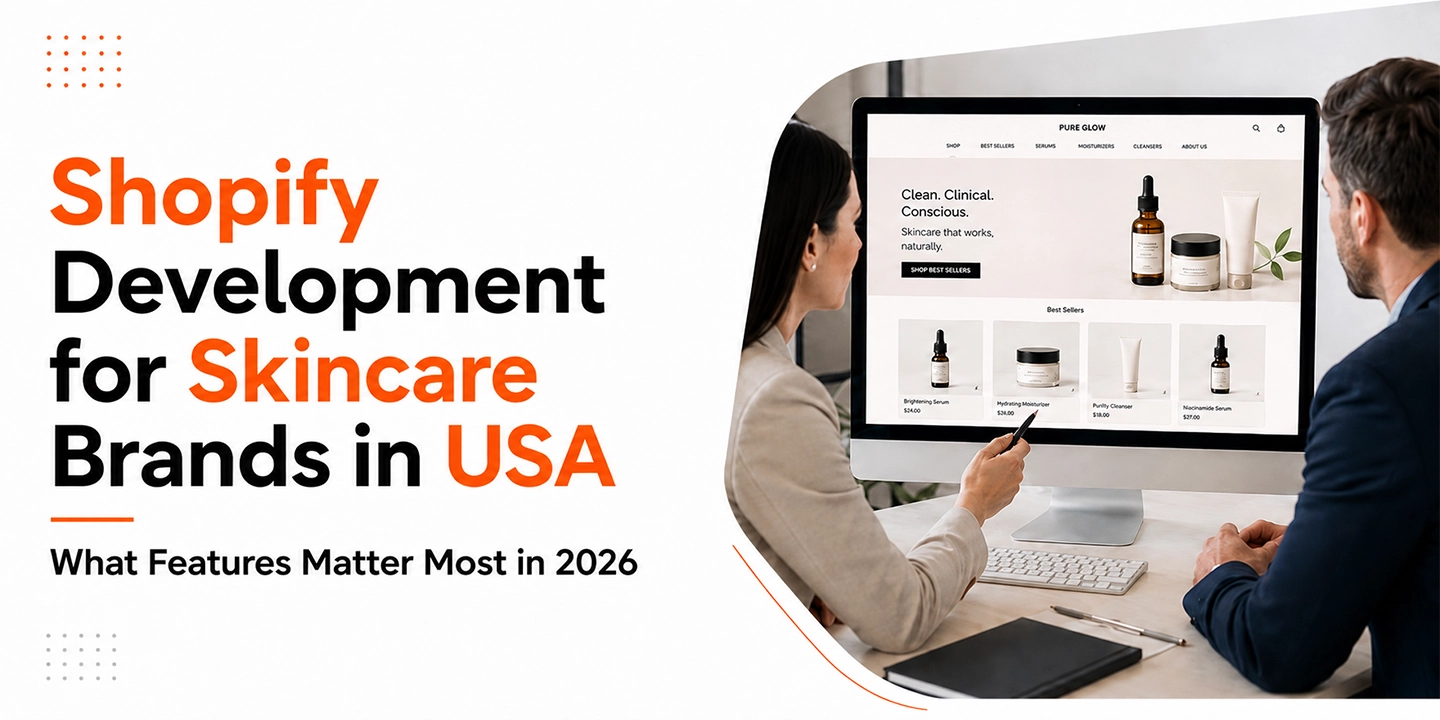
Product photographs alone cannot help sell skincare products through e-commerce platforms. Consumers have to be made aware of the ingredients of the product, its suitability for their skin, directions for use, shipping information, and most importantly, the actual benefits of the product.
The best Shopify skincare store in 2026 will not only be easy to navigate but will also make consumers feel confident and help them discover the right products.
1. A Clean Design That Supports the Brand
The skincare website needs to be sleek but not complicated to navigate. Typography, space, color palette, and high quality imagery of products will allow you to convey whether the brand is scientific, natural, luxurious, dermatological, or everyday.
But at the same time, do not let visuals obscure the necessary information. The visitor must immediately know:
- What the brand sells
- Whom the products are intended for
- What sets the formulas apart
- Where to start
- How to choose products by concern or product type
USA professional Shopify web design company will create the visual direction of your brand based on its target audience, not some trendy beauty template.
2. Easy Shopping by Skin Concern
Consumers of skincare products will not start their search from the name of the product. They will start their search with their concerns:
- Dryness
- Acne-prone skin
- Dark spots
- Fine lines
- Redness
- Irregular skin texture
- Sensitive skin
- Dullness
This consumer behavior must be reflected in your navigation and collections organization. In addition to classic categories like cleansers, moisturizers, serums, and masks, consumers must be able to filter their options by concern, skin type, ingredient, or step of routine.
Possible filters could be:
- Skin type
- Skin concern
- Key ingredient
- Product type
- Texture
- Fragrance-free
- Vegan / cruelty-free
- Price
Good collection pages allow consumers to limit their options without constantly opening single product pages.
3. Detailed Product Pages That Answer Real Questions
Product page is when interest turns into confidence – or hesitation.
It would be great if the product page for skincare was about more than just the product name, price, and purchase button. It needs to address all the questions that customers have about the product before applying it on their skin.
Product Benefits
Describe the function of the product. Make sure your claims aren’t too fluffy.
Skin Type & Concerns
Indicate the skin type and concerns which the product can help.
Ingredients
Tell about the main ingredients and their benefits. You must provide an exhaustive ingredient list.
Instructions for Use
Indicate the instructions for use and how often you need to apply the product. Provide a recommended order of application.
Texture and Packaging of Product
Describe the texture of the product, its packaging, quantity, and frequency of use.
Visuals
Include several pictures of the product from different angles. Take photos of texture, packaging, and product video.
The skilled Shopify website development agency in USA can put this information into the reusable product fields.
4. Metafields and Metaobjects for Structured Content
Many skincare retailers often deal with a significant amount of product-related data, such as ingredients, worries, benefits, instructions, warnings, certificates, routines, and FAQs.
In order to organize such data efficiently, Shopify metafields and metaobjects can be used. Rather than placing all of that information in one long description of the product, developers can make use of well-separated fields.
For instance, an ingredient like niacinamide may be represented in a reusable field consisting of:
- Ingredient name
- Description
- Benefits
- Products related
- An illustrative image
- Usage information
This approach helps to avoid unnecessary effort and makes it easier for the catalog to scale in the future.
5. Routine Builder or Skincare Quiz
While customers will have some knowledge about the issue, but they may not know the products that they should use. For that purpose, a basic quiz or routine builder can serve as a tool for helping them get to the recommended solution.
Examples of what such a quiz may cover include:
- Skin type
- Main issues
- Sensitivity
- Routines used before
- Preference for number of steps
- Preferences regarding products
- Budget
Finally, the recommendation should contain the reasons why the customer should use these products. It should not just show the set of products.
Some brands will be able to use already created apps, and others will require custom algorithms. Here is when services like Shopify app development services in USA may come in handy.
6. Product Bundles and Complete Routines
Skin care products naturally lend themselves to bundles because consumers tend to combine different products.
Some bundles that could be offered are:
- Morning bundle
- Evening bundle
- Start-up bundle
- Travel bundles
- Bundles for treating acne
- Hydration bundle
- Customizable bundles
The bundle page should make it clear what each product is used for, how they should be applied in what order, how much they’re worth, and how much consumers are saving.
Consumers shouldn’t have to wonder whether these products are meant to work together.
7. Subscription Options for Repeat Purchases
Cleansers, moisturizers, sunscreens, and treatments are replenished on a consistent basis. Subscription buying can help in simplifying the re-ordering process while making revenue streams predictable for the brand.
The customer should have an option of choosing between:
- One-off purchase
- Subscription and savings
- Frequency of deliveries
- Subscription management
Transparency needs to be maintained in the subscription offer. Price per delivery period, delivery intervals, discount amount, cancel policy, and account management should all be clearly mentioned.
Deceptive terms might yield quick sales but not goodwill.
8. Reviews, Results, and Customer Education
Before trying a new formula, skincare consumers require proof. Reviewing might help, but it must be done correctly.
Some features that can be included in a useful review are:
- Purchase confirmation
- Skin type
- Age group
- Primary concern
- Duration of use
- Pictures when possible
- Product rating
- Review text
Do not show customer results as guaranteed results. The performance of skincare products differs, and truthful content would have to point that out.
Educational content can also eliminate uncertainty. Consumers will become better-informed because of ingredient reviews, routine articles, product comparison, and “how to use” videos.
9. Mobile-First Shopping Experience
The majority of skincare consumers get exposed to brands via social media, creators, email marketing, and mobile search. The first contact with the store is made by using a mobile device.
The mobile site must provide:
- Fast-loading images
- Structure in menus
- Product information
- Available filters
- Add to Cart button stickiness
- Variant selection
- Cart editing
- Little interruption via pop-ups
Big image sizes, animations, and marketing scripts are the reasons for slowing down the site. The professional Shopify web development company from the USA needs to check the performance of the site during development, not after its launch.
10. A Smooth and Trustworthy Checkout
Consumers can drop out of buying a skin care product due to unforeseen costs, ambiguous delivery methods, and unnecessary questions at checkout.
During checkout, the customer should be informed about:
- Shipment options
- Delivery estimation
- Applicable taxes
- Discount usage
- Accepted forms of payment
- Return policy
- Contact information
It needs to be easy and straightforward for the consumer.
11. Customer Accounts and Reordering
Loyalty customers do not have to go through the whole process of discovery each time they are in need of that product.
Customer accounts could help in:
- Looking at past purchases
- Tracking orders
- Ordering products
- Managing addresses
- Subscriptions
- Saved routines
- Communication preferences
In the case of skincare products, there could be an added benefit to having a clear “buy again” button.
12. Search Engine-Friendly Store Structure
Search visibility goes beyond the mere inclusion of keywords in product descriptions.
A well-built Shopify store will feature:
- Logical product & collection URLs
- Unique title tags & descriptions
- Logical heading structure
- Alt text for images
- Internal linking between products & guides
- Valuable collection content
- Redirections
- Optimized images
- Product data structure
- Speed optimized for mobile devices
Product pages must answer real customer queries, rather than forcing unnatural keyword repetitions.
In the case of choosing Shopify ecommerce development services in USA, always inquire about the approach to SEO at the stage of development.
13. Integrations That Support Daily Operations
For an effective skincare web site, the back-end functionality should be solid as well.
According to the specifics of the business, Shopify can have to integrate with:
- Email or SMS marketing tools
- Review websites
- Customer support tools
- Subscription tools
- Warehouse or inventory management systems
- Loyalty programs
- Accounting tools
- Shipping tools
- Analytics tools
- Retail tools
Not all integrations require a special app. The installation of too many apps may make a solution expensive and complex.
Begin with business needs and use custom development only where it is necessary.
Choosing the Right Shopify Development Partner
An ideal development partner will be well versed with e-commerce as well as the purchasing behavior of skincare products.
Prior to selecting Shopify developers in USA, inquire about:
- Beauty or skincare experience
- Mobile performance
- Product page structure
- Routine and bundle feature
- Subscriptions
- Applications
- Checkout limitations
- SEO implementation
- Testing
- Store team training
- Post launch support
Cheapest estimate may not always prove to be cheapest. Poor structure, unneeded applications, poor mobile performance, and hard content management often result in high costs post launch.
Final Thoughts
The best skin care stores give customers a sense of knowledge before giving them a sense of pressure to purchase.
In 2026, the things that will matter most are those that remove any guesswork: product education, concern-led navigation, organized ingredients, routines, subscription services, packages, mobile compatibility, secure checkout, and easy reordering.
It is also wise for Shopify developers to ensure that their clients’ teams have an easier time managing their Shopify stores internally by making products, ingredients, guides, promotions, orders, and customer experiences accessible without developer assistance.
When building or optimizing a Shopify store for skincare brands, DIT Interactive specializes in Shopify design, development, customization, and integration.