
If you’ve spent any time talking to agencies about BigCommerce development cost, you’ve probably gotten three wildly different quotes for what sounds like the same project. That’s not because anyone is lying to you. It’s because “build me a BigCommerce store” can mean a $4,000 theme customization or a $90,000 headless rebuild, and most businesses don’t realize which one they’re actually asking for until they’re three calls deep.
BigCommerce development cost in the USA typically ranges from $3,000 to $15,000 for a standard store setup with theme customization, $15,000 to $50,000 for mid-level custom development with integrations, and $50,000 to $150,000+ for enterprise-grade or headless builds. Monthly platform fees range from $39 to $399+ depending on your plan, separate from development labor.
I’ve spent over a decade working around ecommerce platforms, including a fair amount of time in BigCommerce’s Stencil framework, and the honest answer is that pricing depends less on the platform and more on what you’re trying to make it do. This guide breaks down the real numbers, what drives them up or down, and how to budget without getting blindsided six months in.
What Determines BigCommerce Development Cost?
A BigCommerce build’s price is shaped by five things: design complexity, the number and difficulty of integrations, whether you need custom app development, your product catalog size, and who you hire (freelancer, boutique agency, or enterprise partner). Two stores with the same plan tier can cost 10x apart depending on these factors.
Here’s the thing — most pricing guides treat BigCommerce development like it’s a single line item. It isn’t. You’re really paying for a combination of platform subscription fees (fixed, set by BigCommerce) and development labor (variable, set by whoever you hire). Confusing the two is where a lot of budgeting goes wrong.
BigCommerce Platform Subscription Costs (2026)
Before development even enters the picture, you’re paying BigCommerce directly for the platform itself. As of June 2026, BigCommerce renamed and restructured its plans, and it’s worth knowing the new names if you’re getting quotes from anyone still using the old terminology.
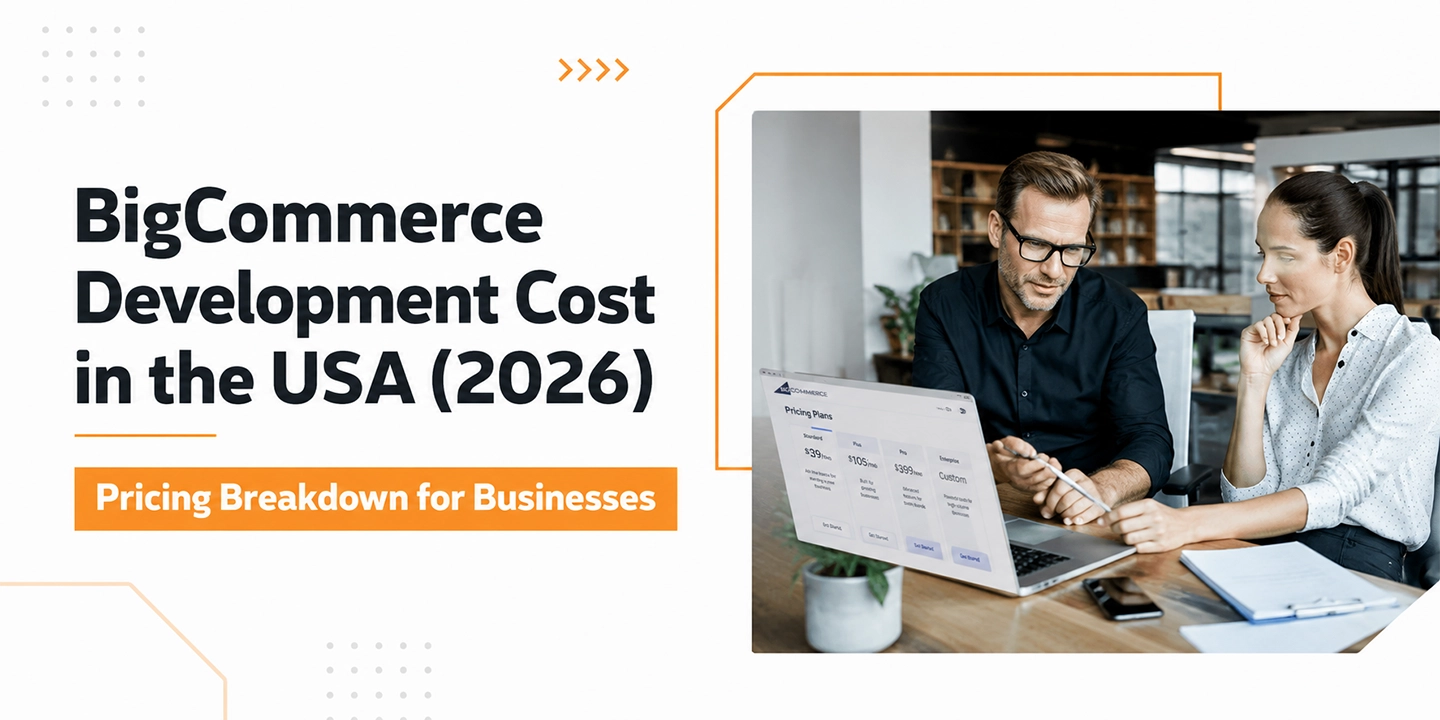
| Plan (2026 name) | Former Name | Monthly Cost (billed annually) | Best For |
| Core | Standard | $39/mo ($29/mo annual) | New stores, up to ~$30K GMV |
| Growth | Plus | $105/mo ($79/mo annual) | Scaling stores, up to ~$100K GMV |
| Scale | Pro | $399/mo ($299/mo annual) | High-volume stores, ~$1M GMV |
| Performance | Enterprise | Custom (from ~$1,499/mo) | High-volume, complex B2B/B2C |
From June 1, 2026, the base monthly prices for Core, Growth, and Scale stayed the same as the old Standard, Plus, and Pro plans, while Performance (formerly Enterprise) moved to custom pricing starting around $1,499 per month. What actually changed is less visible but matters more for your total cost: the trailing-twelve-month GMV thresholds that decide when you get auto-upgraded between tiers were cut sharply, and a new fee of up to 2% now applies to orders processed through any payment gateway not on BigCommerce’s approved list.
One thing many businesses overlook: that Open Payment Provider Fee isn’t trivial if you’re not using BigCommerce’s preferred payment partners. The rates run 2% on Core, 1% on Growth, and 0.6% on Scale, with custom rates on Performance. If you’re processing $500K a year through a gateway that isn’t embedded, that’s potentially $10,000 a year you didn’t budget for. This is exactly the kind of hidden cost that gets missed when people only compare the sticker price.
BigCommerce Website Development Cost by Project Type
In most cases, businesses fall into one of four budget brackets depending on what they’re actually building. Here’s how that breaks down in 2026.
1. Basic Store Setup (Theme + Light Customization): $3,000–$15,000
This covers picking a pre-built theme (free or premium), customizing colors, fonts, and layout, setting up product catalog, payment gateways, shipping rules, and basic apps. BigCommerce’s theme marketplace includes premium themes ranging from $150 to $400 as a one-time purchase, and that’s usually enough for a straightforward catalog without unusual workflow needs. Developer time on top of that, for configuration and light tweaks, is where most of the $3,000–$15,000 range comes from.
2. Custom Theme Development: $2,000–$20,000
This is where the BigCommerce-specific cost reality kicks in. If you need a fully custom design, expect to pay $2,000 to $10,000 for a professional BigCommerce theme built by a developer, though more complex builds with unique product page logic or advanced merchandising can run higher. From my experience, the wide range exists because BigCommerce uses Stencil, its own templating system, and finding developers experienced with Stencil is somewhat harder than finding Shopify Liquid developers, which affects pricing. Fewer specialists means higher hourly rates.
3. Mid-Level Custom Development with Integrations: $15,000–$50,000
This bracket covers ERP/CRM integrations, custom checkout flows, B2B pricing tiers, multi-location inventory, and third-party app stitching (ShipStation, Klaviyo, NetSuite, and similar). Add a contingency for custom development, especially for unique checkout or customer experience requirements, because this is where scope tends to expand. You’ll notice that almost every agency quote in this range includes a line for “discovery” or “technical scoping” before the real number gets locked in. That’s not padding. ERP integrations in particular are notorious for revealing complexity only after someone opens the hood.
4. Enterprise / Headless BigCommerce Development: $50,000–$150,000+
This is custom storefronts built on BigCommerce’s API (often using Catalyst, BigCommerce’s React-based headless framework), complex B2B portals, multi-storefront setups, and deep ERP/PIM integration. Enterprise pricing here is opaque by design. BigCommerce does not publicly disclose Enterprise (Performance) starting prices, and one BigCommerce page states the base subscription cost is similar to Scale, with custom pricing based on projected sales volume and desired integrations. Development labor on top of that subscription is where the real enterprise number lives, and it scales with how many systems you’re connecting and how custom the checkout experience needs to be.
BigCommerce Developer Cost in the USA: Hourly and Project Rates
A BigCommerce developer in the USA typically charges between $75 and $200 per hour, depending on experience level and whether they’re a freelancer or part of an agency. Freelancers on the lower end run $50–$100/hour, mid-level agency developers run $100–$150/hour, and senior Stencil or headless specialists run $150–$250/hour.
Stencil theme development typically costs $100 to $200 per hour from experienced developers, which lines up with what I’ve seen quoted across the agency landscape. The thing is, hourly rate alone doesn’t tell you much without knowing the estimated hours, and that’s where a lot of sticker shock comes from later. A “simple” custom theme that someone quoted at $150/hour can balloon if the scope wasn’t pinned down before work started.
Freelancer vs. Agency: What You’re Actually Paying For
| Factor | Freelancer | Boutique Agency | Enterprise Agency |
| Hourly rate | $50–$100 | $100–$175 | $150–$250+ |
| Project minimum | $1,500–$5,000 | $10,000–$30,000 | $40,000+ |
| Support/SLA | Rarely included | Sometimes | Usually included |
| QA/testing rigor | Variable | Moderate | High |
| Stencil/headless expertise | Hit or miss | Usually solid | Specialized teams |
You’ll notice freelancers look cheaper on paper, and for a small catalog with minimal integrations, they often are the right call. But once you’re touching ERP systems, multi-warehouse logistics, or B2B pricing rules, the agency premium tends to pay for itself in fewer post-launch fire drills.
BigCommerce Agency Pricing: What a Typical Quote Looks Like
A BigCommerce agency in the USA generally structures pricing as either a fixed project quote (most common for stores under $30,000) or a time-and-materials model billed monthly (more common for ongoing custom development past the initial build). Most agencies require a 30–50% deposit before work begins, with the balance due at launch or in milestone payments.
From my experience sitting through these proposals, the agencies worth their pricing usually break the quote into at least four buckets: discovery and UX planning, design, development, and QA/launch. If an agency hands you one lump number with no breakdown, that’s where things change in terms of risk. You have no way to know which part of the project ate the budget if something goes over.
One thing that’s easy to miss in agency pricing conversations: your real BigCommerce cost is not just the subscription, since themes, apps, integrations, and custom development can materially change total cost of ownership. A $25,000 development quote that doesn’t account for the app stack you’ll need post-launch isn’t really a $25,000 project.
Hidden and Recurring Costs Businesses Forget to Budget For
Beyond the upfront development cost, BigCommerce stores carry recurring expenses that catch first-time platform owners off guard. BigCommerce’s native feature set is broad, but most growing stores need 3 to 7 paid apps to fill functionality gaps, and a typical scaling business should budget $75 to $300 per month for essential third-party apps, with some high-growth merchants reporting app stacks costing $500 or more per month.
Here’s a realistic list of what tends to get left off the initial budget:
- Apps and integrations: $75–$500+/month depending on your stack
- Premium theme or custom design: $150–$20,000 one-time
- Domain registration: approximately $6 to $20 per year if purchased through a third-party registrar
- Payment processing fees: typically 2.2%–2.9% + $0.30 per transaction through your gateway
- Open Payment Provider Fee: 0.6% to 2% depending on plan, if your gateway isn’t on BigCommerce’s embedded list
- POS hardware/software: if you sell in person, third-party POS subscriptions and hardware costs apply separately
- Ongoing maintenance and support: usually a separate retainer with your developer or agency
In most cases, businesses budget the development cost and the monthly subscription, then get surprised by the app stack six months in. Planning for that $75–$500/month app range upfront avoids the scramble later.
How BigCommerce Development Cost Compares to Other Platforms
For context, BigCommerce sits in the middle of the platform cost spectrum. Shopify’s Basic plan starts at $29/month, similar to BigCommerce’s entry tier, but Shopify charges transaction fees unless you use Shopify Payments, while BigCommerce does not charge platform transaction fees. WooCommerce is technically free but requires separate hosting, security maintenance, and plugin costs that add up over time. Over three years, a small business might spend $5,000 to $10,000 on BigCommerce’s Standard or Plus plan, while a comparable WooCommerce setup could run $3,000 to $8,000 including hosting, plugins, and development.
The honest takeaway is that BigCommerce tends to win on included native features (its base plans cover more out of the box than Shopify’s), which can offset the per-hour development premium that comes from Stencil’s smaller talent pool. Whether that trade-off is worth it depends on how much custom development your business actually needs versus how much you can get from native functionality and apps.
Why Ecommerce Development Investment Matters Right Now
The pace of ecommerce growth is part of why getting this budgeting right matters more in 2026 than it did five years ago. U.S. retail ecommerce sales for 2026 are expected to total $1.53 trillion, up roughly 7% from 2025, and according to eMarketer’s 2026 forecast, US B2B ecommerce site sales will keep rising steadily through the forecast period, surpassing $3.1 trillion by 2029. If your business sells to other businesses, that growth curve is exactly why a properly scoped BigCommerce build (with B2B pricing tiers, self-service ordering, and ERP integration) tends to justify the higher end of the development cost range.
Checkout experience is another area where underinvesting costs more than it saves. The average online shopping cart abandonment rate sits at 70.19%, based on Baymard Institute’s analysis of dozens of studies, and the top reason shoppers abandon carts is unexpected extra costs like shipping, taxes, and fees, followed by forced account creation and complicated checkout flows. A cheap, generic theme that doesn’t address checkout friction isn’t actually cheap if it’s quietly costing you a majority of your potential conversions. This is the kind of math that doesn’t show up in a development quote but absolutely shows up in your revenue.
Mobile is the other piece worth budgeting around. Mobile cart abandonment runs even higher than the average, at 85.65% of mobile carts abandoned before checkout, which tells you that mobile-responsive design isn’t optional anymore. If a developer is quoting you a “basic” build without explicitly addressing mobile checkout flow, ask what’s actually included.
How to Budget for a BigCommerce Project: A Step-by-Step Approach
To budget a BigCommerce development project, start with your current or projected GMV to pick the right plan tier, then scope your must-have integrations before requesting quotes, get at least three itemized proposals, and add a 15-20% contingency for scope changes that surface during discovery.
- Determine your plan tier based on GMV. Don’t pick a plan based on features alone. Run your trailing twelve-month sales against the new 2026 thresholds so you’re not blindsided by an auto-upgrade mid-project.
- List your non-negotiable integrations first. ERP, CRM, POS, and accounting software connections drive cost more than design does. Know these before you ask for a quote, not after.
- Decide on theme vs. custom design. A premium theme with light customization covers most catalogs under a few hundred SKUs. Custom design earns its cost when your brand or product complexity genuinely requires it.
- Request itemized quotes from at least three sources. Compare discovery, design, development, and QA as separate line items, not one bundled number.
- Budget the recurring app stack separately. Plan for $75–$500/month beyond your subscription and development cost.
- Add 15-20% contingency. Data migration, redirects, and SEO stabilization post-launch are the most commonly underestimated tasks in any BigCommerce project.
- Confirm post-launch support terms before signing. A development contract that ends the day your site launches leaves you exposed during the period when most bugs actually surface.
BigCommerce Development Cost: Real-World Budget Examples
To make this concrete, here’s how three different business types typically land on cost, based on the ranges discussed above.
A small apparel brand moving off Shopify with around 200 SKUs, a premium theme, and three core apps (reviews, email marketing, shipping) typically lands in the $8,000–$18,000 range for development, plus the Growth plan subscription.
A mid-size B2B distributor needing custom pricing tiers, NetSuite integration, and a self-service ordering portal usually lands between $35,000 and $70,000, reflecting the integration complexity discussed earlier, plus Scale or Performance plan costs.
An enterprise multi-brand retailer running a headless Catalyst storefront with multiple regional storefronts and deep PIM integration typically starts around $80,000 and can exceed $150,000 depending on the number of integrated systems, plus custom Performance plan pricing.